
Eclipse Enclave
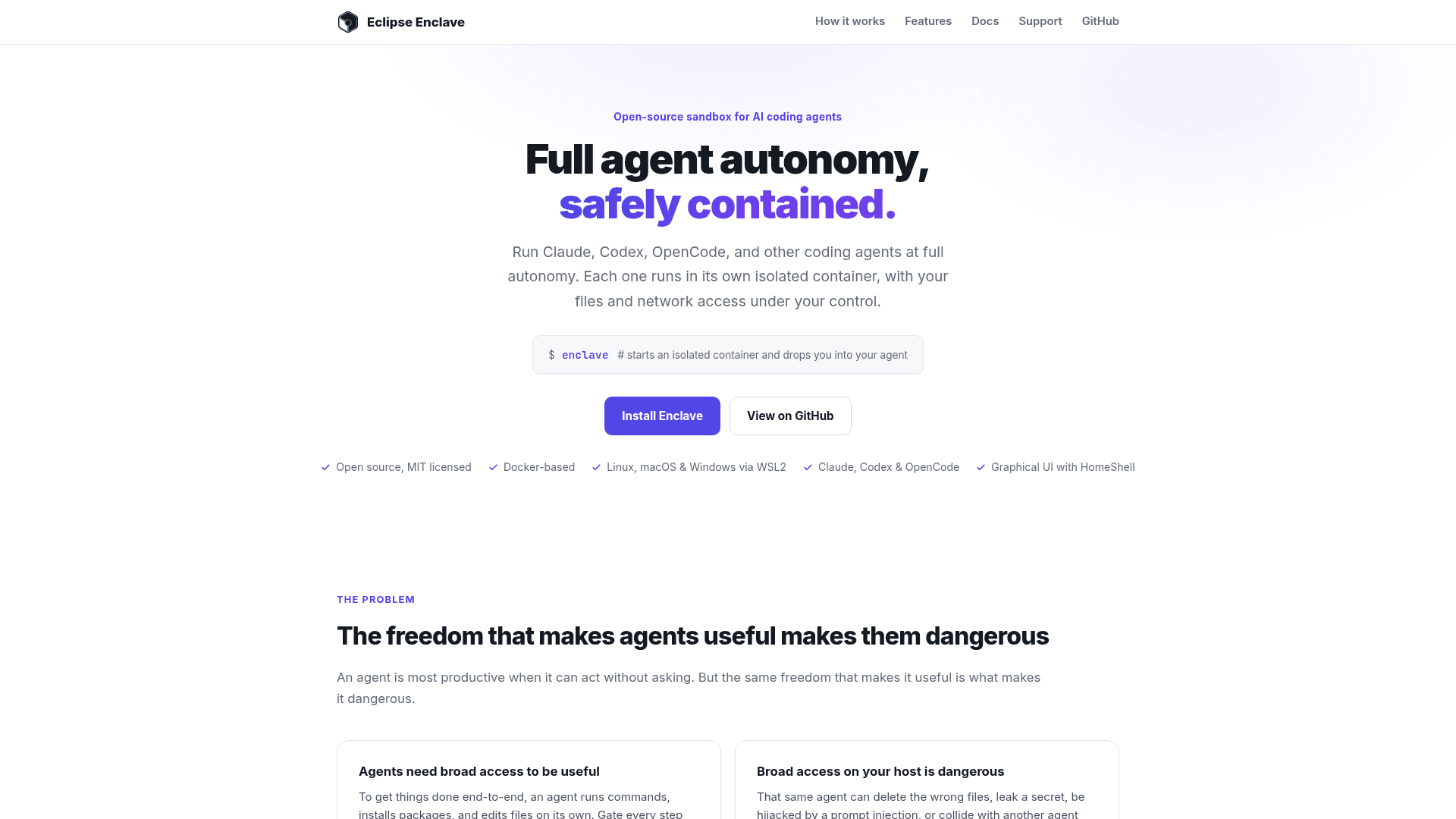
Open-source sandbox that runs AI coding agents at full autonomy inside isolated, network-filtered containers.
At a Glance
About Eclipse Enclave
Eclipse Enclave is an open-source, MIT-licensed sandbox for AI coding agents, hosted under the eclipse-enclave organization. Running enclave in a git repository builds an isolated container, mounts the current checkout, and starts an agent such as Claude Code, Codex, Copilot, OpenCode, or Pi inside it. The latest listed release is v1.0.1.
What It Is
Enclave is a command-line tool that lets coding agents act without confirmation prompts while keeping them away from the host. Each session runs in its own container with a separate filesystem, process tree, and network stack. Only the project worktree and any extra mounts you choose are visible to the agent. The default backend is Docker, and Podman and an experimental QEMU microVM backend are also documented.
How Isolation Works
The docs describe four controls around each session: what the agent sees, where it runs, what it can reach, and what persists.
- Separate git worktrees can be given to parallel agents so their changes do not collide.
- A sidecar gateway filters DNS and proxies outbound traffic, allowing only allowlisted domains and logging allowed and blocked connections.
- Secrets configured for HTTP release reach the agent only as placeholders, and the gateway injects them into requests to matching allowlisted hosts.
- Logins, config, history, and agent memory persist on the host across sessions.
- The experimental QEMU microVM backend currently runs without network restrictions.
Working With Sessions
Commands include enclave --tool codex to choose an agent, enclave continue to resume, enclave --background and enclave attach for detachable sessions, enclave ps to list sessions, enclave shell, and enclave network log to review what the agent tried to reach. Configuration can be global or per project, with custom skills, extra mounts, devcontainer support, and extensions installed from Git. Additional tools such as Amp and Antigravity are available through the separate enclave-extensions repository.
HomeShell Preview
HomeShell is a graphical companion that groups work into projects and workstreams and shows which agent sessions are running or waiting for an answer, in a web UI or desktop window. The docs state it has no stable release yet.
Setup Path
Requirements are Linux, macOS, or Windows through WSL2, rootful Docker with buildx or Podman, and Git 2.26 or newer with an author and committer identity. Installation is via .deb and .rpm packages or standalone binaries for Linux and macOS.
Community Discussions
Be the first to start a conversation about Eclipse Enclave
Share your experience with Eclipse Enclave, ask questions, or help others learn from your insights.
Pricing
Open Source
Eclipse Enclave core CLI is open source under the MIT license; free to use, modify and distribute. Agent provider subscriptions or API costs are external.
- MIT licensed
- Docker or Podman based isolated containers
- Network allowlist gateway with audit logging
- Supports Claude Code, Codex, OpenCode, Copilot, Pi
- Linux, macOS & Windows via WSL2
Capabilities
Key Features
- Per-session container isolation
- Git worktree isolation for parallel agents
- DNS filtering and domain allowlists via sidecar gateway
- Connection audit logging
- Secret placeholders injected by the gateway
- Persistent auth, config, history, and agent memory
- Background, named, and resumable sessions
- Custom skills, agent templates, and extensions
- Devcontainer support
- Docker, Podman, and experimental QEMU microVM backends
- HomeShell graphical companion (preview)