
Eclipse LMOS
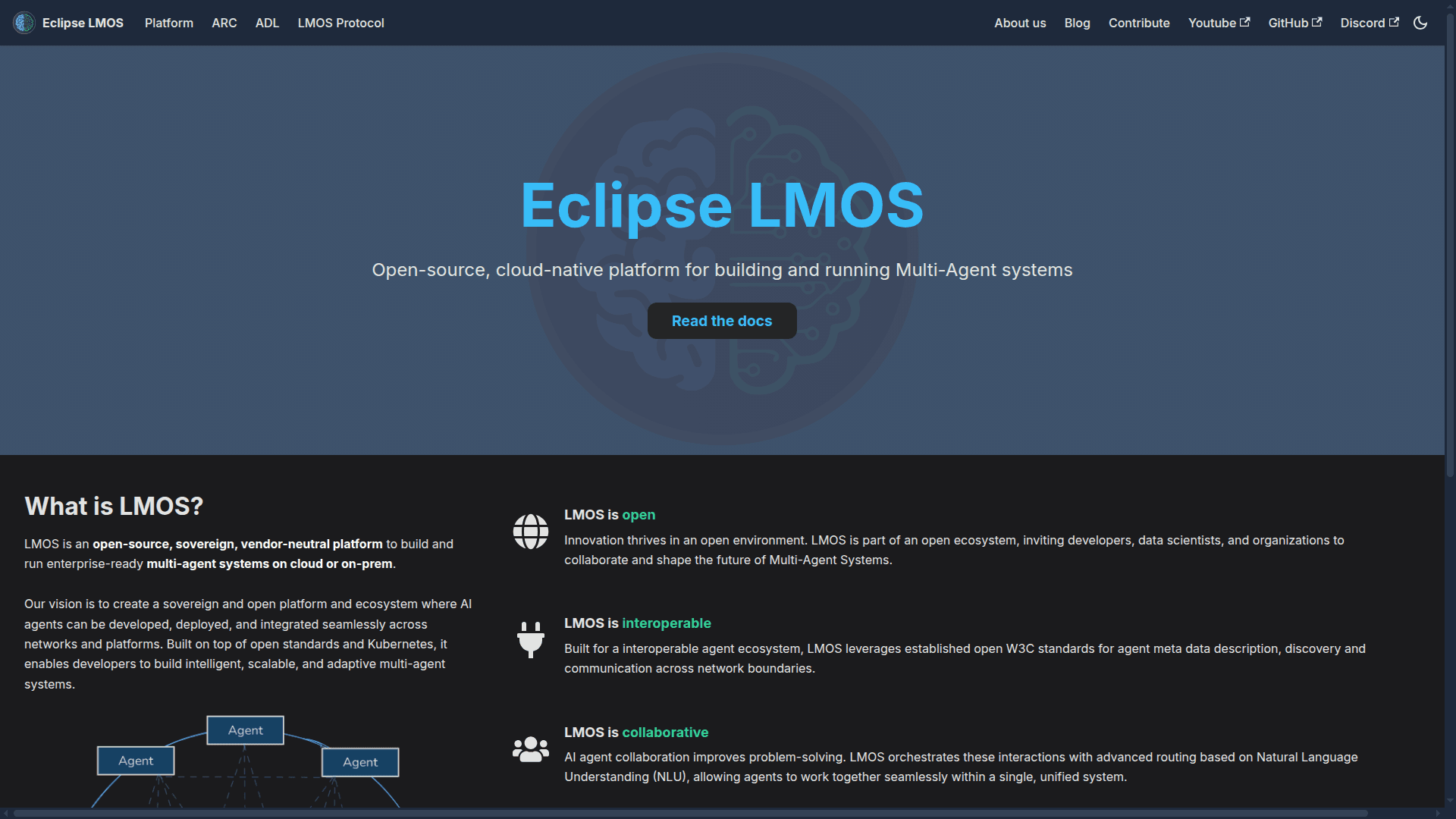
Open-source platform for building, deploying, and managing AI agents at scale with enterprise-grade capabilities.
At a Glance
About Eclipse LMOS
Eclipse LMOS is an open-source platform designed for building, deploying, and managing AI agents at enterprise scale. It provides a comprehensive framework that enables organizations to create intelligent agents capable of handling complex tasks while maintaining production-grade reliability and scalability. The platform is built on Kotlin and leverages modern cloud-native technologies to deliver a robust foundation for AI agent development.
Key Features:
-
Agent Development Framework - Provides a structured approach to building AI agents with support for multiple LLM providers, enabling developers to create sophisticated conversational and task-oriented agents with minimal boilerplate code.
-
Multi-Agent Orchestration - Supports coordination between multiple agents, allowing complex workflows where specialized agents collaborate to solve problems that require diverse capabilities.
-
Channel Integration - Offers built-in support for various communication channels, making it easy to deploy agents across different platforms and interfaces.
-
Kubernetes-Native Deployment - Designed for cloud-native environments with first-class Kubernetes support, enabling seamless scaling and management of agent deployments.
-
Observability and Monitoring - Includes comprehensive logging, tracing, and metrics capabilities to monitor agent performance and behavior in production environments.
-
Extensible Architecture - Features a modular design that allows developers to extend functionality through custom components, tools, and integrations.
-
Enterprise Security - Implements security best practices with support for authentication, authorization, and secure communication between components.
Getting Started:
To begin using Eclipse LMOS, clone the repository from GitHub and follow the quickstart guide in the documentation. The platform requires Kotlin and a Kubernetes environment for full functionality. Developers can start by creating a simple agent using the provided templates and gradually add more sophisticated capabilities as needed. The documentation includes examples for common use cases and integration patterns.
Community Discussions
Be the first to start a conversation about Eclipse LMOS
Share your experience with Eclipse LMOS, ask questions, or help others learn from your insights.
Pricing
Open Source
Free open-source platform under Eclipse Public License
- Full platform access
- Agent development framework
- Multi-agent orchestration
- Kubernetes deployment support
- Community support
Capabilities
Key Features
- AI agent development framework
- Multi-agent orchestration
- LLM provider integration
- Kubernetes-native deployment
- Channel integration support
- Observability and monitoring
- Extensible plugin architecture
- Enterprise security features
- Kotlin-based SDK
- Cloud-native scalability