
Timbal
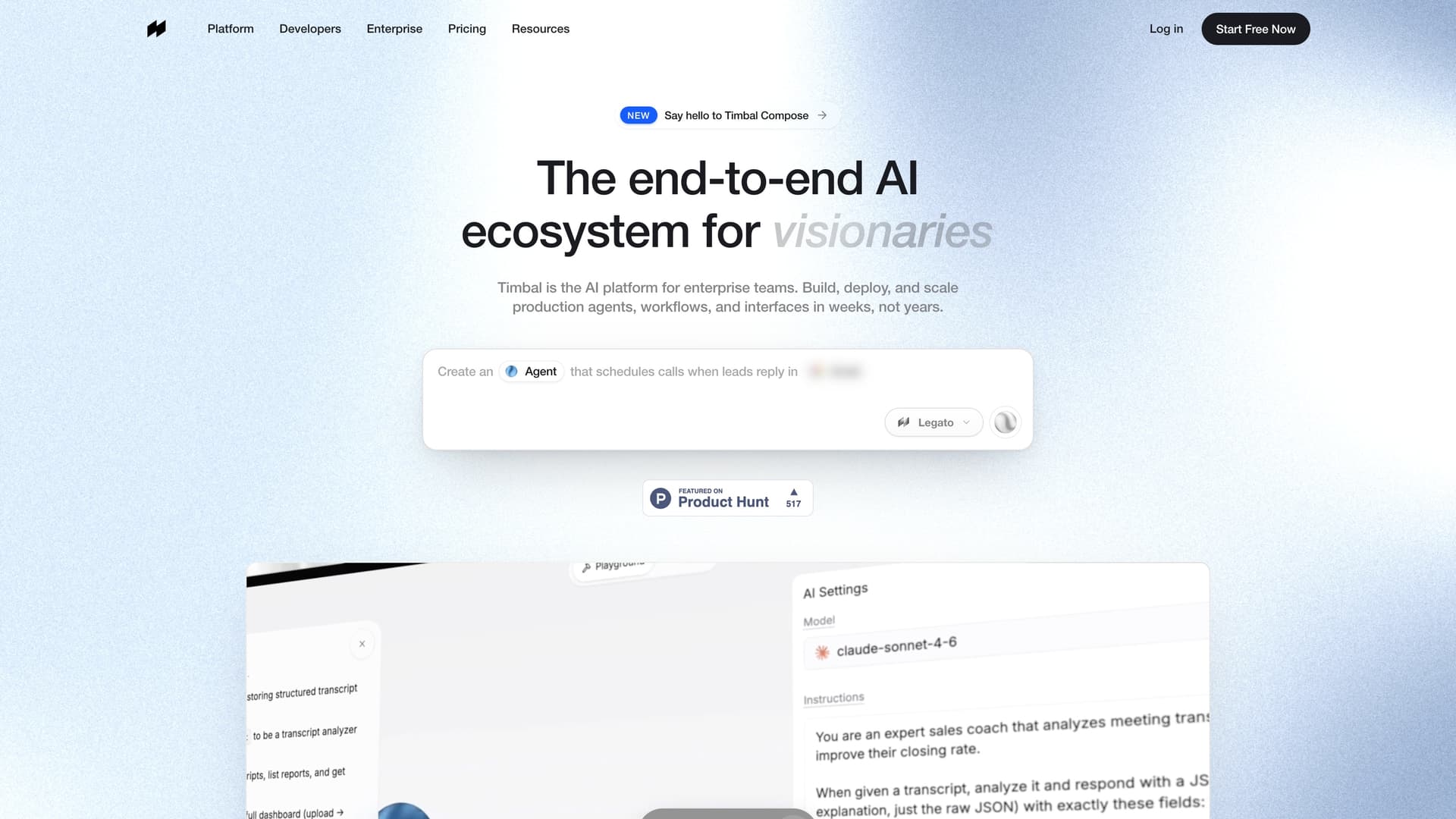
An end-to-end AI platform for enterprises to build, deploy, and scale production agents, workflows, interfaces, and knowledge bases with a governed, model-agnostic stack.
At a Glance
Free forever, no credit card needed. For individuals getting started.
Engagement
Available On
Alternatives
Listed Jul 2026
About Timbal
Timbal is an end-to-end AI platform built for enterprise teams, combining an open-source Python framework with a managed cloud platform (Timbal Studio) to build, deploy, and govern production AI agents, workflows, interfaces, and knowledge bases. The core framework is licensed under Apache 2.0 and available on GitHub, while the broader platform adds managed infrastructure, a visual Studio, enterprise security controls, and 100+ native integrations. Built in Barcelona, Timbal positions itself as a full-stack replacement for the fragmented toolchain of frameworks, workflow builders, vector stores, UI tools, and observability platforms that enterprise AI teams typically assemble.
What It Is
Timbal provides two complementary layers: an open-source Python/TypeScript framework for developers who want typed, async-native agent and workflow primitives, and a managed SaaS platform (Timbal Studio) for teams that need visual building, governed deployments, and enterprise integrations. Agents handle autonomous reasoning with tools and memory; Workflows define deterministic pipelines with explicit dependency resolution. Both share one calling interface and compose without glue code. The platform also ships a Hybrid DB engine (LanceDB + DuckDB) for vector, full-text, and SQL search in a single query, a TypeScript SDK, a CLI, and an MCP endpoint at api.timbal.ai/mcp.
The ACE Control Layer
A distinctive proprietary component is ACE (Action Control Engine), described by Timbal as a behavioral runtime that sits as a proxy in front of any LLM. According to the product page, ACE delivers a claimed +30% reliability gain and 0.1× cost per run versus baseline by steering smaller models with deterministic rules—schemas, refusals, tool-use policies, handoff logic—rather than prompt engineering. It is provider-agnostic and requires only a one-line base URL change to adopt with existing OpenAI or Anthropic SDK clients.
Developer-First Architecture
The framework is designed around a small, hackable core (under 10,000 lines per the README) with no hidden magic:
- Agents and Workflows share one event-stream interface; compose freely with MCP servers, custom tools, and ToolSets that resolve per-request based on session role or context.
- Memory compaction is automatic, with composable strategies (keep last N turns, summarize, compact tool results) triggered at a configurable context-window threshold.
- Human-in-the-loop gates pause any run, persist state, and resume across process restarts via
parent_id. - Evals are declarative YAML suites that validate output semantics, timing, token usage, tool inputs/outputs, and flow shape (sequences, parallel, nested patterns).
- HTTP serving turns any Agent or Workflow into a
/run,/stream,/cancelserver with auto-generated JSON schemas in one command. - The framework publishes benchmark comparisons against LangGraph, CrewAI, OpenAI Agents SDK, PydanticAI, and Agno; the README reports p50 latency of 1.1 ms and throughput of 1,716 runs/second at concurrency 10 in overhead benchmarks with faked LLMs.
Enterprise Deployment and Governance
Timbal supports multi-tenant SaaS, dedicated VPC, and fully on-premises deployments across AWS, Azure, and GCP. Enterprise features include:
- SOC 2 Type II audit in progress, ISO 27001, GDPR, and EU AI Act alignment
- EU-region data hosting with GDPR-aligned DPAs
- SSO (SAML 2.0, OIDC) and SCIM provisioning for Okta, Azure AD, and Google Workspace
- Role-based access controls enforced at the UI, SDK, and API layers
- Audit logs, run-level traceability, and eval-gated promotion across dev/staging/prod environments
- Customer-owned model API keys; model-agnostic routing across OpenAI, Anthropic, Google, Mistral, Llama, and any OpenAI-compatible endpoint
Integrations and Stack Coverage
The platform ships 100+ native connectors including SAP, Salesforce, Slack, Microsoft Teams, Google Drive, Jira, HubSpot, Zendesk, Airtable, Stripe, GitHub, Asana, and major cloud providers. It also supports any MCP server over stdio or HTTP. The homepage positions Timbal as a replacement for infrastructure tools (Vercel, Railway, Docker), agentic frameworks (LangChain, CrewAI, Haystack), workflow builders (n8n, Zapier, Make), UI tools (Streamlit, Gradio, Next.js), vector stores (Pinecone, Weaviate, Chroma, Qdrant), LLM routers (LiteLLM, OpenRouter), and observability tools (LangSmith, Weights & Biases).
Update: v2.2.8
The latest GitHub release is v2.2.8, published on July 6, 2026. The repository was last pushed on July 6, 2026, and the Python framework is listed on PyPI. The developers page references the Python framework as v1.4.0 released April 2026, while the GitHub release tag reflects the more recent v2.2.8 cadence. The product roadmap lists Voice Agents and Timbal Workspace as upcoming products, and the homepage announces "Timbal Compose" as a new feature.
Community Discussions
Be the first to start a conversation about Timbal
Share your experience with Timbal, ask questions, or help others learn from your insights.
Pricing
Free
Free forever, no credit card needed. For individuals getting started.
- 1 admin user
- Full Studio access
- One active project
- Community support
Creator
For individual creators building AI projects.
- 1 admin user
- Unlimited Studio projects
- In-Studio code editor
- Community support
- Custom domains
- No Made with Timbal branding
Pro
Recommended plan for professionals needing more power and support.
- 1 admin user
- Everything in Creator
- Unlimited knowledge bases
- Priority email support
- Beta feature access
Scale
For teams needing dedicated compute and multi-seat access.
- 3 admin users
- Everything in Pro
- Unlimited projects
- Dedicated compute
- Multi-seat access with roles
- Priority chat and email support
Enterprise
Custom pricing for regulated teams, large rollouts, and sovereign hosting needs.
- Unlimited credits
- Unlimited admin users
- Enterprise integrations (SAP, NetSuite, Dynamics 365)
- SSO and SCIM provisioning
- On-premise and private cloud deployment
- Dedicated AISA (AI Solution Architect)
- Custom SLAs and uptime guarantees
- Custom data retention policies
Capabilities
Key Features
- AI Agents with autonomous reasoning, tools, and memory
- Deterministic Workflows with explicit dependency resolution
- Visual Studio (Timbal Studio) for no-code/low-code building
- Knowledge Bases with hybrid vector + full-text + SQL search
- ACE (Action Control Engine) behavioral runtime proxy
- 100+ native integrations (SAP, Salesforce, Slack, Teams, Drive, Jira, etc.)
- MCP server support over stdio or HTTP
- Custom interfaces (chat, dashboards, voice)
- Auto-generated HTTP API for any Agent or Workflow
- TypeScript SDK and Python framework
- CLI for scaffolding, local dev, and deployment
- Human-in-the-loop approval gates with cross-process resume
- Declarative YAML evals for output, timing, tokens, tool calls, and flow shape
- Memory compaction with composable strategies
- FallbackModel for automatic provider failover mid-stream
- Role-based access controls (RBAC)
- SSO (SAML 2.0, OIDC) and SCIM provisioning
- Multi-tenant SaaS, dedicated VPC, and on-premises deployment
- EU-region data hosting with GDPR-aligned DPAs
- SOC 2 Type II (audit in progress), ISO 27001, GDPR, EU AI Act
- Git integration for branch-based agent change review
- Full run-level traceability and observability
- Exportable code — no vendor lock-in
- Model-agnostic routing (OpenAI, Anthropic, Google, Mistral, Llama, and more)