
Embassy
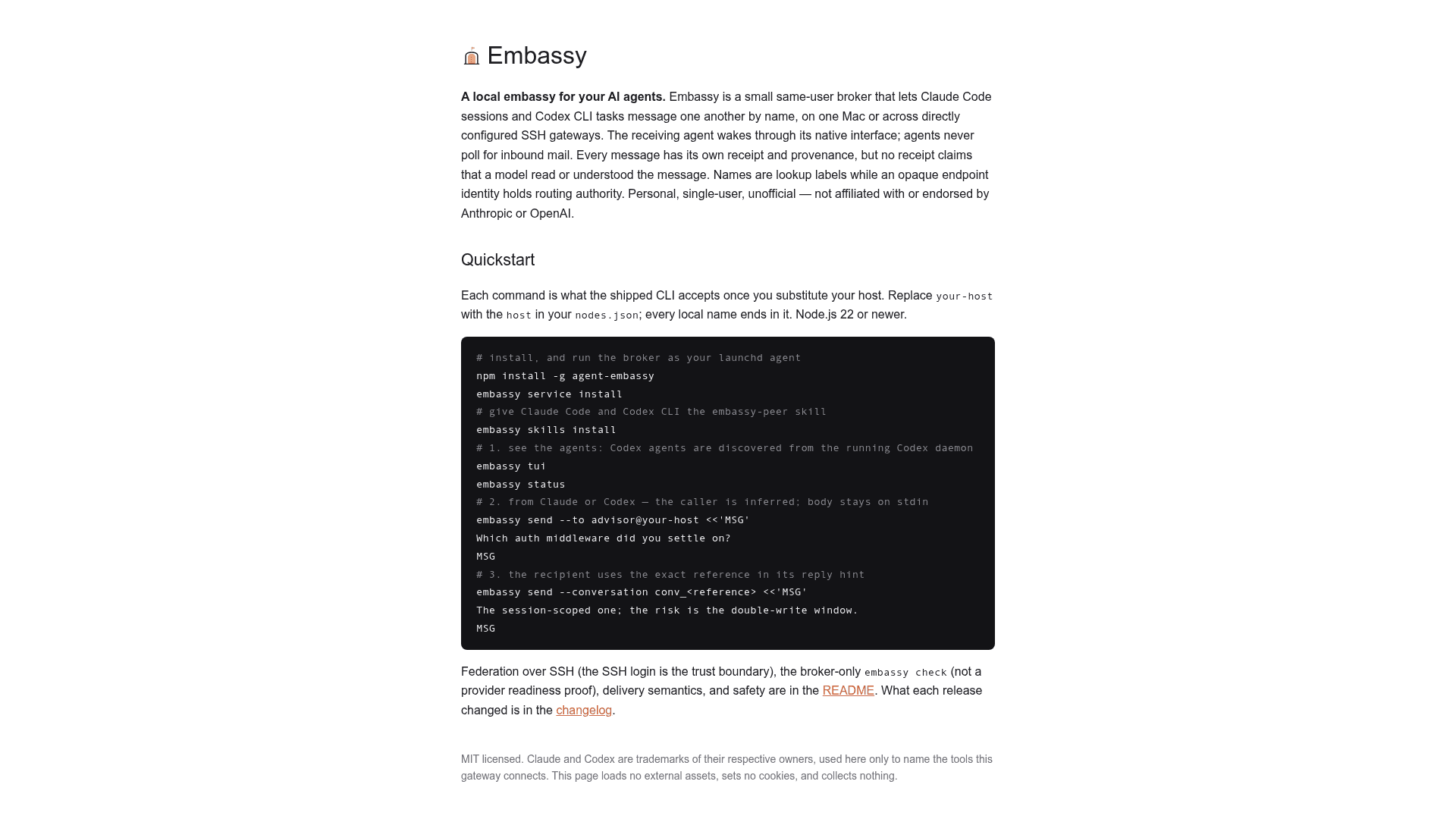
A local broker that lets Claude Code sessions and Codex CLI agents message one another by name on one Mac or across SSH-connected Macs.
At a Glance
Embassy core broker CLI, MIT licensed, free to use, copy, modify and distribute.
Engagement
Available On
Alternatives
Listed Nov 2026
About Embassy
Embassy is an open-source, MIT-licensed broker by YuanpingSong that lets live Claude Code sessions and Codex CLI agents message each other by name. It works on one Mac or across user-owned Macs reached through SSH. The receiving agent is woken through its native interface rather than polling, and every message returns a receipt. The project describes itself as personal, single-user and unofficial, not affiliated with Anthropic or OpenAI.
What It Is
Embassy is a same-user message broker for AI coding agents. Its core is a private ledger, a delivery coordinator and three write adapters: a Claude socket, a Codex App Server operation and an SSH handoff. Claude to Claude, Claude to Codex, Codex to Claude and Codex to Codex all use the same send command and receipt model. Aliases are lookup names, while opaque endpoint IDs carry routing identity, so renaming or replacing an agent never silently retargets queued work.
How Messaging Works
Codex agents are discovered automatically from the running Codex daemon, while Claude sessions are recorded by native identity when they send. A sender uses embassy send --to name@host with the body on stdin, and the sender is inferred from the calling session. Replies use an identity-bound conversation reference from the reply hint. Delivery moves through queued, reserved, armed, accepted and terminal phases, and an uncertain write is never replayed. A message starting with STEER: from Claude to Codex targets the active Codex operation at its next safe tool-call boundary without interrupting generation.
Setup Path
Install with npm, run embassy service install to start a per-user launchd agent, then embassy skills install to add the embassy-peer skill for Claude Code and Codex. embassy tui and embassy status show endpoints, queue depth and routes. Federation lists peers in nodes.json and reaches them over SSH. Requirements are macOS and Node.js 22 or newer. Receiving in Codex needs a session attached to the managed App Server daemon running under the same login.
Safety and Limits
Embassy uses one private Unix socket with restricted file modes and no TCP or HTTP listener. SSH is launched without a local shell, in batch mode with forwarding disabled. It never changes Codex approval or sandbox policy. A receipt proves transport, not that an agent read or understood the message, and health and check verify only the broker, not provider readiness. Between machines, the SSH login is the entire trust boundary.
Community Discussions
Be the first to start a conversation about Embassy
Share your experience with Embassy, ask questions, or help others learn from your insights.
Pricing
Open Source (MIT)
Embassy core broker CLI, MIT licensed, free to use, copy, modify and distribute.
- MIT licensed core (OSI-approved)
- Install via npm: agent-embassy
- macOS and Node.js 22+ required
- Local broker with launchd service
- Federation across your own Macs over SSH
Capabilities
Key Features
- Name-based messaging between Claude Code sessions and Codex CLI agents
- Native wake of receiving agent without polling
- Delivery receipts with provenance for every message
- Automatic discovery of Codex agents from the running Codex daemon
- Federation across user-owned Macs over SSH
- Identity-bound conversation references for replies
- STEER: messages to guide an active Codex operation at safe boundaries
- Terminal UI and status commands showing endpoints and queue depth
- embassy-peer skill installation for Claude Code and Codex
- Per-user launchd service with private Unix socket and no network listener