
Engraphis
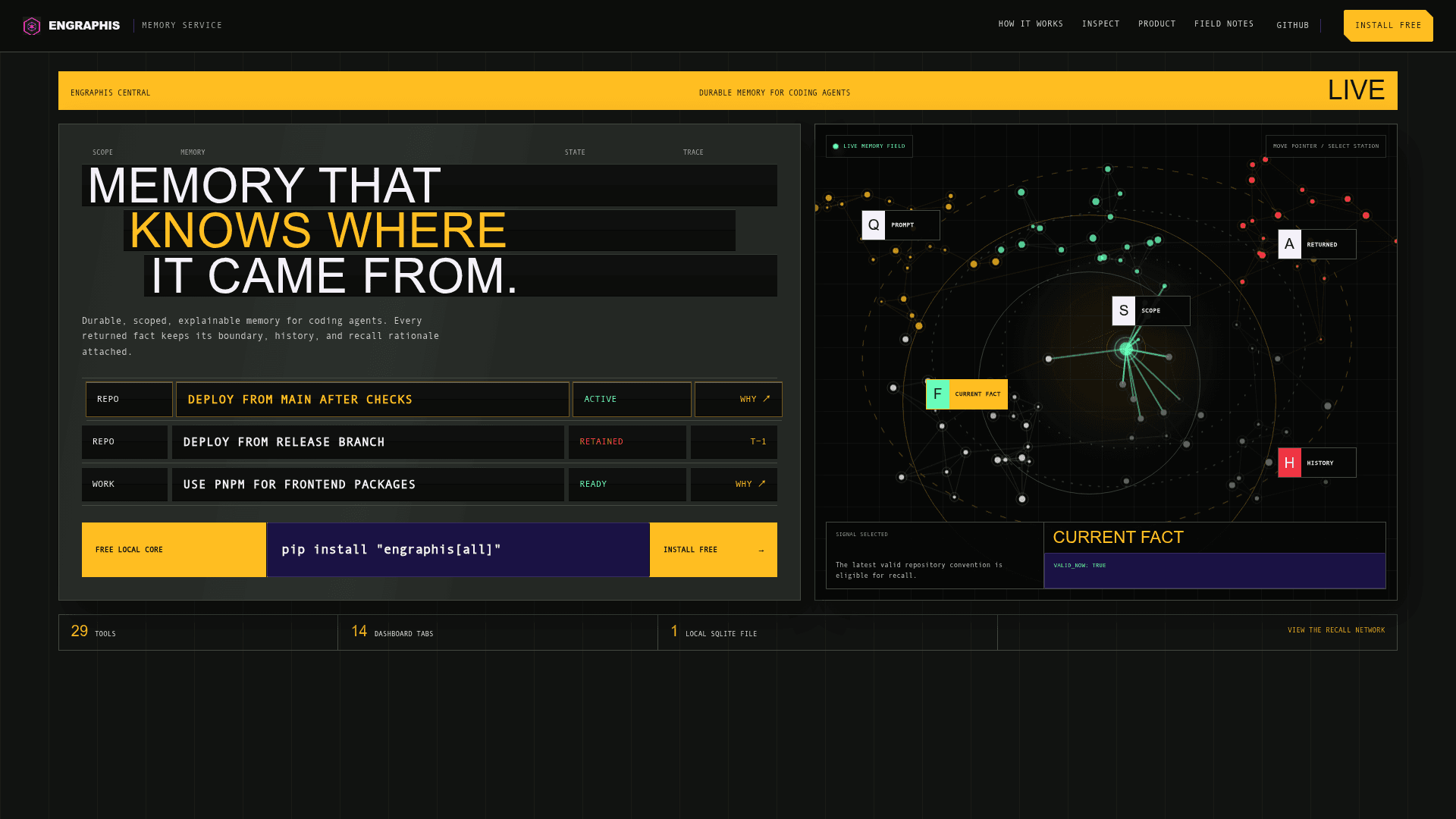
Local-first, durable memory engine for AI coding agents that stores scoped project context across sessions with bi-temporal history, MCP tools, and a self-hosted WebUI dashboard.
At a Glance
The complete local recall engine, MCP server, dashboard, CLI, and library under Apache-2.0, free forever.
3-day free trial of Pro; no credit card required.
Engagement
Available On
Listed Aug 2026
About Engraphis
Engraphis is a local-first memory engine built for AI coding agents, giving them durable, scoped, and explainable project context that persists across sessions and repositories. The core engine is Apache-2.0 licensed and runs entirely on the developer's machine using SQLite, local embeddings, and NumPy — no API key or cloud account required for memory. Optional hosted Pro and Team tiers add analytics, automation, and team governance on top of the free local core.
What It Is
Engraphis solves the "blank slate" problem that affects AI coding agents: every new session, the agent re-learns the codebase from scratch, re-asks which package manager to use, and forgets why a deployment credential was scoped to one workspace six weeks ago. Engraphis installs as a Python package (pip install "engraphis[all]"), connects to coding-agent clients via a native MCP server, and stores typed memory in a workspace → repo → session hierarchy backed by a local SQLite file. The same MemoryService facade backs the dashboard, the MCP server, and the Python library, so what the UI shows is exactly what agents retrieve.
How the Memory Model Works
Engraphis models memory using an Ebbinghaus forgetting-curve decay combined with interaction-aware reinforcement, bi-temporal facts, and hybrid recall that blends vector search, lexical matching, and knowledge-graph proximity.
- Deterministic conflict resolution: writes are resolved offline (add, reinforce, or supersede) without requiring an LLM on the write path.
- Bi-temporal truth: contradictions invalidate rather than overwrite;
engraphis_whyandengraphis_timelineshow exactly what was believed and when. - Grounded answers: cited evidence or an explicit abstain — never a confident guess without support.
- Code-aware recall: an AST-powered symbol graph via
engraphis_index_repoandengraphis_search_code, supporting Python, JavaScript, TypeScript, Go, Rust, Java, C#, C, C++, SQL, and Terraform. - Six-term recall score: retention, semantic similarity, lexical match, graph proximity, importance, and recency.
MCP Integration and Agent Connectivity
Engraphis exposes a zero-configuration Smart MCP gateway with nine compact tools for sessions, prompt-ready recall, durable memory, governed record read/update, conflict review, action discovery, and safe execution. A 34-tool Classic compatibility server is also available for clients that pin the historical tool inventory. The project states support for Claude Code, Cursor, Cline, Zed, Windsurf, and Codex subscription connections. The MCP server is installed with pip install "engraphis[mcp]" and configured with a single engraphis-init command.
Dashboard and Local UI
The Engraphis dashboard runs at http://127.0.0.1:8700 and requires no cloud account or signup. It provides:
- Ledger — the primary interface for recall, memories, graph exploration, provenance, workspaces, and manual consolidation.
- Knowledge Graph — a force-directed interactive graph of memory relationships, inspectable by dragging nodes.
- Memory Inspector — browse, search, and manage the knowledge graph with timeline and audit views.
- Accessibility-first design — keyboard-navigable with light and dark themes; offline graph renderer is vendored.
The dashboard launches on Windows (Desktop/Start Menu shortcut), macOS (Desktop .app), Linux (GNOME/KDE desktop entry), or Docker (docker compose up).
Update: Engraphis 1.6 (August 2026)
The GitHub repository shows active development with multiple releases in quick succession. The latest published release is v1.5 (August 6, 2026), and the README documents a 1.6 release with schema migrations 12–16 covering content-free erasure markers, per-memory hybrid logical clocks for deterministic sync, Obsidian collection and import manifests, and source-neutral local document imports. Version 1.4 introduced the Smart MCP gateway (nine-tool gateway replacing the former 33 direct tools), and version 1.5 added schema bounds for legacy retention state. The repository was created in June 2026 and last pushed in August 2026, indicating rapid early development.
Open-Source Deployment Model
The core engine, local dashboard, MCP server, CLI, and governance tools are Apache-2.0 and permanently free. The project describes itself as "open-core": the free local surface is fully functional and unlimited on the developer's machine, while hosted Pro and Team services — analytics, managed automation, optional Cloud Sync, and Team identity/governance — run on a private hosted control plane not distributed in the public repository. The project states the core recall engine is never crippled to push an upgrade.
Community Discussions
Be the first to start a conversation about Engraphis
Share your experience with Engraphis, ask questions, or help others learn from your insights.
Pricing
Community
The complete local recall engine, MCP server, dashboard, CLI, and library under Apache-2.0, free forever.
- Complete recall engine, unlimited on your machine
- MCP server (Smart gateway + Classic 34-tool compatibility)
- Dashboard with Memory Inspector
- CLI and Python library
- Version-chain diffs and offline knowledge graph
Pro Trial
3-day free trial of Pro; no credit card required.
- Everything in Pro
- Analytics: growth, retention, and decay forecasts
- Auto Consolidation and Auto Dreaming
- Optional hosted Cloud Sync
Team Trial
3-day free trial of Team; no credit card required.
- Everything in Team
- Multi-user roles and seat management
- Per-user audit history
- Scoped credentials and optional shared cloud sync
Pro
Everything in Community plus hosted analytics, automation, and optional Cloud Sync for one owner.
- Everything in Community
- Analytics: growth, retention, and decay forecasts
- Auto Consolidation and Auto Dreaming
- Optional hosted Cloud Sync
- Priority support
Team
Everything in Pro plus multi-user roles, seat management, per-user audit history, and scoped credentials.
- Everything in Pro
- Multi-user admin, member, and viewer roles
- Seat management and per-user audit history
- Scoped agent and sync credentials
- Optional shared cloud sync
- 72-hour pending invitations (resend/revoke)
- Hosted Team audit log + CSV export
Capabilities
Key Features
- Local-first SQLite-backed memory engine
- 29 MCP tools for coding agent integration
- Smart MCP gateway with 9 compact tools
- 34-tool Classic MCP compatibility server
- Bi-temporal fact history with supersession chains
- Hybrid vector + lexical + graph recall
- Ebbinghaus decay-based retention model
- Deterministic offline conflict resolution (add/reinforce/supersede)
- AST-powered code symbol graph indexing
- Self-hosted WebUI dashboard at localhost:8700
- Knowledge Graph force-directed visualization
- Memory Inspector with timeline and audit views
- Workspace → repo → session scoped memory hierarchy
- Grounded cited answers or explicit abstain
- Offline-capable with NumPy-only core
- SQLCipher encryption at rest
- Document import (Markdown, PDF, DOCX, EPUB, etc.)
- Obsidian vault import adapter
- Audio/video transcription via faster-whisper
- PostgreSQL schema introspection
- Docker deployment support
- Python library (MemoryService facade)
- REST API with optional bearer token auth
- Manual and hosted consolidation (Auto Dreaming)
- Privacy-safe content-free audit receipts
- Bi-temporal reads with valid_at and known_at
- Hard-budget context packing for agent prompts
- Adaptive context decision (history bypass vs retrieval)
- Session lifecycle with cross-session handoff
- Optional LLM providers (OpenAI, Anthropic, Google, OpenRouter, Ollama)