
Slowave
A brain-inspired, fully local, open-source memory layer for AI coding tools that keeps context across sessions and tools without requiring an LLM API key.
At a Glance
Fully open-source, locally-running memory layer available at no cost under the AGPL-3.0-or-later license.
Engagement
Available On
Alternatives
Listed Sep 2026
About Slowave
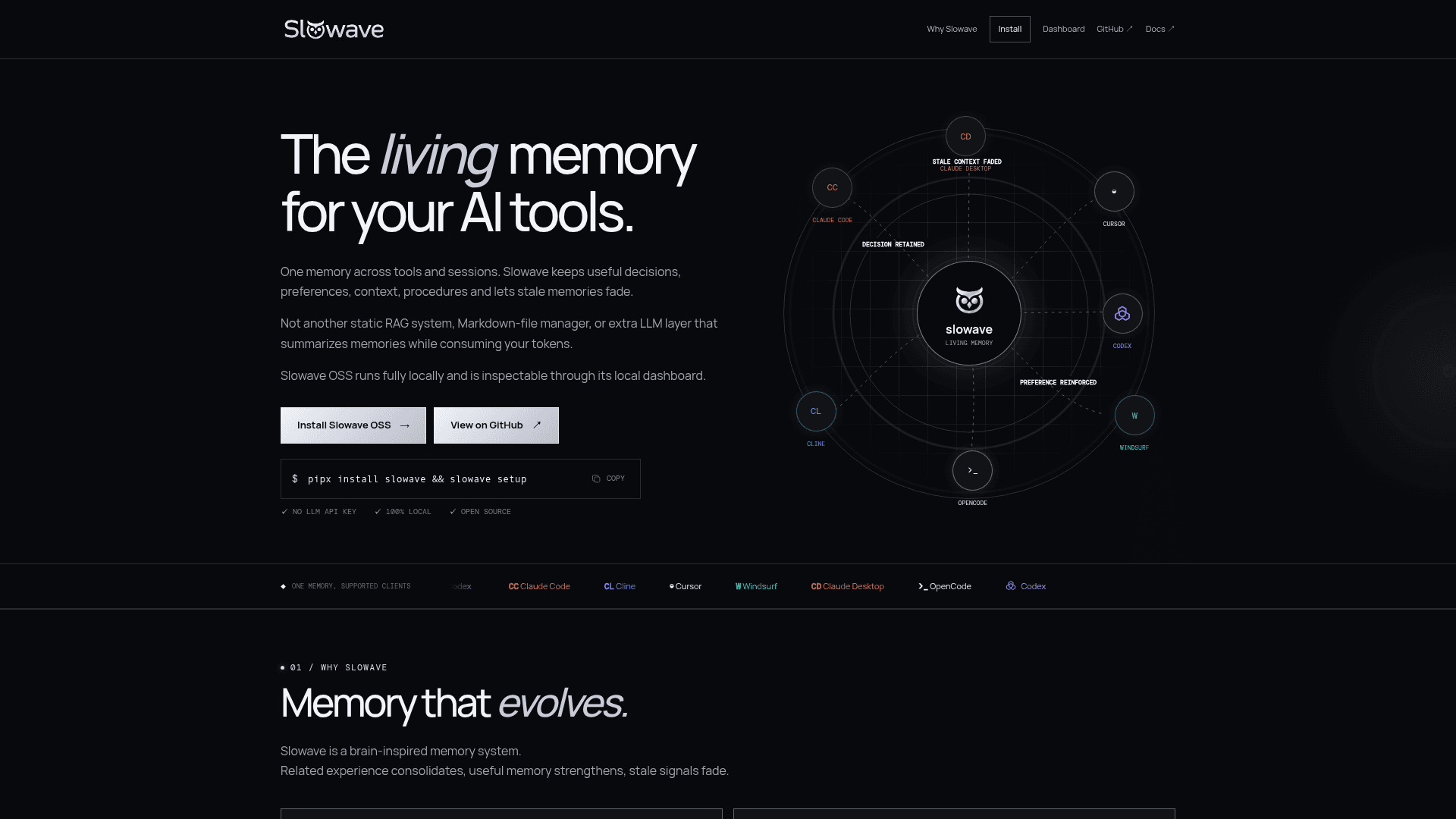
Slowave is an open-source, locally-running memory layer for AI coding agents, released under the AGPL-3.0-or-later license. It gives tools like Claude Code, Cursor, Cline, Codex, Windsurf, OpenCode, and Claude Desktop a single shared memory that persists across sessions and clients, without sending data to a hosted service or requiring a separate LLM API key. The project is currently in public beta (as noted in the README), with the latest release being v0.20.3 published in September 2026.
What It Is
Slowave is a brain-inspired adaptive memory system that sits between your AI coding agents and their context. Rather than acting as a static RAG store or a Markdown-file manager, it implements a continuous feedback loop — remember → recall → use → feedback → reinforce/weaken → decay — so that useful memories strengthen over time and stale ones lose influence. The core runs entirely on local embeddings and deterministic mechanics, meaning no extra model calls and no LLM API key are needed for memory maintenance.
How the Memory Loop Works
Slowave exposes five MCP tools that agents call during a task:
- Activate — starts a session and loads scoped, relevant memory for the current task and goal.
- Remember — saves a durable fact, decision, preference, or constraint.
- Recall — performs a mid-task memory lookup when the agent needs something specific.
- Feedback — marks retrieved memory as useful, irrelevant, or stale, which adjusts future salience.
- Commit — saves the task outcome and any reusable multi-step procedure.
A background consolidation worker processes raw events into episodes, prototypes, schemas, and relations stored in a local SQLite database. The agent's feedback — not a separate LLM judge — shapes what Slowave returns over time.
Local-First Architecture and Inspectability
All memory is stored in plaintext in the current OS user's application-data directory in an open SQLite database. Slowave does not send memory to a hosted service. A local dashboard (launched with slowave dashboard) lets users browse saved memories, procedures, retrievals, activity logs, a memory graph, and system health. The default embedding model (~45 MB) downloads from Hugging Face on first use and is cached locally for offline operation afterward.
Setup Path
Installation is a two-command process via pipx:
pipx install slowave
slowave setup
The setup command auto-detects supported AI clients on the machine, configures MCP connections and lifecycle instructions, and starts the local daemon and consolidation worker. Per-client setup is also available (e.g., slowave setup --client cursor). Claude Desktop and Cursor require one manual paste step after setup. The README notes that client coverage is actively expanding.
Update: v0.20.3
The latest release, slowave-v0.20.3, was published on September 14, 2026. The GitHub repository was created in June 2026 and has seen active development since, with the last push matching the latest release date. The README explicitly flags the project as public beta software, noting that APIs, configuration, and storage schema may change and that migrations are not guaranteed before stable release. Evaluation notes in the repository cover preliminary retrieval-evidence results with stated methodology and limitations, and the project discourages treating any benchmark result as a production-quality claim.
Community Discussions
Be the first to start a conversation about Slowave
Share your experience with Slowave, ask questions, or help others learn from your insights.
Pricing
Slowave OSS
Fully open-source, locally-running memory layer available at no cost under the AGPL-3.0-or-later license.
- Brain-inspired adaptive memory with reinforcement and decay
- One shared memory across all supported AI clients
- 100% local — no hosted service
- No LLM API key required
- Local SQLite storage
Capabilities
Key Features
- Brain-inspired adaptive memory with reinforcement and decay
- One shared memory across Claude Code, Cursor, Cline, Codex, Windsurf, OpenCode, and Claude Desktop
- 100% local — no data sent to hosted memory service
- No LLM API key required for memory maintenance
- Local SQLite storage with open schema
- Local dashboard for inspecting memories, procedures, retrievals, activity, and memory graph
- Five MCP tools: Activate, Remember, Recall, Feedback, Commit
- Background consolidation worker for episodes, prototypes, schemas, and relations
- Local embeddings for retrieval (no external model calls)
- Two-command setup with auto-detection of supported clients
- Scoped memory to reduce accidental context leakage
- Reusable procedures learned from past multi-step work