
Finyuus
A code-first, open-source platform for building, running, and governing durable AI workflows using an indentation-based DSL with Temporal-backed execution.
At a Glance
Fully open-source under Apache License 2.0, free to self-host and use.
Engagement
Available On
Alternatives
Listed Aug 2026
About Finyuus
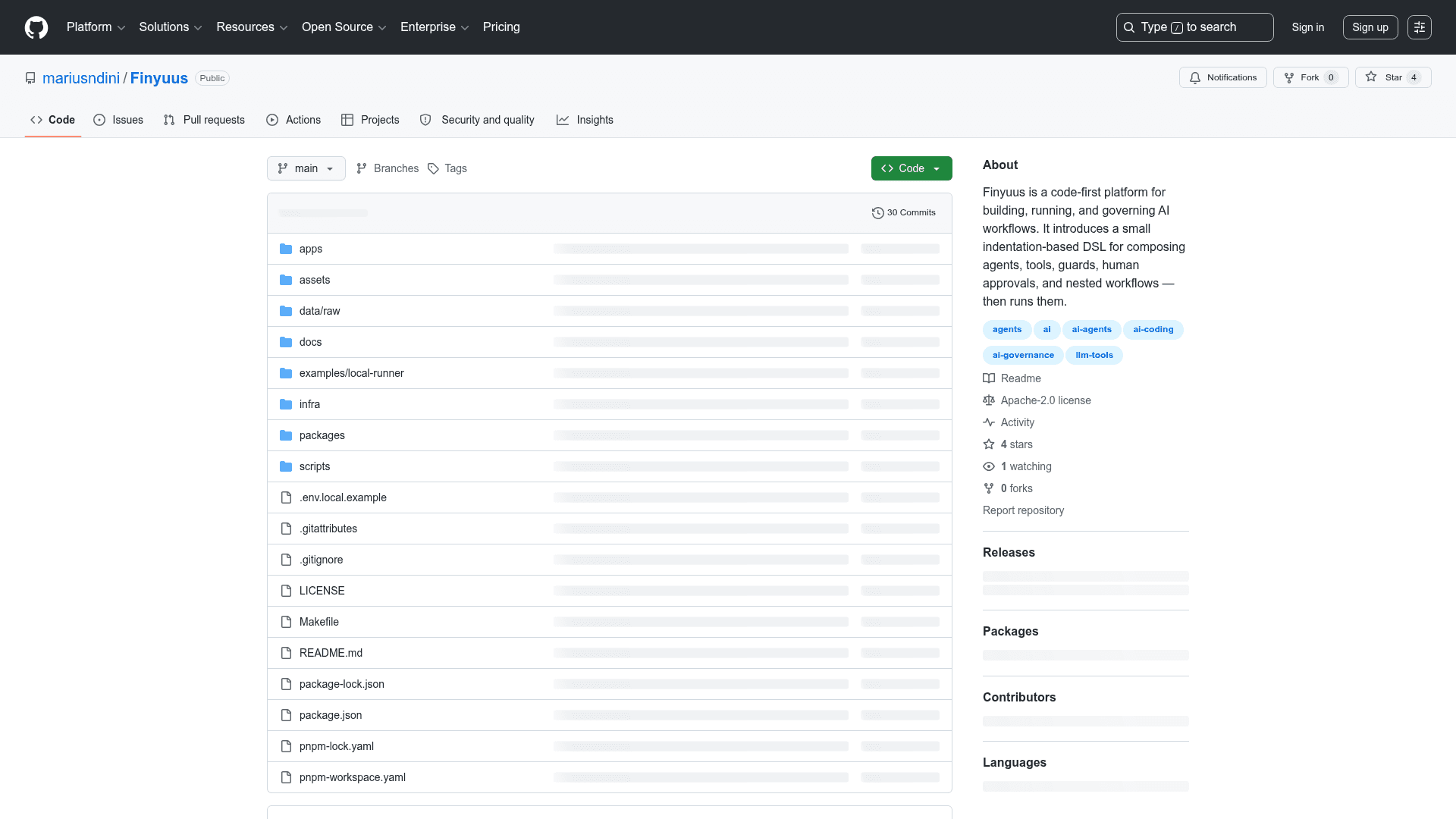
Finyuus is an open-source platform created by Marius Ndini for composing and operating AI workflows as independent, versioned systems rather than logic embedded inside application code. It combines a purpose-built domain-specific language (DSL) with a full runtime and control plane, running workflows durably via Temporal. The project is licensed under Apache 2.0 and is self-hostable from the public GitHub repository.
What It Is
Finyuus addresses a specific pain point in AI development: as teams build more complex AI applications, prompts, tool calls, retries, conditions, and approval logic tend to become scattered across application services. Finyuus separates that AI behavior into explicit, versioned workflow definitions — drawing a parallel to how SQL separates data logic from application code. The platform consists of two primary layers: the Finyuus Language (a focused DSL for defining workflows) and the Finyuus Platform (the runtime, control plane, and dashboard for operating them).
The Finyuus DSL
The language is indentation-based and intentionally scoped to AI workflow orchestration. It provides first-class statements for:
- Agent calls — invoke saved or inline LLM agents with model, instructions, tools, reasoning effort, and structured output schemas
- Guard checks — LLM-based policy checks that route execution through explicit
passorblockbranches, with optional confidence thresholds - Human approvals — pause workflow execution until a reviewer resolves the request via dashboard or API, with assignees, timeouts, and timeout actions
- Tool calls — native TypeScript tools, custom HTTP tools, or pipeline-backed tools that execute saved pipeline versions
- Control flow —
if/else,forloops,parallelbranches, androutematching - Data operations — read/write ClickHouse-backed tables and object-storage-backed files
- Child pipelines — call saved pipelines directly as nested workflows or expose them as agent-callable tools
Workflows are stored as text files (.fy), enabling Git-based version history, pull requests, code review, and readable diffs.
Architecture and Runtime
The platform is structured as a TypeScript monorepo with a clear separation between the control plane and execution plane:
- Control plane: A Next.js web app and API server (dashboard, pipeline editor, approvals inbox, published endpoints), backed by Postgres for definitions and runs, and Redis for SSE event forwarding and rate limiting.
- Execution plane: A Temporal server and worker handle durable workflow state, retries, cancellation, long-running execution, and child-workflow orchestration.
- Observability: Langfuse integration provides LLM traces, token usage, and model cost reporting. Temporal UI exposes workflow timelines. ClickHouse stores application data and pipeline tables.
- Object storage: Local development uses MinIO automatically; production deployments can configure AWS S3.
LLM provider abstraction supports both OpenAI and Anthropic, with Langfuse OpenTelemetry tracing built in.
Pipeline API and Governance Features
Pipelines can be published as authenticated HTTP endpoints with bearer-token auth, Redis-backed rate limiting, idempotency keys, input validation, and Server-Sent Events for live run updates. The platform also supports approval events for workflows requiring human review, making it suitable for compliance-sensitive use cases such as financial advice or content moderation pipelines.
Versioning is a first-class concept: agents, guards, tools, schemas, and pipelines can all be pinned to immutable versions (e.g., pipeline:company_research@v3), allowing safe iteration without breaking running workflows.
Setup Path
The repository supports two entry points:
- CLI runner — try
.fypipeline files immediately vianpx @finyuus/cli runwithout starting any infrastructure services. - Full platform — spin up the complete local stack (Postgres, ClickHouse, Redis, MinIO, Temporal, Langfuse) using Docker Desktop and a
make upcommand, then run the Next.js web app and Temporal worker.
Prerequisites are Node.js 22+, pnpm 10+, Docker Desktop, and at least one LLM provider API key (OpenAI or Anthropic). Optional demo seeds (make demos) populate sample agents, tools, schemas, and pipelines for exploration.
Community Discussions
Be the first to start a conversation about Finyuus
Share your experience with Finyuus, ask questions, or help others learn from your insights.
Pricing
Open Source
Fully open-source under Apache License 2.0, free to self-host and use.
- Full platform source code
- CLI runner
- Temporal-backed durable execution
- Dashboard, pipeline editor, approvals inbox
- Langfuse observability integration
Capabilities
Key Features
- Indentation-based DSL for AI workflow composition
- Durable workflow execution via Temporal
- Reusable versioned agents with model, instructions, tools, and structured output schemas
- LLM-based guard checks with pass/block branching and confidence thresholds
- Human approval workflows with assignees, timeouts, and timeout actions
- Native, HTTP, and pipeline-backed tool registry
- Child pipeline orchestration and pipeline-as-tool support
- Immutable version pinning for agents, guards, tools, schemas, and pipelines
- Pipeline API publishing with bearer-token auth, rate limiting, idempotency, and SSE
- Langfuse integration for LLM traces, token usage, and model cost reporting
- ClickHouse-backed structured data tables
- Object storage support (local MinIO or AWS S3)
- Next.js dashboard with pipeline editor, approvals inbox, and run history
- CLI runner for testing .fy files without infrastructure
- Git-friendly text-based workflow definitions
- Parallel branch execution with fail-fast behavior
- OpenAI and Anthropic provider support