
flar
A Go CLI that runs coding agent CLIs inside isolated Bubblewrap sandboxes restricted to the current project directory.
At a Glance
Self-hosted CLI under Apache License 2.0 (OSI-approved) for running coding agent CLIs inside Bubblewrap sandboxes.
Engagement
Available On
Alternatives
Listed Nov 2026
About flar
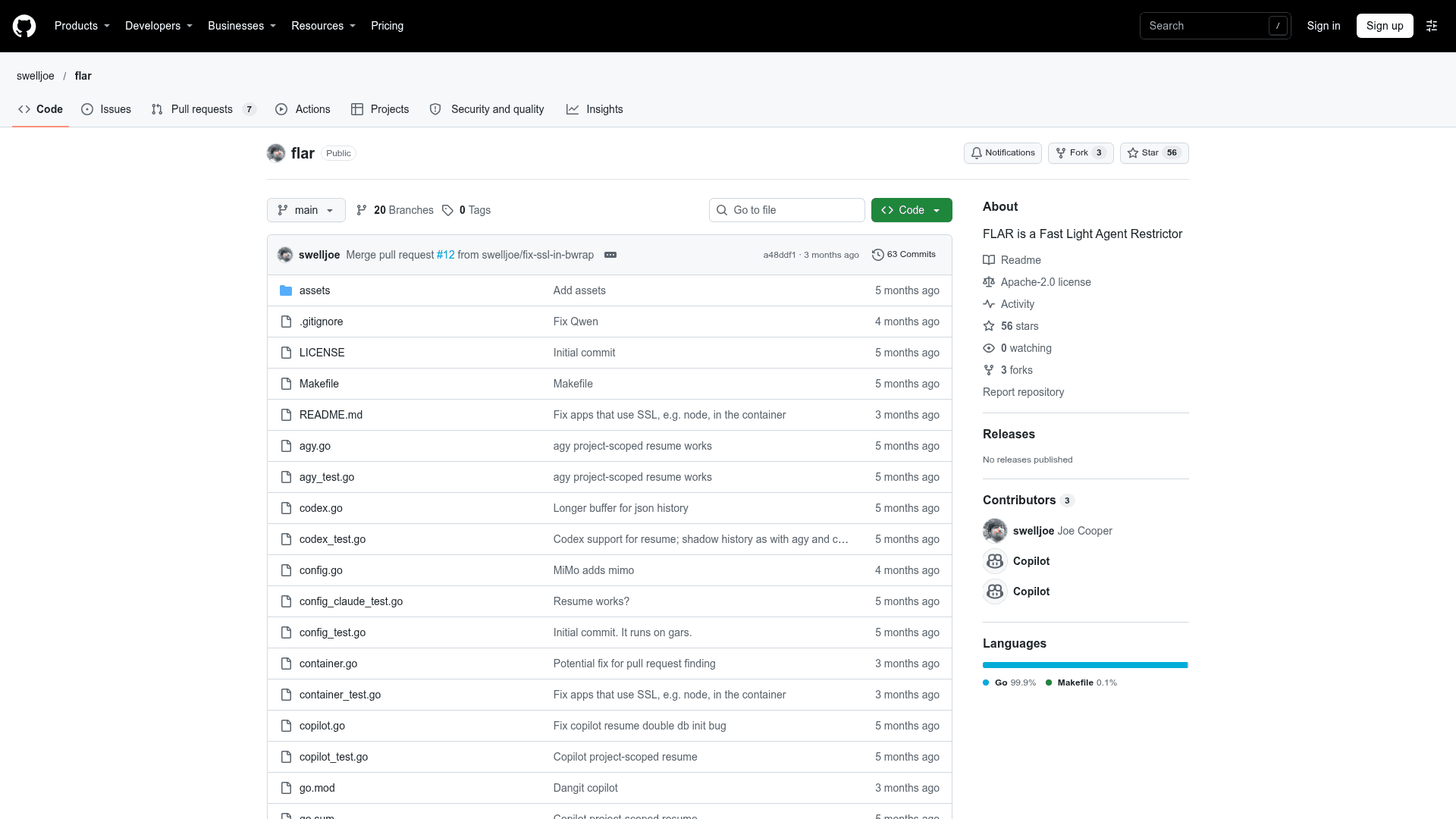
flar (Fast Light Agent Restrictor) is an open-source Go command-line tool published by swelljoe on GitHub. It wraps coding agent CLIs such as Claude Code, Codex, Copilot, Antigravity, Reasonix, Kimi Code, Poolside, and Qwen Code in Bubblewrap sandboxes so each agent can reach only the project it is working on.
What It Is
flar is a lightweight sandbox launcher for AI coding agents on Linux hosts with Bubblewrap installed. Run it in a project folder (or pass a path) and it starts the chosen agent in an unprivileged user namespace with a clean tmpfs root. System paths are mounted read-only from the host, and only the project directory is writable. The README says the aim is to limit the exposure from prompt injection and from supply chain problems in libraries an agent pulls in.
Network and Credential Handling
By default the network namespace is unshared and internet traffic goes through a host-side HTTP/HTTPS proxy that blocks loopback, private, link-local (including cloud metadata), and multicast addresses. Specific local ports, such as a database or a local LLM, can be forwarded into the sandbox, or host networking can be selected. Agent credentials are copied into a temporary config directory so the host originals are untouched. For Antigravity, flar extracts only that one token from the OS keyring and serves it through a private in-sandbox Secret Service.
Sessions and Containers
For agents where it is reasonably safe, such as Claude Code, Reasonix, and Qwen Code, conversation history is bound back to the host, scoped to the current project, so resume and continue work across runs. For other agents, flar forks per-project history on first run. Wrapped agents can also use rootless podman and buildah from the host, with ephemeral storage by default and an optional persistent cache.
Configuration
Options are set through flags such as -m, -ask, -network, -allow-port, and -container-cache, or through a project-level .flar.json or a global config file. Security-sensitive settings are honored only from the global config or from flags, so a cloned repository cannot weaken isolation.
Community Discussions
Be the first to start a conversation about flar
Share your experience with flar, ask questions, or help others learn from your insights.
Pricing
Open Source
Self-hosted CLI under Apache License 2.0 (OSI-approved) for running coding agent CLIs inside Bubblewrap sandboxes.
- Licensed under Apache License 2.0
- Bubblewrap sandbox isolation
- Strict filesystem isolation
- Isolated network mode with host-side proxy
- Port forwarding
Capabilities
Key Features
- Bubblewrap sandbox with read-only host system paths and tmpfs root
- Project-only read-write filesystem access
- Isolated network mode with filtering HTTP/HTTPS proxy
- Local port forwarding into the sandbox
- Optional host network mode
- Automatic permission-bypass flags for supported agents, disabled with -ask
- Credential copying into temporary config directories
- Per-project session persistence and resume
- Antigravity keyring bridging via private Secret Service
- Rootless podman/buildah container builds inside the sandbox
- Per-project and global JSON configuration