
forensic-deepdive
Persistent code knowledge graph and MCP server that gives AI coding agents forensic understanding of a codebase, with confidence-tagged edges and markdown artifacts.
At a Glance
Self-hosted core under the OSI-approved Apache-2.0 license, free to use, modify and redistribute. Runs fully locally with no API keys or network.
Engagement
Available On
Alternatives
Listed Nov 2026
About forensic-deepdive
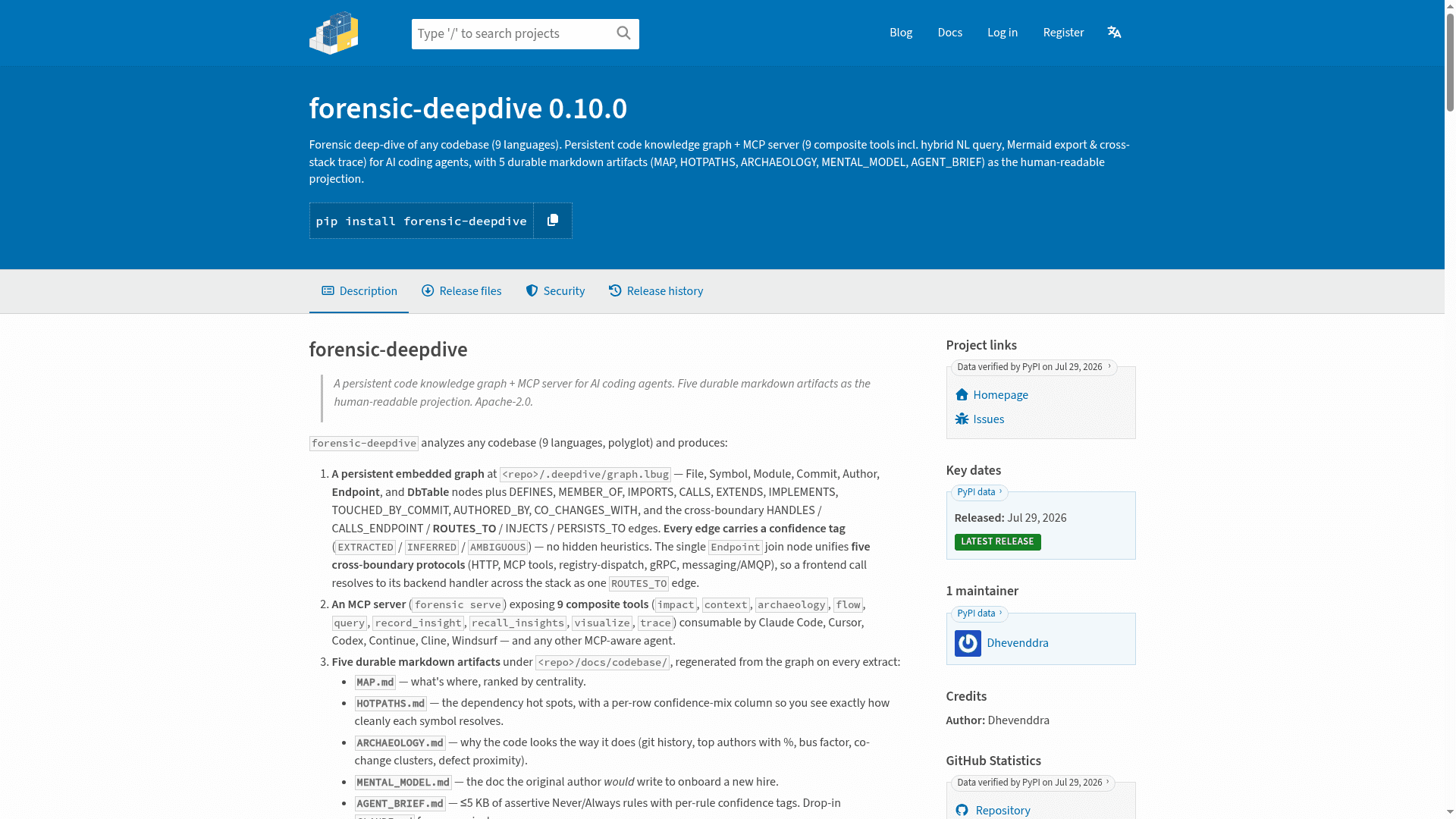
forensic-deepdive is an Apache-2.0 command-line tool by Dhevenddra that analyzes a codebase in nine languages and builds a persistent knowledge graph, an MCP server, and five markdown artifacts for AI coding agents. The current release on PyPI is 0.10.0, listed as Development Status 3 - Alpha.
What It Is
The tool runs forensic extract against a repository and writes an embedded graph to .deepdive/graph.lbug. The graph contains File, Symbol, Module, Commit, Author, Endpoint and DbTable nodes, connected by edges such as CALLS, IMPORTS, EXTENDS, AUTHORED_BY and CO_CHANGES_WITH. Every edge carries a confidence tag: EXTRACTED, INFERRED or AMBIGUOUS. Supported languages are Python, C, Dart, Swift, TypeScript, JavaScript, Java, Go and Rust. Extraction works with no LLM API key and no network.
Outputs and Agent Integration
Five markdown artifacts are regenerated under docs/codebase/: MAP, HOTPATHS, ARCHAEOLOGY, MENTAL_MODEL and AGENT_BRIEF. Ten shims are also written into the target repo: editor rule files for Claude Code, AGENTS.md, Cursor and Continue, five Claude skills, and a plugin manifest. Existing hand-edited files are not overwritten. An optional --emit-vault flag writes an Obsidian-friendly vault.
forensic serve runs a stdio MCP server with nine composite tools: impact, context, archaeology, flow, query, record_insight, recall_insights, visualize and trace. The Endpoint join node unifies HTTP, MCP tools, registry-dispatch, gRPC and messaging protocols, so trace can follow a frontend call to its backend handler.
Setup Path
Install with uv tool install forensic-deepdive or pip install forensic-deepdive, run forensic extract /path/to/repo, then wire the server through a Claude Code plugin, the MCP Registry, or a manual config snippet. Optional extras add offline semantic query, an interactive REPL and terminal browser, OpenAPI YAML parsing, and a Graphiti temporal insight backend.
Current Status
The README describes v0.10.0 as an integrity release focused on upgrade convergence and stale-shim detection, and adds forensic extract --timings. The maintainer states it is an assisted-analysis tool and that faster autonomous issue resolution is not yet proven.
Community Discussions
Be the first to start a conversation about forensic-deepdive
Share your experience with forensic-deepdive, ask questions, or help others learn from your insights.
Pricing
Open Source (Apache-2.0)
Self-hosted core under the OSI-approved Apache-2.0 license, free to use, modify and redistribute. Runs fully locally with no API keys or network.
- Persistent code knowledge graph (9 languages)
- MCP server with 9 composite tools
- Five durable markdown artifacts
- Ten shims for editors and Claude skills
- Agent-insight layer
Capabilities
Key Features
- Persistent embedded code knowledge graph with confidence-tagged edges (EXTRACTED/INFERRED/AMBIGUOUS)
- MCP server with 9 composite tools
- Cross-stack tracing via Endpoint join node across HTTP, MCP, registry-dispatch, gRPC and messaging
- Five markdown artifacts: MAP, HOTPATHS, ARCHAEOLOGY, MENTAL_MODEL, AGENT_BRIEF
- Git archaeology: churn, top authors, bus factor, co-change clusters
- Agent insight layer with record_insight and recall_insights
- Ten shims for Claude Code, Cursor, Continue and AGENTS.md
- Mermaid diagram generation
- Optional Obsidian vault export
- Interactive REPL and terminal graph browser
- Runs with no LLM or network
- Supports 9 languages