
Free Claude Code
An open-source local proxy that routes Claude Code, Codex, and other coding agents through 50+ free and paid LLM providers, delivering 1.3B+ free tokens per month.
At a Glance
Fully free and open-source under the MIT License. Self-hosted local proxy with access to all features.
Engagement
Available On
Alternatives
Listed Aug 2026
About Free Claude Code
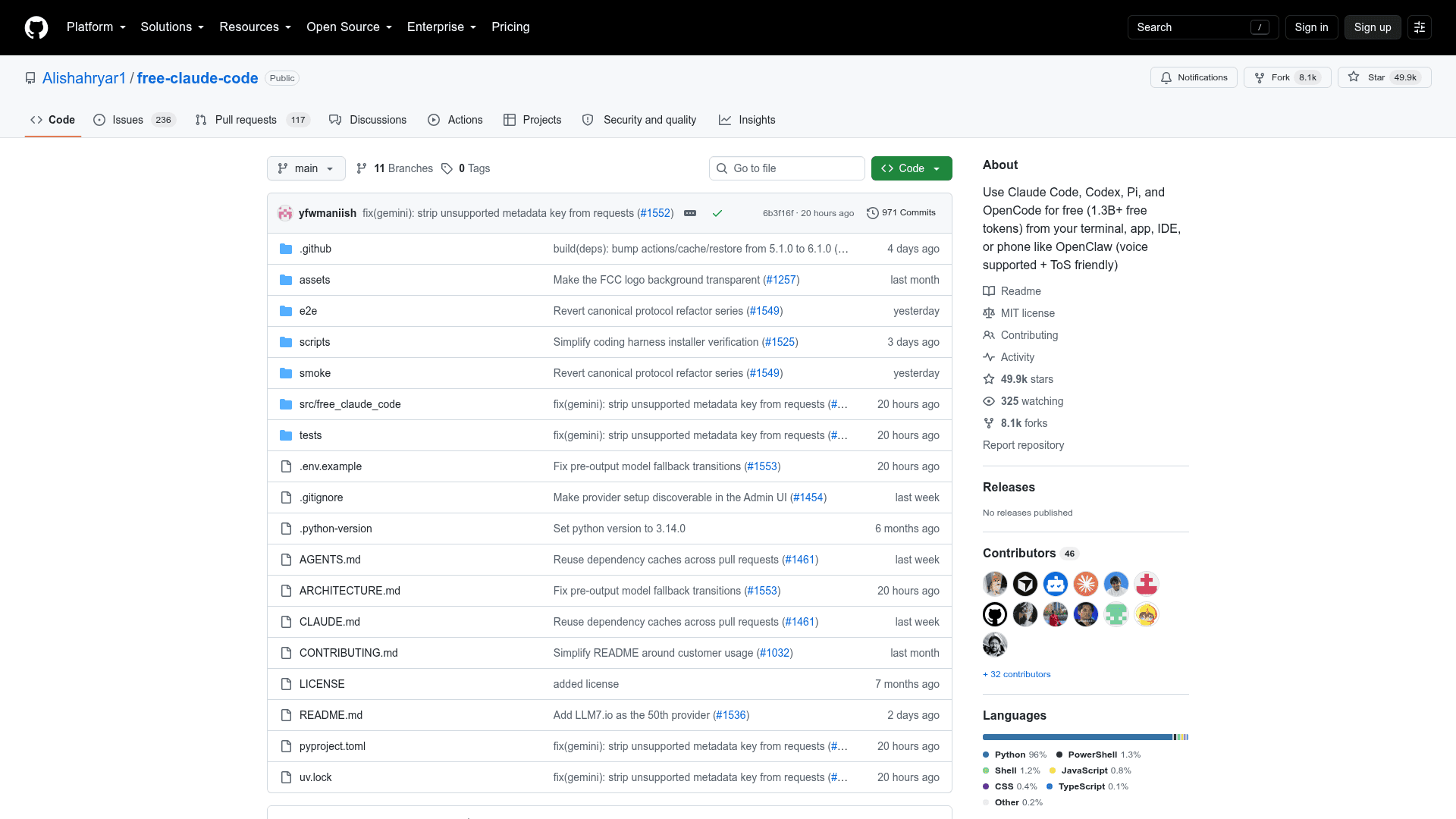
Free Claude Code (FCC) is an MIT-licensed, open-source project by Ali Khokhar that acts as a local proxy server, letting developers run Claude Code, Codex, Pi, OpenCode, Cline, Hermes, DeepSeek Harness, Grok Build, and Muse Code against a catalog of 50+ LLM providers — including many with free tiers — without modifying the agents themselves. The project has accumulated nearly 50,000 GitHub stars and over 8,000 forks since its creation in January 2026, signaling rapid community adoption. It is written in Python and distributed under the MIT License.
What It Is
Free Claude Code is a self-hosted OpenAI-compatible proxy that sits between your coding agent and any supported LLM provider. Instead of paying for Anthropic API credits, you configure one or more providers (NVIDIA NIM, OpenRouter, Groq, xAI, Google Gemini, Mistral, DeepSeek, Ollama, LM Studio, and dozens more) through a local Admin UI, and FCC translates requests so your agent sees a standard API surface. The project's README states it aggregates "1.3B+ free tokens every month" across its provider catalog, though actual availability and limits are controlled by each provider and may change.
Provider Catalog and Routing
FCC ships with integrations for more than 50 providers spanning free tiers, pay-as-you-go APIs, subscription plans, and local inference runtimes:
- Cloud providers: NVIDIA NIM, OpenRouter, Groq, xAI (Grok), Google AI Studio, Google Vertex AI, Azure OpenAI, Amazon Bedrock, Hugging Face, Cohere, GitHub Models, Mistral, DeepSeek, Together AI, DeepInfra, SiliconFlow, Cerebras, SambaNova, Fireworks AI, Cloudflare Workers AI, and more.
- Subscription/coding plans: ClinePass, QwenCloud Coding Plan, Kimi Code, OpenCode Zen/Go, Z.ai Coding Plan.
- Local runtimes: Ollama, LM Studio, llama.cpp.
- Fallback routing: An ordered fallback list automatically retries failed requests on the next configured model without requiring the user to restart the turn.
Optional per-tier routing lets Claude Code's Fable, Opus, Sonnet, and Haiku model tiers each point to a different provider, enabling fine-grained cost and capability control.
Supported Clients and Platforms
FCC works across terminal, desktop, IDE, and mobile surfaces:
- Terminal: Native
fcc-claude,fcc-codex,fcc-pi,fcc-opencode,fcc-cline,fcc-hermes,fcc-dsh,fcc-grok, andfcc-muselaunchers. - VS Code: Claude Code extension and Codex extension, configured via JSON settings or
config.toml. - JetBrains: Claude ACP configuration via
installed.json. - Messaging: Discord and Telegram bot integrations with
/stats,/stop, and/clearcommands. - Voice: Local Whisper (CPU/CUDA) or NVIDIA NIM transcription for voice-note-to-code workflows.
Installation is a single curl | sh command on macOS/Linux or a PowerShell one-liner on Windows, managed by the uv Python package manager.
Token Efficiency and Optimizations
The README describes up to 90% fewer terminal-output tokens through optional RTK (a third-party filter) combined with five built-in FCC optimizations: quota probe suppression, command-prefix detection, title filtering, suggestion filtering, and filepath normalization. These run locally without consuming provider quota.
Architecture and Tooling
FCC is built in Python 3.14, uses uv for dependency management, Pytest for testing, ty for type checking, Ruff for code formatting, and Loguru for logging. An ARCHITECTURE.md and CONTRIBUTING.md are included in the repository. The project explicitly states it is independent and not affiliated with or endorsed by Anthropic; Claude and Claude Code are noted as trademarks of Anthropic.
Current Status
The repository was created in January 2026 and last pushed in August 2026, showing active development. With nearly 50,000 stars and 353 open issues, the project is under active community use and maintenance. The README notes that free-tier availability and limits are controlled by each provider and may change, and that FCC removes integrations if providers stop allowing them.
Community Discussions
Be the first to start a conversation about Free Claude Code
Share your experience with Free Claude Code, ask questions, or help others learn from your insights.
Pricing
Open Source
Fully free and open-source under the MIT License. Self-hosted local proxy with access to all features.
- 50+ LLM provider integrations
- 9 supported coding agents
- Local Admin UI
- Automatic fallback routing
- Voice note transcription
Capabilities
Key Features
- 50+ LLM provider integrations with free and paid tiers
- 1.3B+ free tokens per month across provider catalog
- Supports 9 coding agents: Claude Code, Codex, Pi, OpenCode, Cline, Hermes, DeepSeek Harness, Grok Build, Muse Code
- Automatic fallback routing across providers on failure
- Up to 90% fewer terminal-output tokens with RTK and built-in optimizations
- Local Admin UI for provider configuration and model selection
- Per-tier model routing for Claude Code (Fable, Opus, Sonnet, Haiku)
- VS Code, JetBrains, terminal, and messaging client support
- Discord and Telegram bot integrations
- Voice note input via local Whisper or NVIDIA NIM transcription
- Local inference support: Ollama, LM Studio, llama.cpp
- Reasoning control override per model tier
- Proxy authentication for local server protection
- MIT licensed open-source project