opencodex
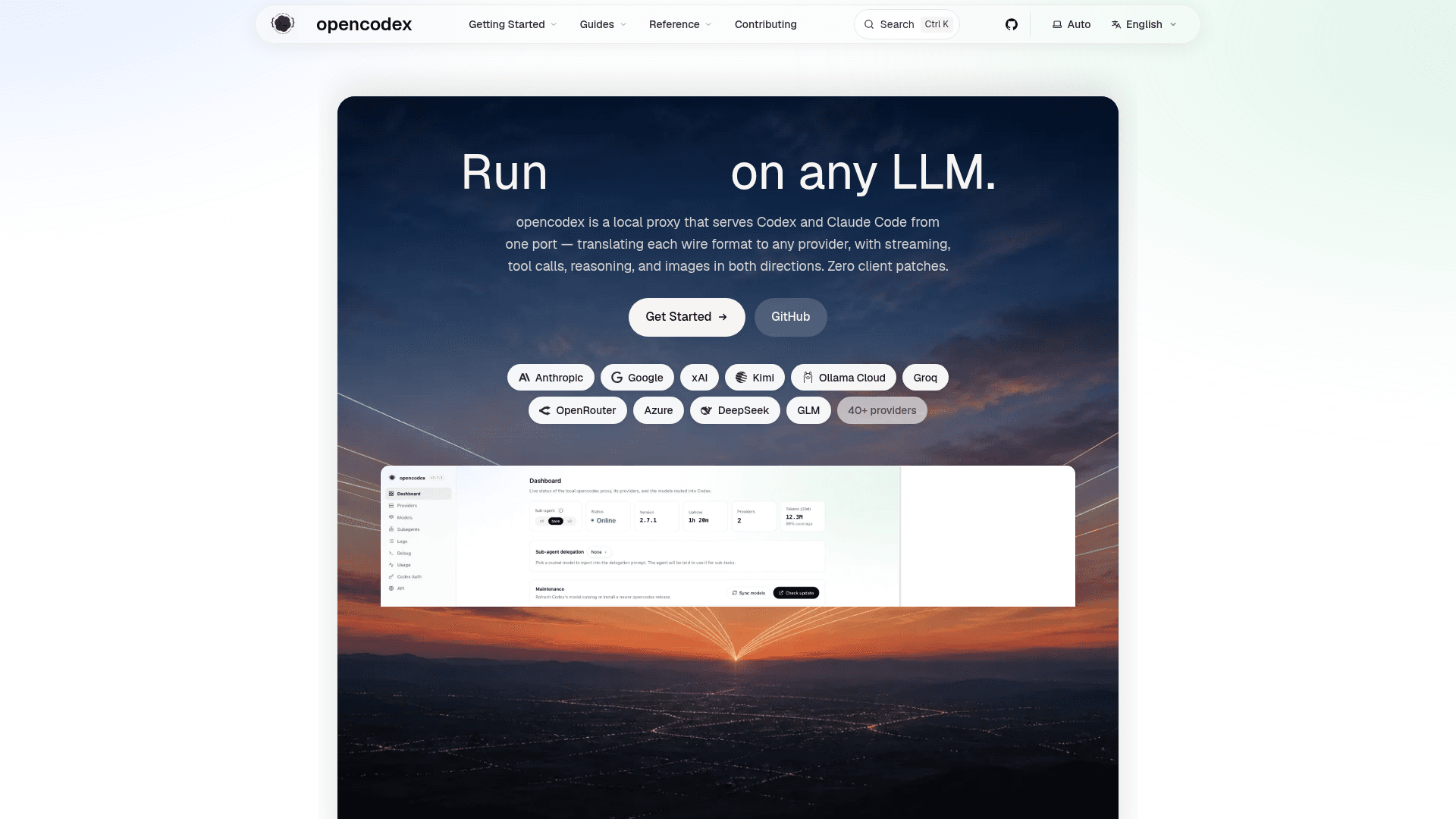
A local proxy that lets you run OpenAI Codex, Claude Code, Claude Desktop, and Grok Build on any LLM provider by translating wire formats with streaming, tool calls, and image support.
At a Glance
Fully free and open-source under the MIT License. Self-hosted local proxy with all features included.
Engagement
Available On
Listed Aug 2026
About opencodex
opencodex is an open-source, community-maintained local proxy that routes OpenAI Codex, Claude Code, Claude Desktop, and Grok Build through any LLM provider — including Anthropic, Google Gemini, xAI, DeepSeek, Ollama, and 40+ others — without patching the client. It is published under the MIT License and available on GitHub at lidge-jun/opencodex, with documentation at opencodex.me. The project is not affiliated with or endorsed by OpenAI, Anthropic, or any other provider.
What It Is
opencodex is a lightweight local proxy written in TypeScript that intercepts the OpenAI Responses API format used by Codex and translates it bidirectionally to whatever protocol a target provider speaks. This means streaming completions, tool calls, reasoning tokens, and images all flow correctly in both directions without any modification to the Codex CLI, App, SDK, or Claude Code client. The proxy runs on localhost:10100 by default and exposes a web dashboard for configuration and live request monitoring.
How the Routing Works
The proxy uses five adapters to cover the major wire formats:
- Anthropic Messages — for Claude models
- Google Gemini — for Gemini models
- Azure OpenAI — for Azure-hosted models
- OpenAI Responses passthrough — for native OpenAI endpoints
- OpenAI-compatible Chat Completions — for any compatible endpoint (DeepSeek, Groq, OpenRouter, Ollama, Together, Fireworks, Cerebras, Mistral, Hugging Face, NVIDIA NIM, and more)
Models are addressed with a provider/model syntax (e.g., anthropic/claude-opus-5 or google/gemini-3-pro). A "Combos" feature lets users define a virtual model ID backed by failover or weighted round-robin across multiple providers.
Platform and Deployment Model
opencodex runs as a local process or background service on macOS (arm64/x64), Linux (x64/arm64), and Windows (x64). It requires Node 18+; the Bun runtime is bundled automatically on install so no separate Bun installation is needed. Key deployment options include:
- Foreground proxy —
ocx start - Background service —
ocx service(launchd on macOS, systemd on Linux, Task Scheduler or WinSW on Windows) - On-demand shim —
ocx codex-shim installstarts the proxy whenevercodexlaunches
Authentication supports OAuth (xAI, Anthropic, Kimi with auto-refresh), API keys, environment variable references, and a ChatGPT account pool with thread affinity and quota-aware auto-switching.
Key Capabilities
- Sub-agent surface — pin up to five routed or native models for Codex
spawn_agent, with v1/v2 surface control and fallback chains - Claude Code integration —
ocx claudelaunches Claude Code against the same port with every routed model available in the/modelpicker and auto-context up to 1M tokens - Search and vision sidecars — non-OpenAI models gain real web search and image understanding through a GPT sidecar over a ChatGPT login
- Image and video bridges — documented guides for routing image and video inputs through the proxy
- Management API — a REST API for programmatic control alongside the CLI and web dashboard
- Clean uninstall —
ocx stoprestores Codex to its original configuration with zero residue
Update: v2.11.0
The latest release is v2.11.0, published on August 8, 2026, with the repository last pushed the same day. The project was created in June 2026 and has accumulated over 8,500 GitHub stars and 650 forks in under two months, according to GitHub metadata. The repository is actively maintained with 110 open issues and documentation available in English, Korean, Simplified Chinese, Russian, and Japanese.
Community Discussions
Be the first to start a conversation about opencodex
Share your experience with opencodex, ask questions, or help others learn from your insights.
Pricing
Open Source
Fully free and open-source under the MIT License. Self-hosted local proxy with all features included.
- All provider adapters and 40+ built-in providers
- Web dashboard
- CLI and Management API
- Sub-agent surface
- Claude Code integration
Capabilities
Key Features
- Local proxy for Codex, Claude Code, Claude Desktop, and Grok Build
- 40+ built-in LLM providers
- Bidirectional streaming, tool calls, reasoning tokens, and image support
- Five protocol adapters: Anthropic Messages, Google Gemini, Azure, OpenAI Responses, OpenAI-compatible Chat Completions
- Model routing with provider/model syntax
- Combos: virtual model IDs with failover or weighted round-robin
- ChatGPT account pool with thread affinity and quota-aware auto-switching
- OAuth support for xAI, Anthropic, and Kimi with auto-refresh
- Sub-agent surface with v1/v2 control and fallback chains
- Claude Code integration with up to 1M auto-context
- Search and vision sidecars for non-OpenAI models
- Image and video bridges
- Web dashboard with live request log and cache token counts
- Management API for programmatic control
- Background service mode (launchd, systemd, Task Scheduler/WinSW)
- On-demand codex-shim for lightweight startup
- Clean uninstall restoring native Codex configuration
- Remote access with bearer token authentication