
GenericAgent
A minimal, self-evolving autonomous agent framework that gives any LLM system-level control of a local computer through 9 atomic tools.
At a Glance
GenericAgent core framework distributed under the MIT License, free to use, copy, modify and distribute. LLM/API costs are external.
Engagement
Available On
Listed Oct 2026
About GenericAgent
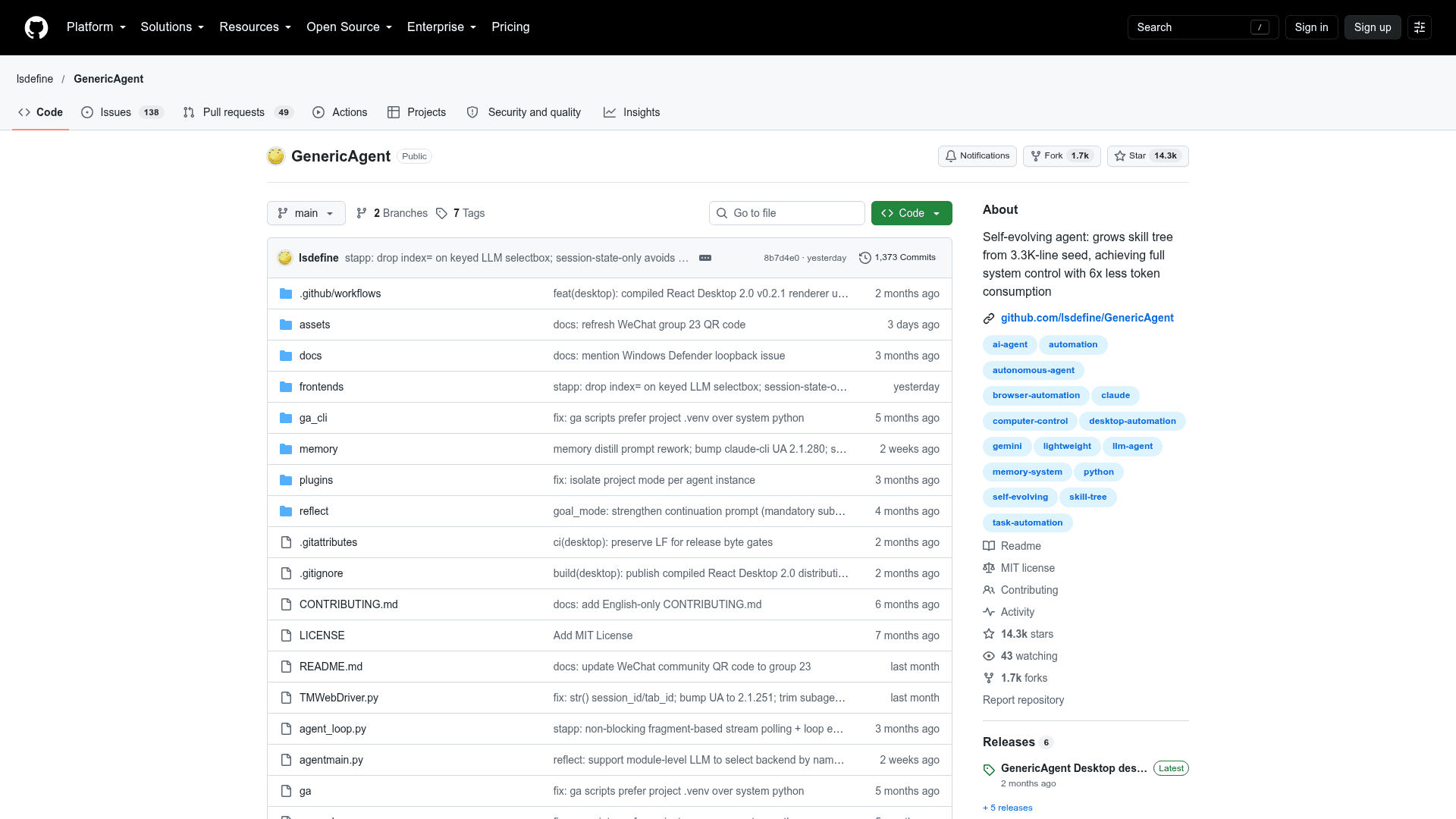
GenericAgent is an open-source, MIT-licensed autonomous agent framework published by lsdefine. According to the README, its core is about 3K lines of code built around 9 atomic tools and a roughly 100-line agent loop. It lets an LLM control a local computer, including the browser, terminal, filesystem, keyboard and mouse, screen vision and mobile devices over ADB.
What It Is
GenericAgent is a Python agent framework that connects to LLMs such as Claude, Gemini, Kimi and MiniMax. Its design philosophy is to not preload skills but let them evolve. When the agent solves a new task, it records the execution path as a reusable Skill in its memory, so the same task can be recalled directly next time.
The agent can be run through a terminal UI, a Streamlit web UI, a desktop app, or IM bot frontends for Telegram, Discord and Lark/Feishu. The Chinese section also lists WeChat, QQ, WeCom and DingTalk.
How the Agent Works
The core loop perceives environment state, reasons about the task, executes tools, writes experience to memory, and repeats. The nine tools are code_run, file_read, file_write, file_patch, web_scan, web_execute_js, ask_user, update_working_checkpoint and start_long_term_update. Through code_run, the agent can install Python packages, write scripts, call external APIs or control hardware at runtime.
Memory is layered: meta rules, an insight index, global facts, task skills/SOPs, and a session archive for long-horizon recall.
Browser Control and Advanced Capabilities
Web tools run through TMWebdriver, a local WebSocket server plus a Chrome extension, which drives a real persistent browser session and preserves logins and cookies. The README reports passing several bot-detection test pages with this approach. These are project-published results.
Advanced capabilities such as web automation, OCR, vision and computer use are unlocked by instructing the agent to set them up, using its pre-installed SOPs, rather than by manual installation.
Recent Updates
The roadmap lists TUI v3 (2026-05-23), Morphling mode for project-level skill absorption, Goal Hive multi-worker mode, a desktop GUI, Conductor sub-agent orchestration, and Goal mode for time-budgeted loops. A technical report is on arXiv. The latest release listed is desktop-portable-v0.2.0.
Setup Path
The README recommends Python 3.11 or 3.12 and not 3.14. Install by cloning the repository, creating a uv virtual environment, installing the package with the ui extra, and copying a key template to fill in an LLM API key. A one-line installer is also provided for Windows, Linux and macOS.
Community Discussions
Be the first to start a conversation about GenericAgent
Share your experience with GenericAgent, ask questions, or help others learn from your insights.
Pricing
Open Source (MIT)
GenericAgent core framework distributed under the MIT License, free to use, copy, modify and distribute. LLM/API costs are external.
- MIT License
- ~3K lines of seed code
- 9 atomic tools
- ~100-line Agent Loop
- Self-evolving skill tree
Capabilities
Key Features
- Self-evolving skill crystallization from completed tasks
- About 3K-line core with a roughly 100-line agent loop
- 9 atomic tools for code, files, web and memory
- Real-browser control via TMWebdriver preserving login sessions
- Layered memory (L0-L4) with SOPs and session archive
- Computer control via keyboard/mouse, screen vision and ADB for mobile
- Terminal UI, Streamlit UI and desktop app frontends
- IM bot frontends for Telegram, Discord and Lark/Feishu
- Goal mode, Goal Hive and Conductor sub-agent orchestration
- Multiple LLM backends including Claude, Gemini, Kimi and MiniMax