EveryDev.ai
Subscribe
Home
Tools

4,791+ AI tools

  • New
  • Trending
  • Featured
  • Rate tools
  • Compare
  • Arena
Categories
  • Agents2432
  • Coding1785
  • Infrastructure837
  • Projects689
  • Research582
  • MCP557
  • Marketing486
  • Analytics468
  • Design396
  • Testing384
  • Data355
  • Security297
  • Integration249
  • Communication238
  • Prompts231
  • Extensions216
  • Commerce167
  • Voice162
  • DevOps161
  • Web117
  • Learning113
  • Finance33
AI Tools by Topic
  • AI Coding Assistants
  • Agent Frameworks
  • MCP Servers
  • AI Prompt Tools
  • Vibe Coding Tools
  • AI Design Tools
  • AI Database Tools
  • AI Website Builders
  • AI Testing Tools
  • LLM Evaluations
Follow Us
  • X / Twitter
  • LinkedIn
  • Reddit
  • Discord
  • Threads
  • Bluesky
  • Mastodon
  • YouTube
  • GitHub
  • Instagram
Get Started
  • Users
  • Rate Tools
  • About
  • Editorial Standards
  • Corrections & Disclosures
  • Community Guidelines
  • Advertise
  • Contact Us
  • Newsletter
  • Submit a Tool
  • Start a Discussion
  • Write A Blog
  • Share A Build
  • Terms of Service
  • Privacy Policy
Explore with AI
  • ChatGPT
  • Gemini
  • Claude
  • Grok
  • Perplexity
Agent Experience
  • llms.txt
Theme
With AI, Everyone is a Dev. EveryDev.ai ©
    1. Home
    2. Tools
    3. gget
    gget icon

    gget

    Academic Research
    Featured

    Free, open-source command-line tool and Python package for querying genomic reference databases with single-line commands.

    Visit Website

    At a Glance

    Pricing
    Open Source

    Free, open-source command-line tool and Python package for querying genomic databases, licensed under BSD 2-Clause.

    Engagement

    Available On

    API
    SDK
    CLI

    Resources

    WebsiteDocsGitHubllms.txt

    Topics

    Academic ResearchData ProcessingCommand Line Assistants

    Alternatives

    Ontology PlaygroundolmOCRPyOD
    Developer
    scversescverse is an open-source, community-governed ecosystem of p…

    Listed Oct 2026

    About gget

    gget is a free, open-source command-line tool and Python package for querying genomic databases. It was developed by Laura Luebbert in the Pachter Lab and is part of the scverse project, fiscally sponsored by NumFOCUS. Its latest listed release is v0.30.8.

    What It Is

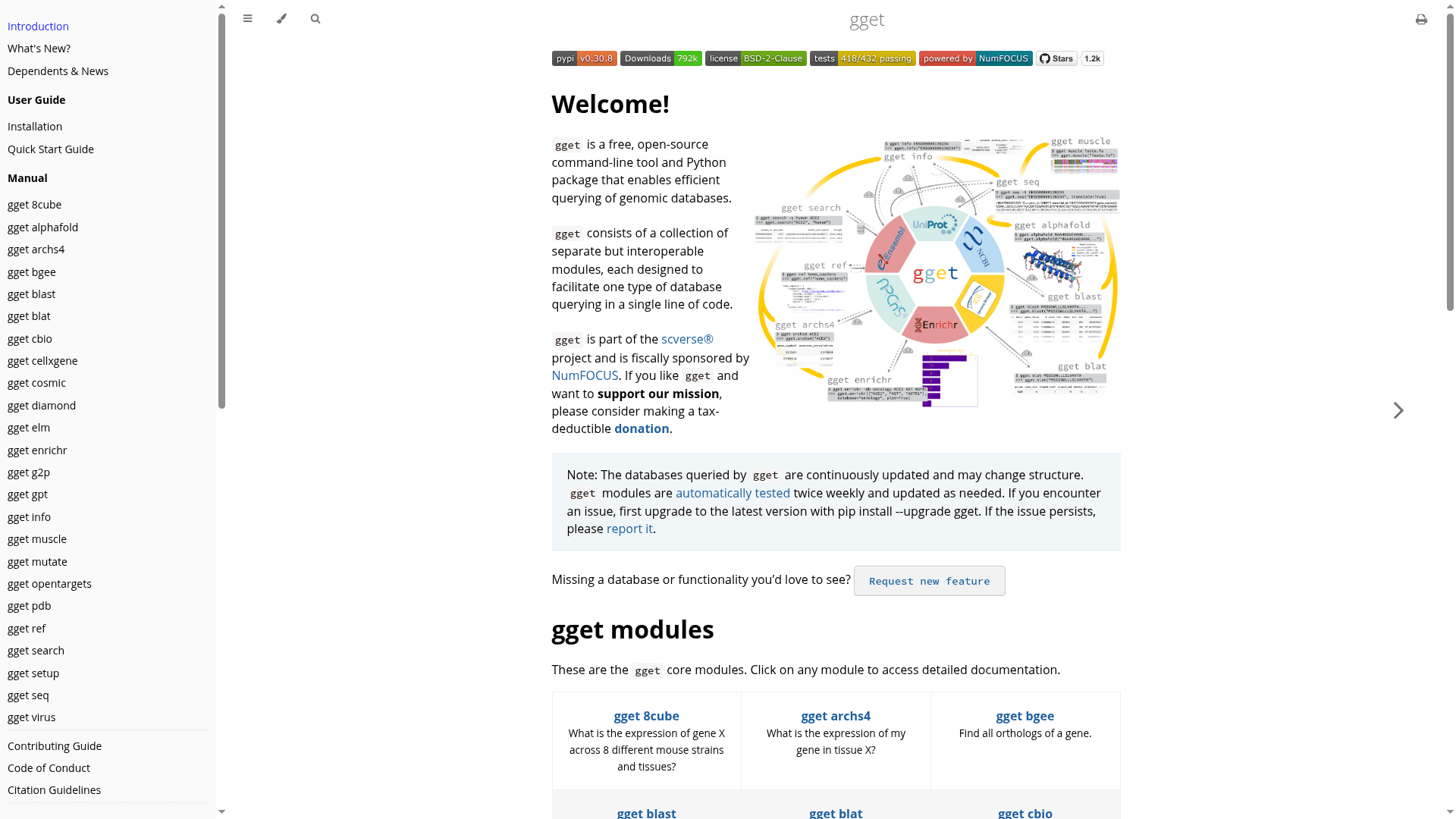
    gget is a collection of separate but interoperable modules, each designed to handle one type of database query in a single line of code. It can be used from the command line, from Python in Jupyter Lab or Google Colab, and from R through reticulate. Typical inputs are gene names, Ensembl IDs, nucleotide or amino acid sequences, PDB IDs, and gene lists. Outputs include reference genome links, sequences, alignments, annotations, expression data, and protein structures.

    Modules and Workflows

    The modules cover several areas of genomic and proteomic lookup:

    • Gene and sequence lookup: gget ref fetches Ensembl reference genomes, gget search finds Ensembl IDs, gget info retrieves annotations for an Ensembl ID, and gget seq fetches nucleotide or amino acid sequences.
    • Sequence analysis: gget blast, blat, muscle, and diamond handle BLAST searches, genomic location lookup, multiple sequence alignment, and alignment to a reference.
    • Expression and disease context: archs4, 8cube, bgee, cbio, cosmic, opentargets, and enrichr cover tissue expression, orthologs, cancer data, disease and drug associations, and enrichment analysis.
    • Structure and motifs: gget pdb fetches Protein Data Bank data, gget elm finds eukaryotic linear motifs, and gget g2p links genes and proteins to residue-level annotations.
    • Data retrieval: gget cellxgene returns single-cell RNA-seq count matrices in AnnData format, and gget virus filters and fetches viral sequences with metadata from NCBI Virus.
    • Sequence editing: gget mutate changes nucleotide sequences based on specified mutations.

    Setup Path

    Install with pip or uv, or from source via git. Some modules, such as elm and cellxgene, need a one-time gget setup step. The documentation notes that the queried databases change over time, and that modules are automatically tested twice weekly and updated as needed. The project is BSD 2-Clause licensed and asks users to cite the 2023 Bioinformatics paper.
    gget - 1

    Community Discussions

    Be the first to start a conversation about gget

    Share your experience with gget, ask questions, or help others learn from your insights.

    Pricing

    OPEN SOURCE

    Open Source

    Free, open-source command-line tool and Python package for querying genomic databases, licensed under BSD 2-Clause.

    • BSD 2-Clause license (OSI-approved)
    • Command-line tool and Python package
    • Modules for genomic database querying (ref, search, info, seq, blast, blat, muscle, diamond, enrichr, archs4, pdb, virus, and more)
    • Voluntary tax-deductible donations accepted via NumFOCUS

    Capabilities

    Key Features

    • Command-line and Python interfaces
    • Modular single-line database queries
    • Ensembl reference genome retrieval
    • Gene search and info lookup
    • Sequence fetching with translation
    • BLAST, BLAT, MUSCLE and DIAMOND alignment
    • Enrichr enrichment analysis
    • ARCHS4 tissue expression queries
    • PDB structure download
    • CELLxGENE single-cell count matrices in AnnData format
    • NCBI Virus sequence retrieval
    • Eukaryotic Linear Motif search
    • Open Targets, COSMIC, cBioPortal and Bgee queries
    • Sequence mutation
    • Callable from R via reticulate

    Integrations

    Ensembl
    NCBI
    NCBI Virus
    Enrichr
    ARCHS4
    Protein Data Bank
    CELLxGENE
    Open Targets
    COSMIC
    cBioPortal
    Bgee
    AlphaFold
    UniProt
    Jupyter Lab
    Google Colab
    R reticulate
    Bioconda
    API Available
    View Docs

    Demo Video

    gget Demo Video
    Watch on YouTube

    Ratings & Reviews

    No ratings yet

    Be the first to rate gget and help others make informed decisions.

    Rate other tools you’ve used

    Developer

    scverse

    scverse is an open-source, community-governed ecosystem of packages for single-cell and spatial omics. It develops interoperable core packages and hosts hackathons, workshops, and an annual conference. The project is currently governed by a core team.

    Read more about scverse
    WebsiteLinkedInX / Twitter
    1 tool in directory

    Similar Tools

    Ontology Playground icon

    Ontology Playground

    A free, open-source web app for learning about ontologies and Microsoft Fabric IQ — explore pre-built ontologies, design your own visually, export as RDF/XML, and share interactive diagrams.

    olmOCR icon

    olmOCR

    olmOCR is an open-source toolkit by AI2 for converting PDFs and document images into clean, structured plain text using vision-language models.

    PyOD icon

    PyOD

    A Python library for anomaly detection across tabular, time series, graph, text, image, and audio data with 60+ detectors and agentic workflow support.

    Browse all tools

    Related Topics

    Academic Research

    AI tools designed specifically for academic and scientific research.

    82 tools

    Data Processing

    AI-enhanced ETL (Extract, Transform, Load) tools and data pipelines that automate the processing, cleaning, and transformation of large datasets with intelligent optimizations.

    187 tools

    Command Line Assistants

    AI-powered command-line assistants that help developers navigate, search, and execute terminal commands with intelligent suggestions and context awareness.

    300 tools
    Browse all topics
    Back to all toolsSuggest an edit
    ratings
    discussions