
Ontology Playground
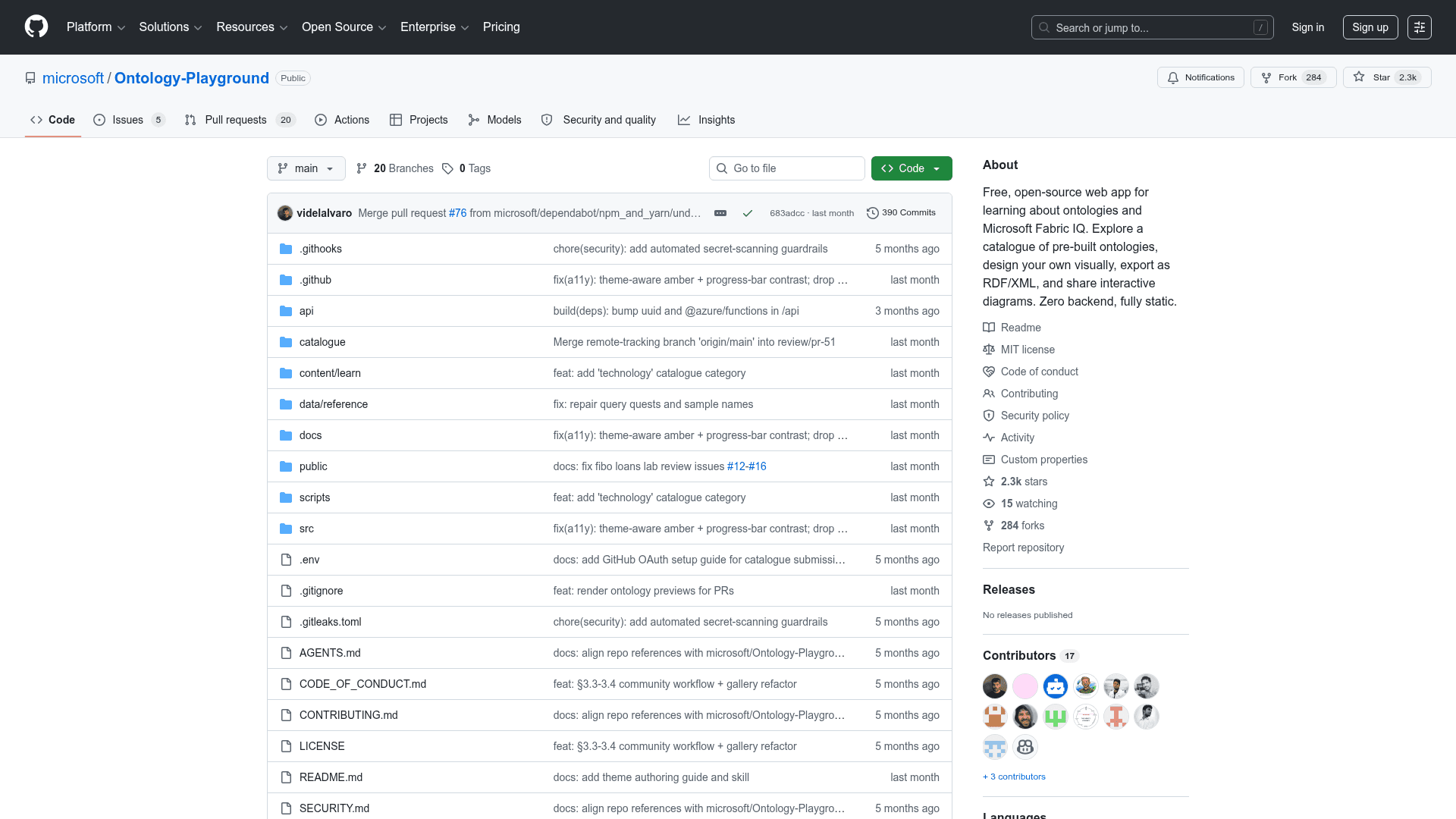
A free, open-source web app for learning about ontologies and Microsoft Fabric IQ — explore pre-built ontologies, design your own visually, export as RDF/XML, and share interactive diagrams.
At a Glance
About Ontology Playground
Ontology Playground is a free, open-source web application built by Microsoft for learning about ontologies and Microsoft Fabric IQ. It runs entirely as a static site with zero backend dependencies, deployable to Azure Static Web Apps or GitHub Pages. The project was developed with AI-assisted coding and is licensed under the MIT License.
What It Is
Ontology Playground sits at the intersection of knowledge graph tooling and educational software. It lets users explore, design, and export ontologies — structured representations of entities and their relationships — in a visual, browser-based environment. The tool is specifically oriented around the RDF/OWL format that Microsoft Fabric IQ expects, making it a companion learning and prototyping tool for that platform.
Core Features
The application ships with a rich set of capabilities organized around exploration, creation, and learning:
- Interactive Graph Exploration — Cytoscape.js-powered diagrams with pan, zoom, node inspection, and live search, using the fcose layout algorithm.
- Ontology Catalogue — A curated library spanning six domains (Retail, E-Commerce, Healthcare, Finance, Manufacturing, Education) with shareable deep links per ontology.
- Visual Ontology Designer — A full-screen split-pane editor with undo/redo (50 levels), real-time validation, live graph preview, and export to RDF/XML or JSON.
- RDF Import & Export — Full round-trip support for RDF/XML (OWL classes, datatype properties, object properties with cardinalities), compatible with
.rdfand.owlfiles. - Embeddable Widget — A self-contained
ontology-embed.jsfile that renders an interactive ontology viewer on any web page with a single<script>tag, supporting dark/light themes. - One-Click Catalogue PR — GitHub device-flow sign-in lets users fork the repo, commit RDF + metadata, and open a pull request directly from the designer.
Ontology School and Learning System
A structured learning hub at /#/learn provides 9 courses covering conceptual paths and hands-on labs. Content includes an Ontology Fundamentals track (6 articles from "What is an Ontology?" through RDF/OWL and Fabric IQ), seven domain learning paths (Retail, E-Commerce, Finance, Healthcare, Manufacturing, University, HR System), and a hands-on IQ Lab that builds a 15-entity retail supply chain ontology across 7 steps. Every article supports presentation mode (slides split at ## headings) and includes interactive quizzes with instant feedback.
A Quest System offers five progressive quests with multi-step instructions, hints, progress bars, and achievement badges. A Natural Language Query Playground lets users type questions like "Which customers placed orders?" and see how they map to ontology entities — previewing Fabric IQ's NL2Ontology capability.
Architecture and Deployment
The app is built with React 19, TypeScript 5, Vite, Zustand for state management, Framer Motion for animations, and Cytoscape.js for graph rendering. It is fully static — no server required at runtime. Two deployment paths are supported out of the box via GitHub Actions:
- Azure Static Web Apps — primary deployment target, with automatic PR preview environments.
- GitHub Pages — ideal for forks, with automatic
VITE_BASE_PATHconfiguration.
An optional Azure Functions backend can be enabled via the VITE_ENABLE_AI_BUILDER environment variable to power an Azure OpenAI-based ontology builder.
AI Agent Integration
The repository includes GitHub Copilot customization files (skills, instructions, and reusable prompts) so AI agents can reliably import customer RDF/OWL into catalogue-ready format, generate progressive Ontology School modules, and route lesson content through human review workflows. Included skills cover ontology catalog import, school path generation, community ontology contribution, and name generation for demos and tests.
Current Status
The project is in Preview as of its README. The GitHub repository under the microsoft organization was created in February 2026 and last updated in July 2026, with 1,209 stars and 193 forks reported by the repository metadata. The live application is hosted at microsoft.github.io/Ontology-Playground.
Community Discussions
Be the first to start a conversation about Ontology Playground
Share your experience with Ontology Playground, ask questions, or help others learn from your insights.
Pricing
Open Source
Fully free and open-source under the MIT License. Self-host or use the live GitHub Pages deployment.
- Interactive graph exploration
- Ontology Catalogue (6 domains)
- Visual Ontology Designer
- RDF/XML import and export
- Embeddable widget
Capabilities
Key Features
- Interactive graph exploration with Cytoscape.js (pan, zoom, node inspection, live search)
- Ontology Catalogue with 6 domain categories and shareable deep links
- Visual Ontology Designer with split-pane editor, undo/redo (50 levels), and live preview
- RDF/XML import and export (OWL classes, datatype properties, object properties)
- Embeddable widget (ontology-embed.js) for any web page
- One-click catalogue pull request via GitHub device flow
- Ontology School with 9 courses, quizzes, and presentation mode
- Quest System with 5 progressive quests and achievement badges
- Natural Language Query Playground (NL2Ontology preview)
- Command palette (⌘K / Ctrl+K) with keyboard navigation
- 5 domain starter templates (Retail, Healthcare, Finance, IoT, Education)
- Interactive onboarding tour with spotlight overlay
- Deep linking and hash-based URL routing
- Dark/light theme support
- Azure Static Web Apps and GitHub Pages deployment workflows
- Optional Azure OpenAI ontology builder (VITE_ENABLE_AI_BUILDER)
- AI agent skills for Copilot (RDF import, school path generation, community contribution)