GitWit
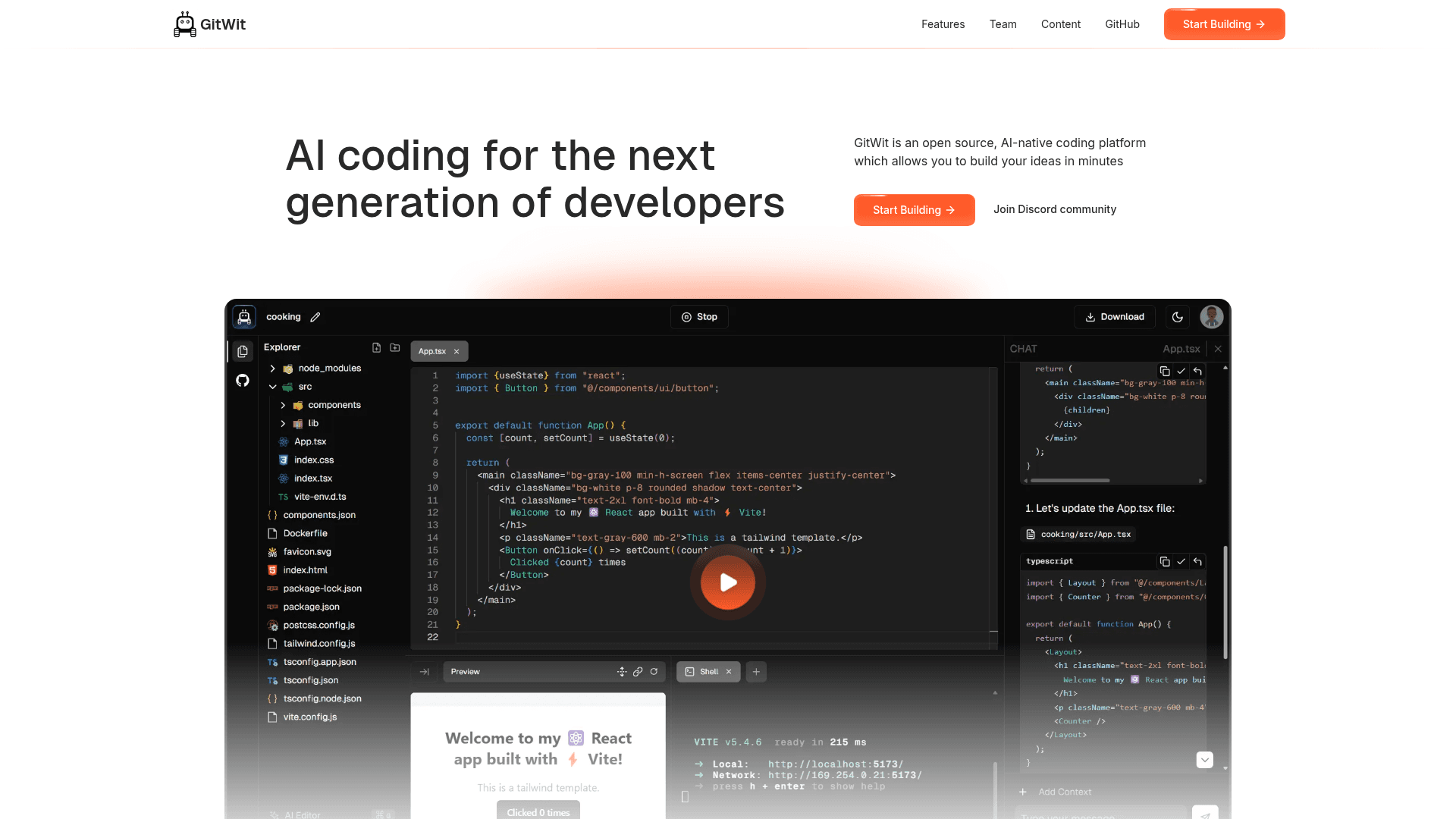
GitWit is an open-source, AI-native cloud-based code editing environment with custom AI code generation, live preview, and AI chat for building apps in minutes.
At a Glance
Free and open-source under the MIT License. Self-host on your own infrastructure.
Engagement
Available On
Listed Jul 2026
About GitWit
GitWit is an open-source, AI-native coding platform built by a decentralized team of AI engineers and full-stack developers. It provides a browser-based IDE with AI-powered code generation, live preview, and real-time collaboration, all running in secure cloud sandboxes. The project is licensed under the MIT License and hosted on GitHub under the gitwitorg organization.
What It Is
GitWit is a cloud-based code editing environment that combines a full-featured browser IDE with AI assistance and sandbox execution. Rather than requiring local setup, developers write, run, and preview code entirely in the browser. The platform targets the "next generation of developers" — people who want to go from idea to working app quickly using AI-assisted workflows.
Architecture and Tech Stack
GitWit is built as a Turborepo monorepo with a Next.js frontend (using Hono API routes) and an Express backend for WebSocket and real-time connections. Key infrastructure dependencies include:
- Clerk for user authentication
- E2B for secure sandbox terminals and live preview
- PostgreSQL for the database, managed with Drizzle ORM migrations
- Dokku (optional) for deployment of user projects to a separate server via SSH
Templates are pre-built E2B sandbox environments for React + Vite, Next.js, Vanilla JS, Streamlit (Python), PHP, and an empty starter. Node-based templates inherit from a shared base template that includes Node.js 20, git, ripgrep, fzf, and opencode.
AI Provider Support
GitWit supports multiple AI providers, configurable either at the system level (via .env) or per-user through Dashboard Settings. Supported providers include:
- Anthropic: Claude Sonnet 4.5, Haiku 4.5, Opus 4.1, Sonnet 4, Opus 4, Sonnet 3.7, Haiku 3.5
- OpenAI: GPT-4.1, GPT-4.1 Nano, GPT-4.1 Mini
- OpenRouter: Access to multiple models via a single API
- AWS Bedrock: Claude and Qwen models via AWS infrastructure
User-configured API keys are encrypted using AES-256-GCM before storage. The chat interface automatically surfaces available models based on which provider keys are configured, with a priority order of OpenRouter > Anthropic > OpenAI > AWS Bedrock.
Open-Source Community and Deployment Model
GitWit is built in the open and encourages community contribution. The team runs weekly live coding sessions on YouTube and hosts a Discord server at discord.gitwit.dev for contributors and users. The repository follows Conventional Commits formatting and uses Prettier for code style. Contributors can self-host GitWit on AWS EC2 — a video guide for AWS deployment is available on the team's YouTube channel.
The project had 62 stars and 27 forks on GitHub as of mid-2026, with active development reflected in the repository's last push in April 2026.
User Features
Beyond code editing, GitWit includes a social layer:
- Public user profiles at
/@usernameshowing public projects - Dashboard for managing sandboxes, profile info, and API keys
- Sandbox visibility controls (public/private per project)
- GitHub OAuth integration for authentication and repository linking
Community Discussions
Be the first to start a conversation about GitWit
Share your experience with GitWit, ask questions, or help others learn from your insights.
Pricing
Open Source
Free and open-source under the MIT License. Self-host on your own infrastructure.
- Full browser-based IDE
- AI code generation and chat
- Multiple AI provider support
- Pre-built project templates
- GitHub integration
Capabilities
Key Features
- Browser-based IDE with syntax highlighting and auto-completion
- AI-powered code generation and chat
- Live preview in secure cloud sandboxes
- Multiple AI provider support (Anthropic, OpenAI, OpenRouter, AWS Bedrock)
- Per-user encrypted API key management
- GitHub integration and OAuth
- Pre-built project templates (React, Next.js, Vanilla JS, Streamlit, PHP)
- Public user profiles and social features
- Sandbox visibility controls (public/private)
- Real-time collaboration via WebSocket
- Self-hostable on AWS EC2
- Deployment support via Dokku
Integrations
Demo Video