Google Agent Development Kit (ADK)
An open-source framework from Google for building, deploying, and orchestrating AI agents with multi-agent systems support.
At a Glance
Fully open-source under Apache 2.0 license. Free to use, modify, and distribute.
Engagement
Available On
Updated Jun 2026
About Google Agent Development Kit (ADK)
Agent Development Kit (ADK) is Google's open-source agent development framework, available under the Apache 2.0 license. It targets developers who need to build reliable, production-grade AI agents rather than one-off prototypes, and it ships with multi-language support across Python, TypeScript, Go, Java, and Kotlin. The framework is actively maintained on GitHub and the documentation site at adk.dev serves as the primary reference.
What It Is
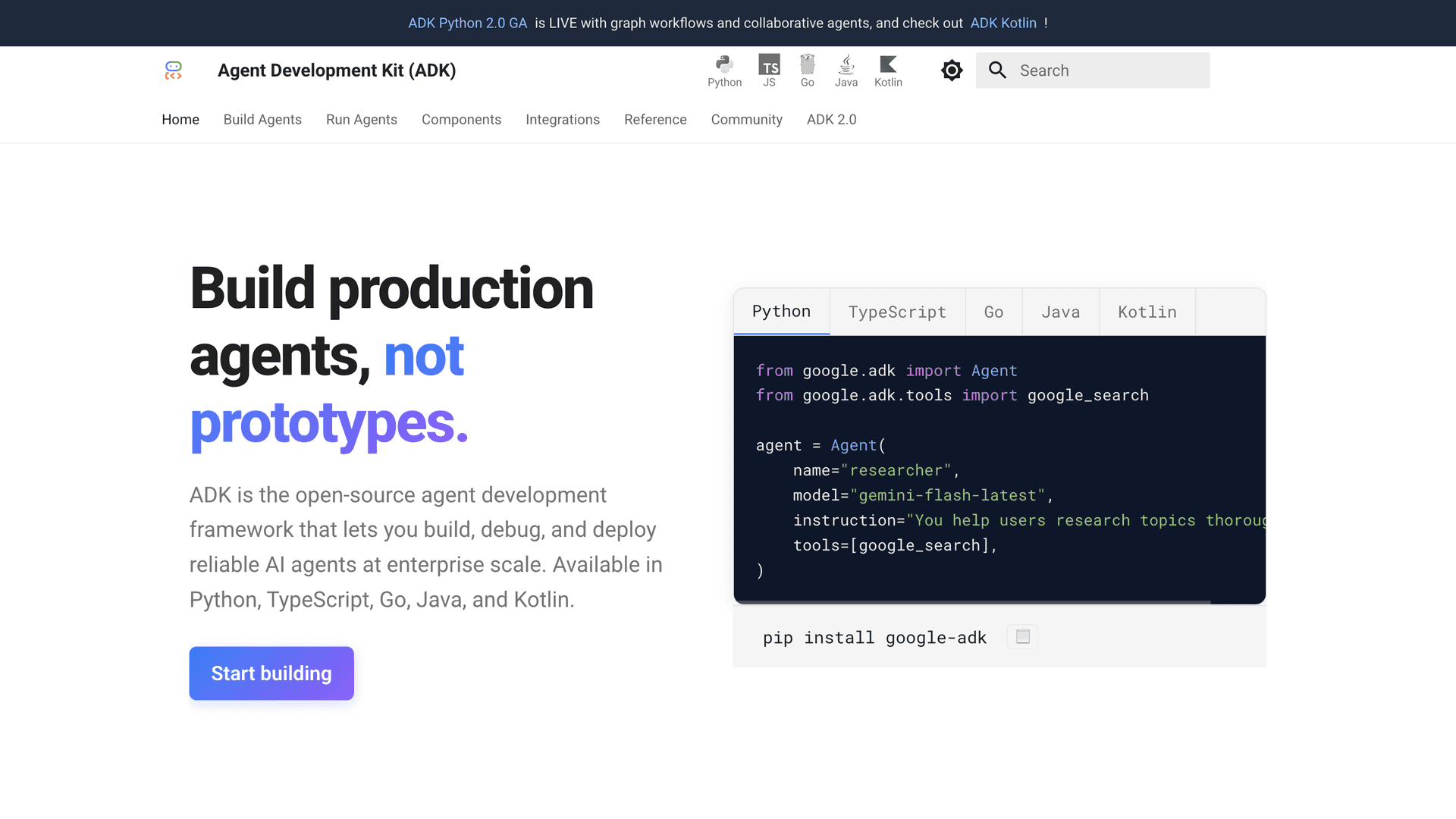
ADK is a structured framework for composing AI-powered agents and deterministic execution nodes into workflows. It handles the scaffolding that would otherwise require significant boilerplate: context management, session and memory tracking, tool calling, multi-agent orchestration, streaming, evaluation, and deployment. Developers start with a simple agent definition—a name, a model, an instruction, and a list of tools—and can progressively add complexity through graph-based workflows, collaborative multi-agent patterns, and enterprise deployment targets.
Multi-Agent Workflow Architecture
ADK supports several distinct workflow types, each suited to different complexity levels:
- Graph-based workflows (introduced in ADK 2.0): compose AI agents and deterministic nodes into a flexible execution graph with decision branching and explicit execution paths.
- Dynamic workflows: use full programmatic code logic to compose agents and nodes at runtime.
- Collaborative workflows: a single coordinator agent dynamically delegates to a set of sub-agents.
- Template workflows: pre-built sequential, loop, and parallel execution patterns extended from
BaseAgent. - Agent Routing (experimental): select between multiple agents at runtime using router functions for fallback, A/B testing, and auto-routing.
Model Access and Integrations
ADK provides first-class access to Google's Gemini and Gemma model families, and also supports Anthropic Claude, Ollama, vLLM, LiteLLM, and LiteRT-LM for local or alternative inference. For enterprises, ADK connects to models hosted on Google Cloud via Agent Runtime (Agent Platform) and Apigee AI Gateway, enabling managed performance, reliability, security, and cost controls. The open integration ecosystem connects agents with external apps, data sources, and evaluation tools through a documented integrations layer.
Context Management and Safety
The ADK documentation describes a deliberate approach to context management: rather than concatenating strings until the context window overflows, ADK treats context like source code. Sessions, memory, tool outputs, and artifacts are assembled into a structured view where the framework automatically filters irrelevant events, summarizes older conversational turns, lazy-loads artifacts, and tracks token usage. Safety and security tooling is available as a dedicated component, and callback hooks allow developers to intercept and modify agent behavior at defined points in the execution lifecycle.
Deployment and Observability
ADK is designed for "deploy anywhere" flexibility. Agents can be containerized and run on any infrastructure, or deployed with a single command to Google Cloud via Agent Runtime, Cloud Run, or GKE. Cloud deployments inherit managed infrastructure, built-in authentication, Cloud Trace observability, and enterprise-grade security without requiring changes to agent code. The observability layer includes logging, metrics, and distributed traces. An evaluation subsystem supports criteria-based testing, user simulation, environment simulation, and custom metrics, with an optimization path built on top.
Update: ADK 2.0 GA
The ADK 2.0 release, announced as generally available on the adk.dev homepage, introduced graph-based workflows and collaborative agent patterns as major new capabilities. ADK Kotlin support also launched alongside 2.0. The adk-samples repository on GitHub—which provides ready-to-use reference agents covering use cases from academic research and financial advising to supply chain and medical pre-authorization—was last pushed in June 2026, indicating active ongoing development. The repository carries the Apache 2.0 license and is explicitly noted as not an officially supported Google product, intended primarily for demonstration and development acceleration.
The adk-samples Repository
The google/adk-samples repo on GitHub is a collection of ready-to-run example agents built on ADK. Think of it as a recipe book: instead of starting from a blank file, you copy a working agent that already does something close to what you want and adapt it. The samples span the full range of complexity, from simple conversational bots to multi-agent workflows.
Agents are organized by language, with subfolders for Python, TypeScript, Go, and Java (Python is by far the most populated, covering roughly 30 agents). Examples include academic research, a financial advisor, customer service, RAG, a travel concierge, supply chain, medical pre-authorization, a blog writer, and data science and data engineering agents, among others. You need ADK installed first, then you navigate to a language subfolder for setup instructions.
The repo is licensed under Apache 2.0 and has picked up significant community traction (around 9.2k stars and 2.5k forks). Google explicitly notes it is not an officially supported product and is meant for demonstration and development acceleration, not production use as-is.
Community Discussions
Be the first to start a conversation about Google Agent Development Kit (ADK)
Share your experience with Google Agent Development Kit (ADK), ask questions, or help others learn from your insights.
Pricing
Open Source
Fully open-source under Apache 2.0 license. Free to use, modify, and distribute.
- Multi-language support: Python, TypeScript, Go, Java, Kotlin
- Graph-based and multi-agent workflows
- MCP and OpenAPI tool integration
- Gemini, Claude, Ollama, vLLM, LiteLLM model support
- Evaluation, observability, and safety tooling
Capabilities
Key Features
- Multi-language support: Python
- TypeScript
- Go
- Java
- Kotlin
- Graph-based workflows with decision branching
- Dynamic and collaborative multi-agent workflows
- Template workflows: sequential
- loop
- parallel
- Agent Routing (experimental) for fallback and A/B testing
- Gemini
- Gemma
- Claude
- Ollama
- vLLM
- LiteLLM model support
- MCP (Model Context Protocol) tool integration
- OpenAPI tool integration
- Structured context management with automatic summarization and filtering
- Session and memory management
- Artifact handling with lazy loading
- Streaming support via Gemini Live API Toolkit
- A2A (Agent-to-Agent) Protocol support
- Built-in evaluation: criteria
- user simulation
- environment simulation
- custom metrics
- Observability: logging
- metrics
- distributed traces
- Safety and security plugins
- One-command deployment to Google Cloud (Agent Runtime
- Cloud Run
- GKE)
- Web UI visual builder for agent development
- Agents CLI for AI-assisted scaffolding and deployment
- Callback hooks for agent behavior customization
- Google Search grounding
- Skills system for reusable agent capabilities