
Eve
Eve is Vercel's open-source agent framework that lets developers build, run, and scale production AI agents using a file-based convention—no infrastructure assembly required.
At a Glance
Free forever plan for personal projects and web apps on Vercel, which hosts Eve agents.
Engagement
Available On
Listed Jun 2026
About Eve
Eve is an open-source agent framework from Vercel, designed to let developers build, run, and scale AI agents in production without manually assembling infrastructure. It draws an explicit parallel to Next.js: just as a Next.js folder becomes a route by convention, an Eve file becomes an agent capability by convention, with no boilerplate or manual wiring required. The public preview is open now, and the CLI wizard gets a developer from nothing to a running local dev server in under a minute.
What It Is
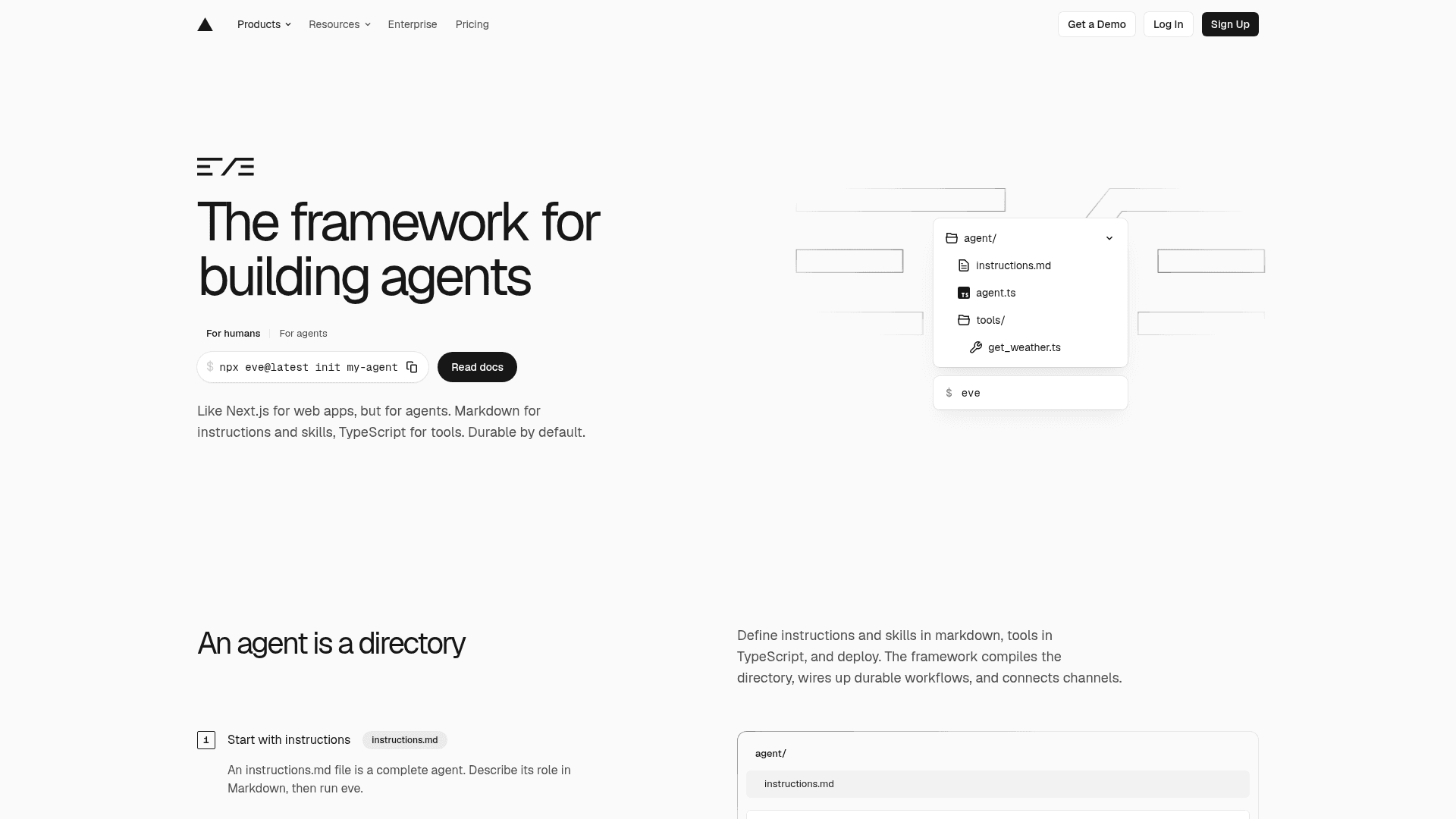
Eve is a file-first agent framework where an agent is defined as a directory of files, each describing one component of the agent's behavior. agent.ts sets the model and options; instructions.md is the system prompt prepended to every model call; files under tools/ are typed TypeScript functions using defineTool with Zod schemas; files under skills/ are markdown documents loaded contextually by the model; and subagents/, channels/, and schedules/ directories extend the agent further. Because everything is a file, the entire agent lives in Git with diffs, reviews, and history like any other codebase.
Production Infrastructure Built In
Eve ships with durable execution, a sandboxed compute environment, human-in-the-loop approvals, multi-channel support, tracing, and evals—all included by default.
- Durability is built on Vercel's open-source Workflow SDK: every conversation is checkpointed step by step, so a session can survive a crash or redeploy and resume exactly where it stopped.
- Sandboxing isolates agent-generated code from the application runtime entirely; locally it uses Docker, microsandbox, or just-bash, and in production it switches to Vercel Sandbox automatically.
- Approvals are a single field on a tool definition (
needsApproval), which can accept a function to evaluate dynamically; the agent pauses indefinitely without consuming compute until a person responds. - Tracing produces a standard OpenTelemetry span tree that exports to Braintrust, Honeycomb, Datadog, Jaeger, or any other tracing service, and surfaces in Vercel's Observability tab under "Agent Runs" when deployed.
- Evals let developers write scored test suites alongside the agent, checking tool calls, rule adherence, and expected reply content; these can run locally or be wired into CI as a deploy gate.
Connections, Channels, and Scheduling
Agents connect to external services through connection files that point at MCP servers or any OpenAPI-compatible API, with Eve brokering auth so the model never sees credentials or URLs. At launch, Vercel states supported integrations include Slack, GitHub, Snowflake, Salesforce, Notion, and Linear, plus any OAuth or API-key-protected service.
Channels work by convention: running eve channel add slack writes a single channels/slack.ts file, and the deployed agent immediately answers in Slack with platform-native UI elements like approval buttons and select menus. Schedules are one additional file with a cron expression, which on Vercel deploys automatically as a Vercel Cron Job.
How Vercel Uses Eve Internally
Vercel states it runs over a hundred agents in production on Eve today. According to Vercel's own published claims:
- d0, the most-used internal tool, handles more than 30,000 questions a month by letting any employee ask warehouse data questions in Slack, scoped to their own permissions.
- "Lead Agent", an autonomous SDR, works every inbound lead immediately and follows up independently.
- "Vertex", the support agent, resolves 92% of support tickets on its own across the help center, docs, and Slack, escalating the remaining 8% to the human team.
- "V", a routing agent, receives all Slack tasks and dispatches them to whichever specialist agent in the fleet is best suited.
Current Status: Public Preview
Eve is currently in public preview. Vercel states that a year ago agents triggered less than 3% of deployments on Vercel, and that figure has risen to around 29%, with agents expected to account for half of all deployments in the near future. Source code and discussions are public at github.com/vercel/eve, and documentation is available at eve.dev/docs, with the docs also bundled inside the npm package at node_modules/eve/docs once installed. Eve works with any model and any MCP server, and support for deployment targets beyond Vercel is described as forthcoming.
Community Discussions
Be the first to start a conversation about Eve
Share your experience with Eve, ask questions, or help others learn from your insights.
Pricing
Hobby
Free forever plan for personal projects and web apps on Vercel, which hosts Eve agents.
- Import repo and deploy in seconds
- Automatic CI/CD
- Web Application Firewall
- Global automated CDN
- Fluid compute
Pro
Everything needed to build and scale apps and agents on Vercel, including Eve deployments.
- All Hobby features
- $20 of included usage credit
- Advanced spend management
- Team collaboration & free viewer seats
- Faster builds + no queues
- Cold start prevention
- Enterprise add-ons
Enterprise
Critical security, performance, observability, platform SLAs, and support for large teams.
- All Pro features
- Guest & Team access controls
- SCIM & Directory Sync
- Managed WAF Rulesets
- Multi-region compute & failover
- 99.99% SLA
- Advanced Support
Capabilities
Key Features
- File-based agent definition (agent.ts, instructions.md, tools/, skills/)
- Durable execution with step-by-step checkpointing via Vercel Workflow SDK
- Sandboxed compute environment (Docker, microsandbox, or Vercel Sandbox in production)
- Human-in-the-loop approvals via needsApproval field on tool definitions
- Multi-channel support (Slack, and more) via convention-based channel files
- Cron-based scheduling via schedule files deployed as Vercel Cron Jobs
- MCP server and OpenAPI-compatible API connections with brokered auth
- OpenTelemetry-based tracing exportable to Braintrust, Honeycomb, Datadog, Jaeger
- Scored eval test suites runnable locally or in CI
- Preview deployments per commit with channel support
- Local dev server with terminal UI showing real-time step traces
- TypeScript tool definitions with Zod schema validation
- Skill files (markdown) loaded contextually by the model
- Subagent support via subagents/ directory
- Works with any LLM model and any MCP server