GPT Researcher
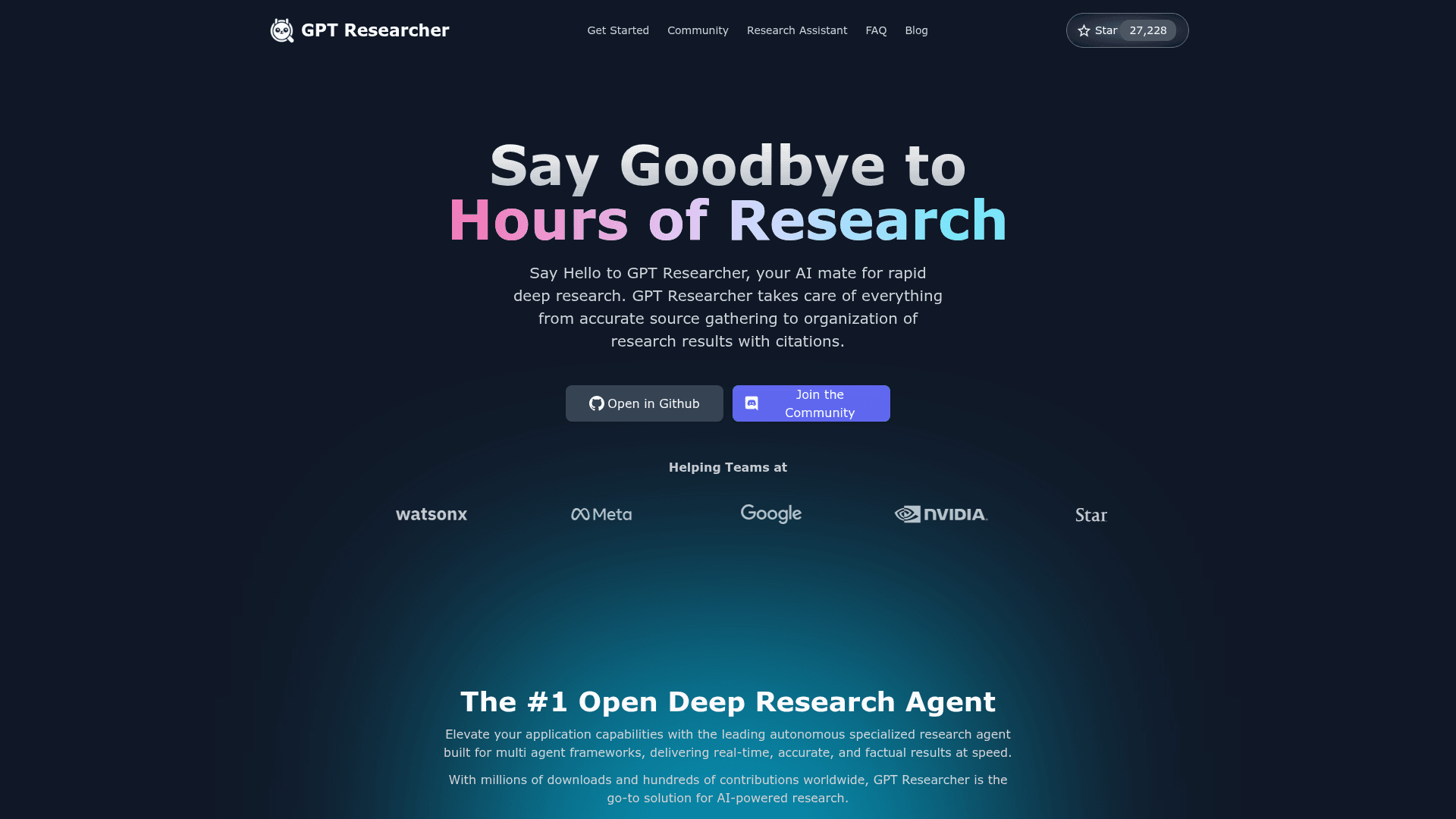
An open-source autonomous AI agent that conducts deep web and local document research, generating detailed, cited reports using any LLM and search provider.
At a Glance
About GPT Researcher
GPT Researcher is an open-source autonomous research agent built by Assaf Elovic and released under the Apache 2.0 license. It automates the full research workflow—from query planning and multi-source web scraping to summarization and report generation—producing detailed, cited reports exceeding 2,000 words. The project is available as a Python pip package, a Docker image, and an MCP server, and is actively maintained with regular releases.
What It Is
GPT Researcher is a Python-based autonomous agent designed to replace hours of manual research with a single function call. It uses a planner-executor-publisher architecture: a planner agent generates targeted research questions, execution agents crawl and summarize sources in parallel, and a publisher aggregates findings into a structured report. The project describes itself as "the first open deep research agent designed for both web and local research on any given task," and is inspired by the Plan-and-Solve and RAG research papers.
Architecture and How It Works
The core workflow follows five steps:
- A task-specific agent is created from the research query.
- The planner generates sub-questions that collectively address the topic objectively.
- Crawler agents gather information for each sub-question from multiple sources.
- Each source is summarized and tracked with citations.
- Summaries are filtered and aggregated into a final report.
The system supports parallelized agent execution to reduce research time and aggregates over 20 sources per query to reduce bias and misinformation. A Deep Research mode adds a recursive, tree-like exploration pattern with configurable depth and breadth, taking approximately 5 minutes per run.
Flexibility and Integrations
GPT Researcher is designed to be LLM- and retriever-agnostic. The project states support for over 100 LLMs including OpenAI GPT-4o, Anthropic Claude, Google Gemini, Meta Llama, DeepSeek, and Hugging Face models. Supported retrievers include Tavily, Bing, Google CSE, DuckDuckGo, SearXNG, and Arxiv. Additional integrations include:
- MCP (Model Context Protocol): Connects to GitHub repositories, databases, and custom APIs for hybrid web + local research.
- LangGraph and AG2: Multi-agent frameworks for collaborative research workflows, inspired by the STORM paper.
- LangSmith: Observability and tracing for multi-agent runs.
- Google Gemini: AI-generated inline images embedded in reports (Nano Banana feature).
Local document research supports PDF, plain text, CSV, Excel, Markdown, PowerPoint, and Word formats. Reports can be exported to PDF, Word, Markdown, JSON, and CSV.
Deployment Options
Users can run GPT Researcher in several ways:
- pip install:
pip install gpt-researcherfor programmatic use in Python applications. - Docker: Official Docker image available on Docker Hub via
docker-compose up --build, spinning up a Python backend on port 8000 and a React frontend on port 3000. - Frontend: A lightweight HTML/CSS/JS static frontend served by FastAPI, or a production-ready NextJS + Tailwind application.
- Claude Skill: Installable as a Claude skill via
npx skills add assafelovic/gpt-researcher. - MCP Server: A dedicated
gptr-mcprepository enables AI assistants like Claude Desktop to invoke deep research directly.
There is no first-party hosted SaaS offering. All compute costs are paid directly to the user's chosen LLM and retriever providers.
Academic Recognition and Community Signal
The project's homepage cites Carnegie Mellon University's DeepResearchGym benchmark (May 2025), which according to the vendor evaluated leading deep research systems on 1,000 complex queries and ranked GPT Researcher first in citation quality, report quality, and information coverage, outperforming Perplexity, OpenAI, OpenDeepSearch, and HuggingFace. The project has also been cited in multiple peer-reviewed arXiv papers through 2024–2025. The GitHub repository shows 27,210 stars and 3,658 forks as of the last recorded update.
Update: v3.4.4
The latest release is v3.4.4, published on April 16, 2026. The repository was last pushed on the same date and remains actively maintained on the main branch. Recent feature additions documented in the README include AI-generated inline images via Google Gemini, MCP client integration for hybrid research, and the Deep Research recursive workflow mode. The project roadmap is tracked publicly on Trello, and community contributions are coordinated via Discord.
Community Discussions
Be the first to start a conversation about GPT Researcher
Share your experience with GPT Researcher, ask questions, or help others learn from your insights.
Pricing
Open Source
Full GPT Researcher Python package, self-hosted on your own infrastructure. MIT licensed with no usage limits imposed by the project.
- Full GPT Researcher Python package on PyPI
- Official gptr-mcp Model Context Protocol server
- Self-host on your own machine, server, or container
- Use any supported LLM and any supported retriever
- MIT license
Capabilities
Key Features
- Autonomous multi-source web research
- Local document research (PDF, CSV, Excel, Word, Markdown, PowerPoint)
- Deep Research recursive tree-like exploration
- Generates reports exceeding 2,000 words with citations
- Aggregates 20+ sources per query
- Supports 100+ LLMs (OpenAI, Claude, Gemini, Llama, DeepSeek, etc.)
- Supports multiple retrievers (Tavily, Bing, Google CSE, DuckDuckGo, SearXNG, Arxiv)
- Export to PDF, Word, Markdown, JSON, CSV
- MCP client and server integration
- Multi-agent support via LangGraph and AG2
- AI-generated inline images via Google Gemini
- LangSmith observability and tracing
- JavaScript-enabled web scraping
- Smart image scraping and filtering
- Frontend available in lightweight and NextJS versions
- Docker deployment support
- Claude Skill integration
Integrations
Demo Video