
GPT-SoVITS
Open-source few-shot voice cloning and text-to-speech WebUI that trains voice models from about one minute of audio.
At a Glance
Self-hosted GPT-SoVITS core released under the MIT License; free to use, copy, modify, and distribute.
Engagement
Available On
Listed Nov 2026
About GPT-SoVITS
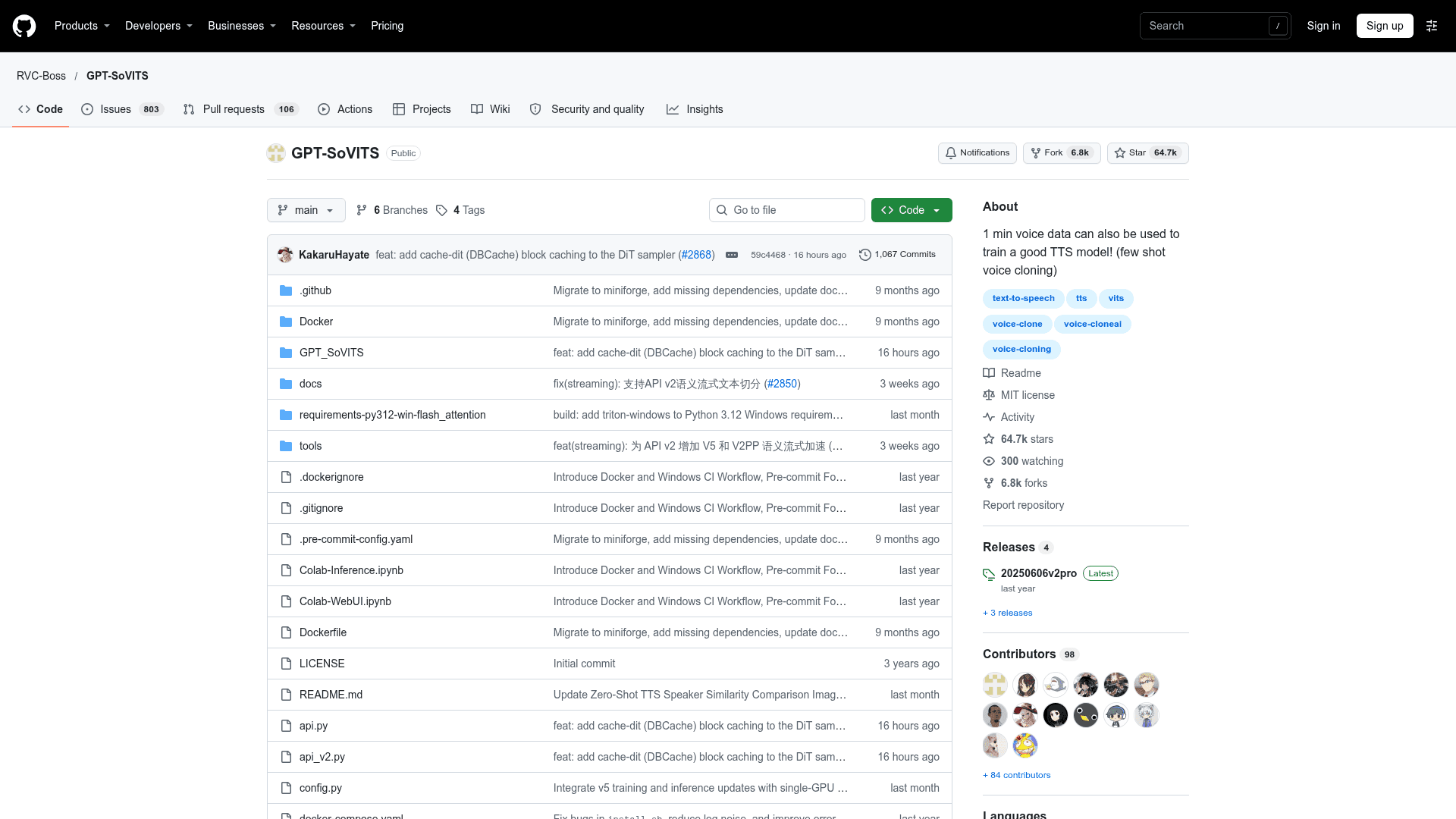
GPT-SoVITS is an open-source WebUI for few-shot voice cloning and text-to-speech, published on GitHub by RVC-Boss under the MIT license. It can synthesize speech from a 5-second vocal sample or fine-tune a model on about one minute of training data. The repository includes integrated tools for preparing datasets and running inference.
What It Is
GPT-SoVITS is a Python-based text-to-speech and voice conversion toolkit with a browser-based interface. Users provide reference or training audio, and the system produces speech in the target voice. The README documents cross-lingual inference in English, Japanese, Korean, Cantonese and Chinese, meaning the inference language can differ from the training data language.
Dataset Preparation and Fine-tuning Workflow
The WebUI bundles tools for vocal and accompaniment separation (UVR5), automatic audio slicing, optional denoising, ASR transcription (Chinese ASR, plus Faster Whisper for English and Japanese), and text labeling. The documented fine-tuning path is: fill in the audio path, slice the audio, optionally denoise, run ASR, proofread the transcriptions, and then fine-tune in the next tab. Annotation uses a .list file with the format vocal_path|speaker_name|language|text.
Model Versions
The README documents several model generations. V2 added Korean and Cantonese support and extended pretraining from 2k to 5k hours. V3 improved timbre similarity, and V4 natively outputs 48k audio and fixes metallic artifacts present in V3. V2Pro and V5 follow, with V5 adding cuda_graph and flash_attention inference acceleration. The README reports an RTF of 0.028 on a 4060Ti for v2 ProPlus.
Setup Path
Installation options include a Windows integrated package launched with go-webui.bat, install scripts for Windows, Linux and macOS, manual installation, and Docker Compose images (full and Lite). Supported devices include CUDA, ROCm, Apple silicon (MPS) and CPU. The README notes that models trained on Mac GPUs show significantly lower quality, so CPU is used for training there. A Colab training notebook is also provided.
Community Discussions
Be the first to start a conversation about GPT-SoVITS
Share your experience with GPT-SoVITS, ask questions, or help others learn from your insights.
Pricing
Open Source (MIT)
Self-hosted GPT-SoVITS core released under the MIT License; free to use, copy, modify, and distribute.
- MIT License
- Zero-shot TTS from a 5-second vocal sample
- Few-shot TTS fine-tuning with 1 minute of training data
- Cross-lingual inference (English, Japanese, Korean, Cantonese, Chinese)
- WebUI tools: vocal accompaniment separation, automatic training set segmentation, Chinese ASR, text labeling
Capabilities
Key Features
- Zero-shot TTS from a 5-second vocal sample
- Few-shot fine-tuning with about 1 minute of training data
- Cross-lingual inference in English, Japanese, Korean, Cantonese and Chinese
- Vocal and accompaniment separation (UVR5)
- Automatic audio slicing for training sets
- ASR transcription via FunASR and Faster Whisper
- Text labeling and proofreading tools
- TTS speaking speed control
- Docker images and Colab training notebook
- Multiple model versions (v1, v2, v3, v4, v2Pro, v5)