gptme
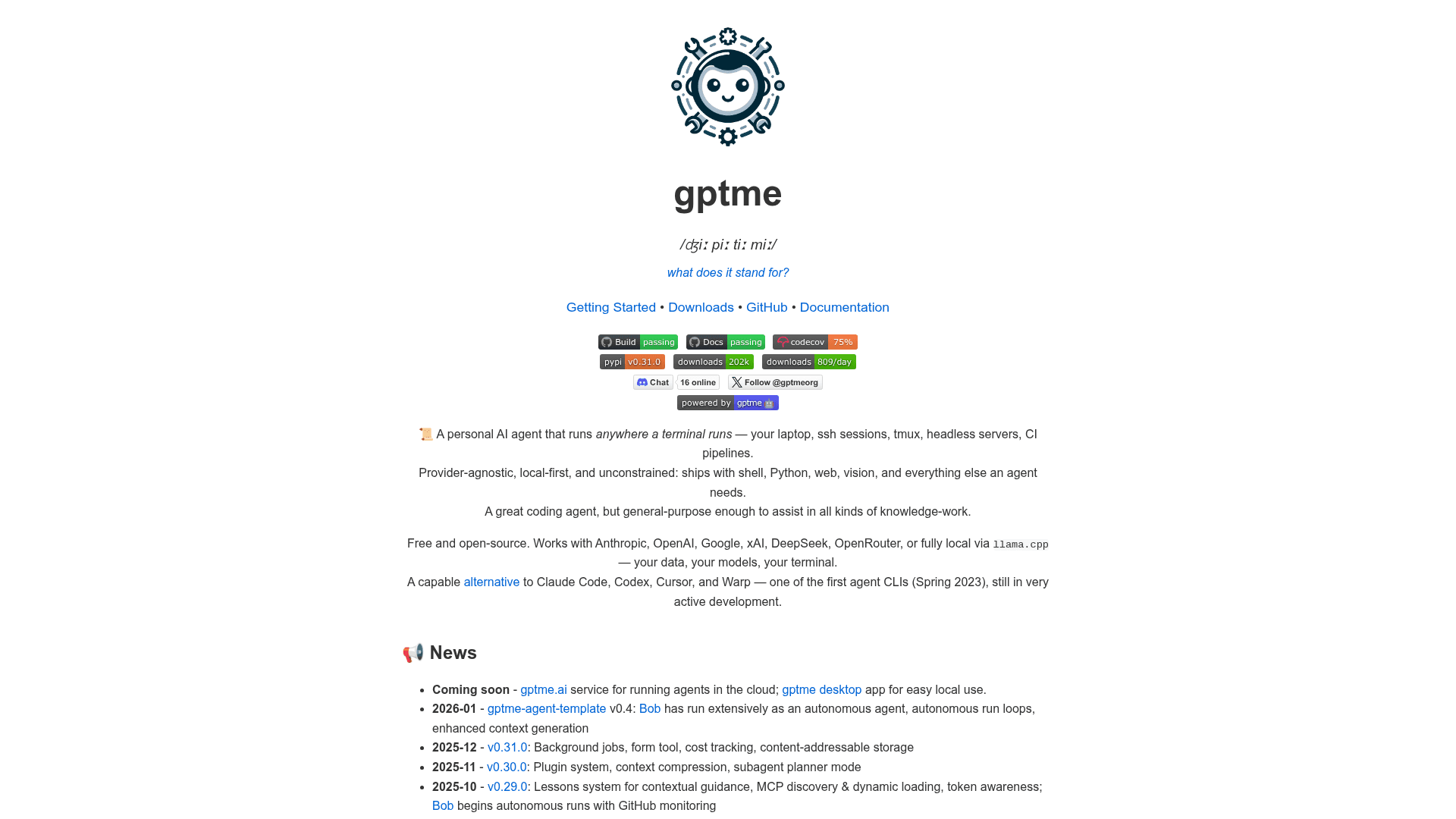
A free, open-source personal AI agent that runs in any terminal, equipped with shell, Python, web browsing, vision, and autonomous agent capabilities.
At a Glance
Fully free and open-source under the MIT License. Install via pip or pipx.
Engagement
Available On
Listed Jun 2026
About gptme
gptme is a free and open-source personal AI agent that runs anywhere a terminal runs — laptops, SSH sessions, tmux, headless servers, and CI pipelines. Created in Spring 2023 by Erik Bjäreholt, it is provider-agnostic and local-first, shipping with shell, Python, web browsing, vision, and everything else an agent needs. The project is licensed under the MIT License and available on GitHub under the gptme organization.
What It Is
gptme is a CLI-based AI agent framework in the category of autonomous coding and knowledge-work assistants. Its core job is to let users interact with large language models through a terminal while giving those models real tools to act on the local environment — executing shell commands, reading and writing files, browsing the web, taking screenshots, and spawning sub-agents. Unlike IDE-centric tools, gptme is designed to work in any environment where a terminal is available, including fully headless and automated contexts.
Built-In Toolset
gptme ships with a rich set of built-in tools that the AI can invoke during a conversation:
- shell — execute shell commands directly in the terminal
- ipython — run Python code with access to installed libraries
- read / save / append — read and write files and directories
- patch / morph — make incremental or fast edits to existing files
- browser — search and navigate the web via Playwright
- vision / screenshot — process images and capture desktop screenshots
- rag — retrieve context from local files using Retrieval Augmented Generation
- gh — interact with GitHub via the GitHub CLI
- tmux — run long-lived commands in persistent terminal sessions
- computer — full desktop access for GUI interactions
- subagent — spawn sub-agents for parallel or isolated tasks
- chats — reference and search past conversations
Provider Agnosticism and Local-First Design
gptme supports Anthropic (Claude), OpenAI (GPT), Google (Gemini), xAI (Grok), DeepSeek, and OpenRouter as LLM providers. It also supports fully local inference via llama.cpp with no API key required. Model routing lets users assign fast or cheap models to triage tasks and more powerful models to coding work. This local-first architecture means user data and models stay under user control.
Autonomous Agent Architecture
Beyond interactive use, gptme is designed to run as a persistent autonomous agent. The gptme-agent-template provides a complete scaffold including a git-tracked workspace ("brain") with journal, tasks, knowledge base, and lessons; scheduled or event-driven run loops via systemd or launchd; structured task queues with GTD-style workflows; and multi-agent coordination through file leases and a message bus. The project's reference implementation, "Bob," has been running continuously since late 2024, opening PRs, reviewing code, fixing CI, and posting on social media.
Extensibility: Plugins, Skills, Lessons, and MCP
gptme has a layered extensibility system. Plugins extend the tool with custom tools, hooks, and commands via Python packages. Skills are lightweight workflow bundles that auto-load when mentioned by name. Lessons inject contextual guidance into conversations based on keywords, tools, and patterns. Hooks run custom code at lifecycle events without requiring a full plugin. The community-contributed gptme-contrib repository includes plugins for multi-model consensus, image generation, Language Server Protocol integration, and work-state persistence. gptme also has built-in MCP (Model Context Protocol) support for dynamic discovery and loading of MCP servers, and ACP (Agent Client Protocol) support for use as a drop-in coding agent in Zed and JetBrains IDEs.
Update: v0.31.0
The latest release is v0.31.0, published on December 15, 2025. It added background jobs, a form tool, cost tracking, and content-addressable storage. Prior notable releases include v0.30.0 (plugin system, context compression, subagent planner mode), v0.29.0 (lessons system, MCP discovery and dynamic loading, token awareness), and v0.28.0 (MCP support, morph tool, auto-commit, redesigned server API). A managed cloud service at gptme.ai and a desktop app (gptme-tauri) are listed as coming soon on the project homepage.
Community Discussions
Be the first to start a conversation about gptme
Share your experience with gptme, ask questions, or help others learn from your insights.
Pricing
Open Source
Fully free and open-source under the MIT License. Install via pip or pipx.
- Shell, Python, browser, vision, and file tools
- Support for Anthropic, OpenAI, Google, xAI, DeepSeek, OpenRouter, and local models
- MCP and ACP support
- Plugin, Skills, and Lessons extensibility system
- Autonomous agent mode
Capabilities
Key Features
- Shell command execution
- Python code execution
- Web browsing via Playwright
- Vision and screenshot capture
- File read/write/patch/morph
- RAG for local files
- GitHub CLI integration
- tmux session management
- Computer use (full desktop access)
- Sub-agent spawning
- Autonomous agent mode
- Persistent agent workspace
- Multi-agent coordination
- MCP (Model Context Protocol) support
- ACP (Agent Client Protocol) support
- Plugin system
- Skills and Lessons system
- Hooks for lifecycle events
- Model routing
- Self-correcting output loop
- Web UI and REST API
- Non-interactive/CI mode
- JSONL machine-readable output
- Cost tracking
- Context compression
- Pre-commit integration
- Local inference via llama.cpp
- OpenRouter multi-provider gateway