
Graphiti
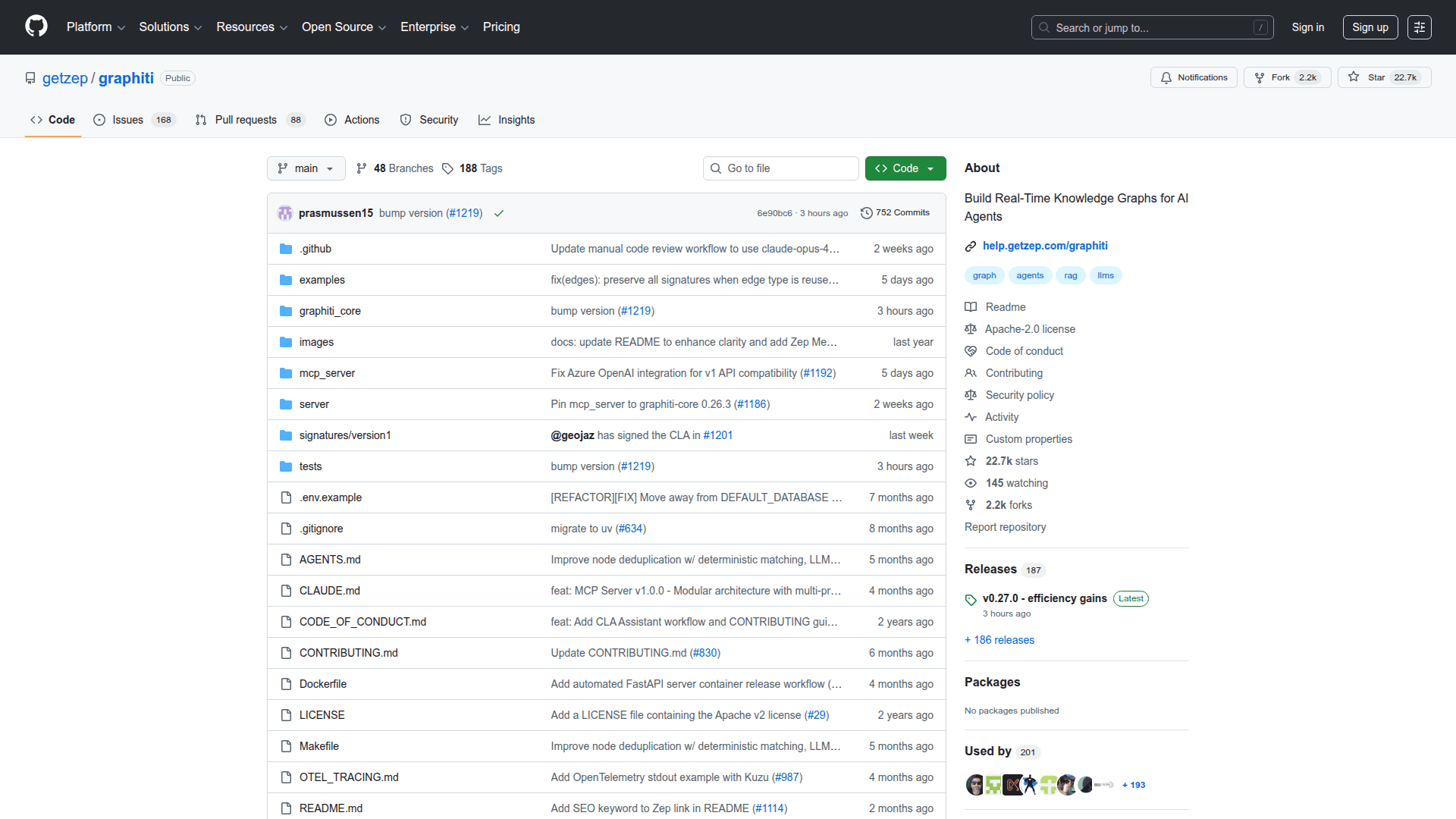
A Python library for building and querying dynamic, temporally-aware knowledge graphs for AI agents and RAG applications.
At a Glance
About Graphiti
Graphiti is an open-source Python library developed by Zep that enables developers to build and query dynamic, temporally-aware knowledge graphs. Designed specifically for AI agents and retrieval-augmented generation (RAG) applications, Graphiti provides a framework for creating knowledge graphs that can evolve over time while maintaining temporal context and relationships between entities.
The library addresses the challenge of managing complex, time-sensitive information in AI systems by offering a structured approach to knowledge representation that goes beyond traditional vector databases. Graphiti allows developers to capture not just static facts but also how information changes and relates across different time periods.
-
Temporal Awareness enables the knowledge graph to track when facts were added, modified, or became obsolete, allowing AI agents to reason about information in its proper temporal context.
-
Dynamic Graph Construction supports incremental updates to the knowledge graph, making it suitable for applications where information continuously evolves rather than remaining static.
-
Entity and Relationship Extraction automatically identifies entities and their relationships from unstructured text, building structured knowledge representations that can be queried efficiently.
-
Hybrid Search Capabilities combines graph traversal with semantic search, enabling more nuanced and context-aware information retrieval compared to pure vector similarity approaches.
-
Integration with LLMs works seamlessly with large language models to enhance both the construction and querying of knowledge graphs, leveraging AI for entity resolution and relationship inference.
-
Python-Native Design provides a clean, Pythonic API that integrates easily with existing AI and machine learning workflows, including popular frameworks and tools.
To get started with Graphiti, install the library via pip and configure your graph database connection. The library supports Neo4j as its primary graph database backend. Define your entity types and relationships, then use the provided APIs to ingest documents and build your knowledge graph incrementally. Query the graph using natural language or structured queries to retrieve relevant information for your AI applications.
Community Discussions
Be the first to start a conversation about Graphiti
Share your experience with Graphiti, ask questions, or help others learn from your insights.
Pricing
Open Source
Free open-source library available on GitHub
- Full library access
- Temporal knowledge graphs
- Entity extraction
- Neo4j integration
- Community support
Capabilities
Key Features
- Temporal-aware knowledge graphs
- Dynamic graph construction
- Entity and relationship extraction
- Hybrid search capabilities
- LLM integration
- Incremental graph updates
- Neo4j database support
- Python-native API
- RAG application support
- AI agent memory management