EveryDev.ai
Subscribe
Home
Tools

4,805+ AI tools

  • New
  • Trending
  • Featured
  • Rate tools
  • Compare
  • Arena
Categories
  • Agents2438
  • Coding1795
  • Infrastructure838
  • Projects691
  • Research588
  • MCP558
  • Marketing486
  • Analytics469
  • Design397
  • Testing387
  • Data357
  • Security299
  • Integration249
  • Communication238
  • Prompts231
  • Extensions216
  • Commerce167
  • Voice162
  • DevOps161
  • Web117
  • Learning113
  • Finance33
AI Tools by Topic
  • AI Coding Assistants
  • Agent Frameworks
  • MCP Servers
  • AI Prompt Tools
  • Vibe Coding Tools
  • AI Design Tools
  • AI Database Tools
  • AI Website Builders
  • AI Testing Tools
  • LLM Evaluations
Follow Us
  • X / Twitter
  • LinkedIn
  • Reddit
  • Discord
  • Threads
  • Bluesky
  • Mastodon
  • YouTube
  • GitHub
  • Instagram
Get Started
  • Users
  • Rate Tools
  • About
  • Editorial Standards
  • Corrections & Disclosures
  • Community Guidelines
  • Advertise
  • Contact Us
  • Newsletter
  • Submit a Tool
  • Start a Discussion
  • Write A Blog
  • Share A Build
  • Terms of Service
  • Privacy Policy
Explore with AI
  • ChatGPT
  • Gemini
  • Claude
  • Grok
  • Perplexity
Agent Experience
  • llms.txt
Theme
With AI, Everyone is a Dev. EveryDev.ai ©
    1. Home
    2. Tools
    3. GraphRAG
    GraphRAG icon

    GraphRAG

    Knowledge Management
    Featured

    A modular graph-based Retrieval-Augmented Generation system from Microsoft that extracts knowledge graphs from unstructured text to improve LLM question answering.

    Visit Website

    At a Glance

    Pricing
    Open Source

    GraphRAG core is released under the MIT License and is free to use, copy, modify and distribute. LLM inference costs (e.g., model API usage) are external and not charged by the project.

    Engagement

    Available On

    Windows
    Android
    API
    SDK
    CLI

    Resources

    WebsiteDocsGitHubllms.txt

    Topics

    Knowledge ManagementRetrieval-Augmented GenerationAI Development Libraries

    Alternatives

    post-graph-ragEdgeQuakeAutoFlow
    Developer
    Microsoft ResearchRedmond, WAEst. 1991$32.5B raised

    Listed Oct 2026

    About GraphRAG

    GraphRAG is a Microsoft Research project that turns unstructured text into a knowledge graph and uses it to give LLMs better context when answering questions about private data. It ships as a Python data pipeline with a command-line interface, indexing and query packages, and prompt tuning guidance. The README notes the project is largely in maintenance mode, with bug fixes and dependency updates but no new features or PRs, and describes the code as a demonstration rather than an officially supported Microsoft offering.

    What It Is

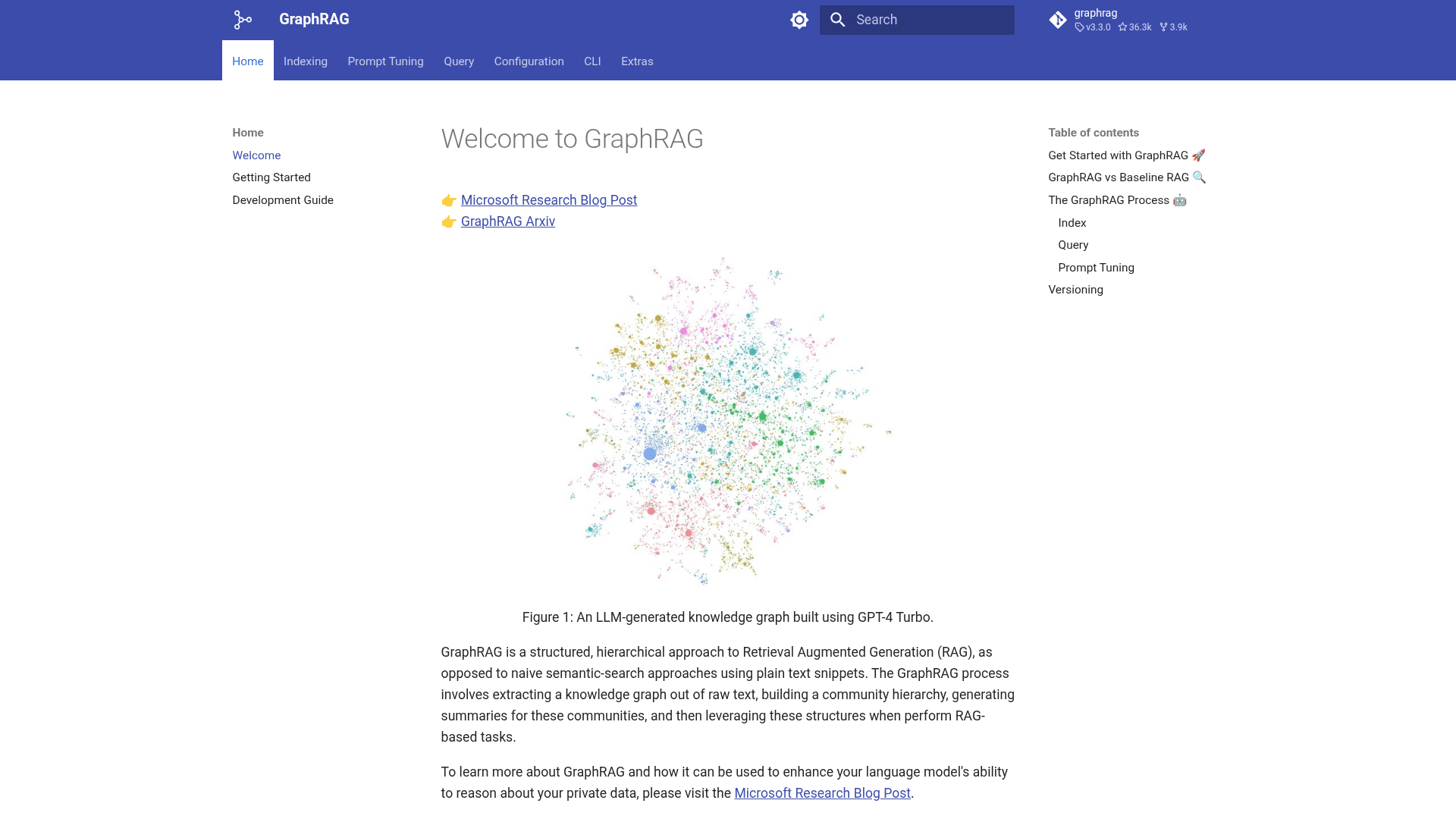
    GraphRAG is a structured, hierarchical approach to Retrieval Augmented Generation, as opposed to baseline RAG that relies on vector similarity over plain text snippets. The project describes itself as a data pipeline and transformation suite for extracting structured data from unstructured text using LLMs. The documentation says that baseline RAG struggles to connect disparate pieces of information and to holistically understand large collections, and that GraphRAG is designed to address these two kinds of questions.

    How the Indexing Pipeline Works

    The index step slices an input corpus into TextUnits, which serve as analyzable units and provide fine-grained references in outputs. It then extracts entities, relationships, and key claims from those units. The graph is clustered hierarchically with the Leiden technique, and summaries are generated for each community from the bottom up. Docs also cover indexing methods, inputs, outputs, and bringing your own graph.

    Query Modes

    At query time, these structures supply context to the LLM. Global Search uses community summaries to reason about holistic questions over the corpus. Local Search fans out from specific entities to their neighbors and associated concepts. DRIFT Search does similar entity-focused reasoning but adds community information. Basic Search handles queries best answered by standard top-k vector search. Question generation is also documented.

    Setup and Tuning

    The recommended starting point is the command line quickstart. Configuration is created with the init command and documented in detailed YAML settings and language model selection pages. The docs strongly recommend prompt tuning, with auto and manual tuning guides, since out-of-the-box results may not be optimal. Indexing can be expensive, so the README advises starting small. Between minor versions, users should rerun the init command with force, and a migration notebook is provided for major version bumps.

    Current Status

    The latest release listed is v3.3.0. The repository is MIT licensed and states it is in maintenance mode, focused on bug fixes, dependency updates, and CVE responses.
    GraphRAG - 1

    Community Discussions

    Be the first to start a conversation about GraphRAG

    Share your experience with GraphRAG, ask questions, or help others learn from your insights.

    Pricing

    OPEN SOURCE

    Open Source (MIT)

    GraphRAG core is released under the MIT License and is free to use, copy, modify and distribute. LLM inference costs (e.g., model API usage) are external and not charged by the project.

    • MIT License
    • Self-hosted Python data pipeline and transformation suite
    • Indexing, Global/Local/DRIFT/Basic search, prompt tuning
    • Project is in maintenance mode; demonstration code, not an officially supported Microsoft offering
    • Indexing can be expensive due to LLM usage costs

    Capabilities

    Key Features

    • Knowledge graph extraction from unstructured text
    • Entity, relationship, and claim extraction from TextUnits
    • Hierarchical Leiden community clustering
    • Bottom-up community summaries
    • Global Search
    • Local Search
    • DRIFT Search
    • Basic Search (vector top-k)
    • Question generation
    • Auto and manual prompt tuning
    • Bring your own graph
    • YAML configuration and init command
    • Command line interface
    • Example notebooks and visualization guide
    API Available
    View Docs

    Ratings & Reviews

    No ratings yet

    Be the first to rate GraphRAG and help others make informed decisions.

    Rate other tools you’ve used

    Developer

    Microsoft Research

    Microsoft Research advances the state of the art in computer science and related fields through fundamental research and applied innovation. The team behind AutoGen focuses on building frameworks that enable developers to create sophisticated AI applications with multiple collaborating agents. Microsoft Research publishes open-source tools and conducts cutting-edge research across AI, systems, and human-computer interaction.

    Founded 1991
    Redmond, WA
    $32.5B raised
    1,000 employees

    Used by

    Microsoft product teams and Microsoft…
    Xbox Games Studios and Ninja Theory…
    National University of Singapore…
    BKW (Aurora 1.5 proof point through…
    Read more about Microsoft Research
    WebsiteGitHubLinkedInX / Twitter
    11 tools in directory

    Similar Tools

    post-graph-rag icon

    post-graph-rag

    An open-source Graph RAG library that runs entirely on PostgreSQL, using bi-temporal supersession to close contradicted facts and controlled predicate vocabularies to make graph edges queryable.

    EdgeQuake icon

    EdgeQuake

    Open-source Rust Graph-RAG framework that turns documents into knowledge graphs and answers queries with sources on PostgreSQL.

    AutoFlow icon

    AutoFlow

    An open-source Graph RAG-based conversational knowledge base tool built on TiDB Vector Storage, LlamaIndex, and DSPy.

    Browse all tools

    Related Topics

    Knowledge Management

    AI-powered systems for organizing, discovering, and accessing collective team knowledge with intelligent search, tagging, and contextual recommendations across knowledge bases and wikis.

    192 tools

    Retrieval-Augmented Generation

    RAG Systems that enhance LLM outputs by retrieving relevant information from external knowledge bases, combining the power of generative AI with information retrieval for more accurate and contextual responses.

    169 tools

    AI Development Libraries

    Programming libraries and frameworks that provide machine learning capabilities, model integration, and AI functionality for developers.

    441 tools
    Browse all topics
    Back to all toolsSuggest an edit
    ratings
    discussions