
H3 Image MLX
Local MiniMax H3 Image generation and multi-image editing on Apple Silicon Macs using MLX, via a CLI and Python API.
At a Glance
Apache-2.0 licensed runtime code for local MiniMax H3 Image generation and editing on Apple Silicon via MLX. The MiniMax H3 Image model weights are under a separate MiniMax license with regional and usage restrictions.
Engagement
Available On
Alternatives
Listed Nov 2026
About H3 Image MLX
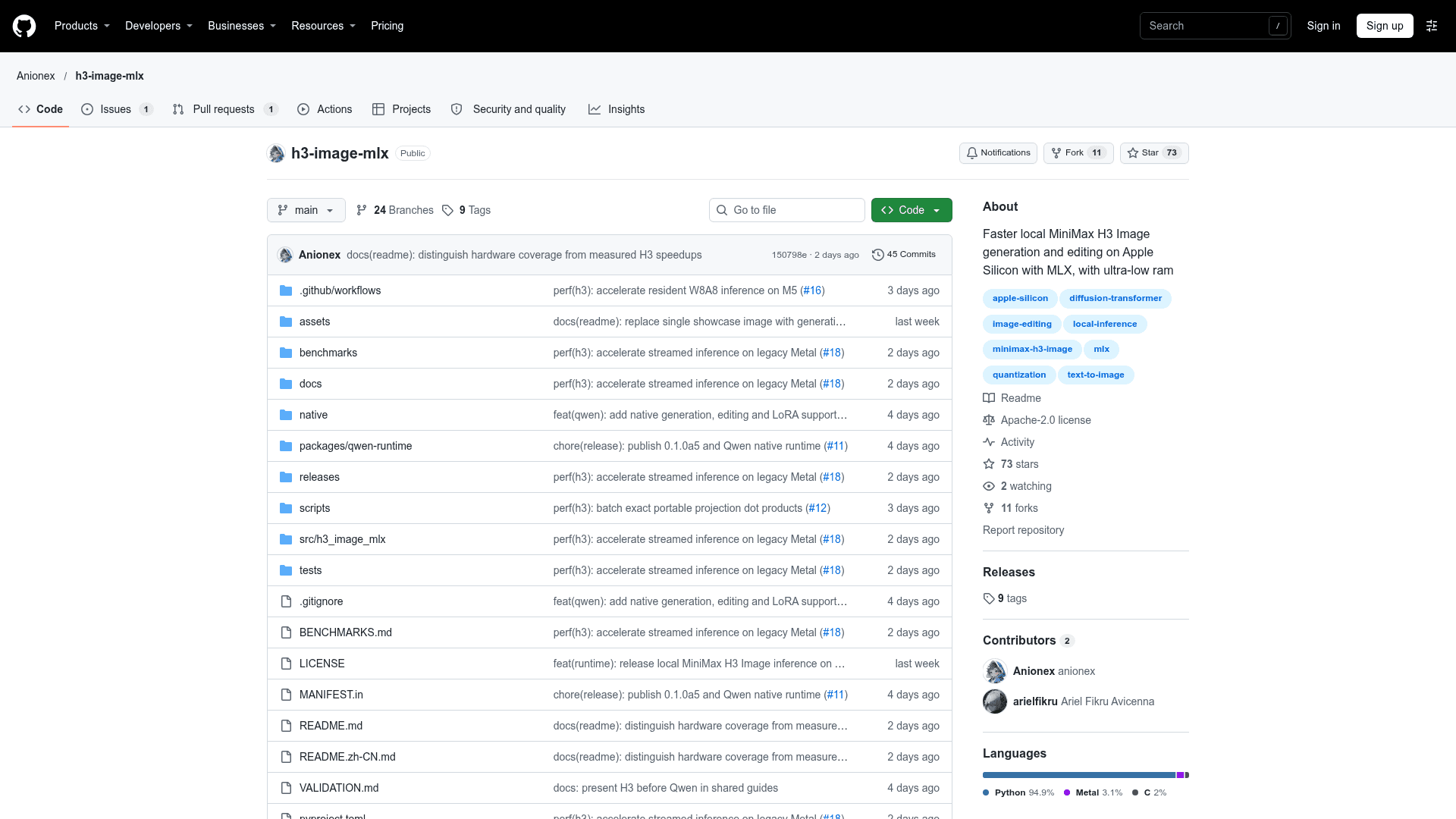
H3 Image MLX is an open-source runtime by Anionex that runs MiniMax H3 Image text-to-image generation and reference-image editing locally on Apple Silicon Macs using MLX. It is available as a Python package with a command-line interface and a Python API. The README says it is optimized for fast inference, with 4K generation using around 7 GB of peak inference-process memory.
What It Is
H3 Image MLX is a local inference tool for the MiniMax H3 Image diffusion model. Users install the package from PyPI, fetch the model weights, and generate PNG images from text prompts. Output sizes range from 256 to 4096 pixels per side in multiples of 32. It can also edit images from up to 16 reference pictures, which the prompt addresses by number (for example, <Picture 1>).
How It Reduces Memory
The pipeline splits work into separate processes for text encoding, denoising, and VAE decoding. Each stage releases its memory before the next one starts, and editing adds a reference-image encoding stage. It reads Comfy-Org's INT8 weights with W8A8 quantization. In stream mode it loads denoiser weights block by block, and optional prefetch and async switches overlap weight reads with GPU computation. The VAE decodes in overlapping tiles to limit memory at high resolutions.
Hardware and Backends
M5 and M6 chips use W8A8 Metal TensorOps by default, while M1–M4 use the portable MLX backend. On M1–M4 Macs running macOS earlier than 26.4, release a9 uses tiled Metal projections for streamed INT8. A resident mode keeps denoiser weights in memory between steps. BF16 weights are also supported through a --precision bf16 option, and INT8 is the default.
Performance Notes
The README reports same-machine benchmarks. In one test on an M5 Pro, streaming with prefetch and async matched resident-mode speed (23.61 s vs 23.63 s at 1024×1024) while lowering peak process memory from 21.18 GB to 3.23 GB. It also reports comparisons against a ComfyUI pipeline on the same machine. Optional experimental few-step LoRA inference is available on the GitHub main branch and is off by default.
Setup Path
The tool requires Python 3.11 or later and a Mac with Metal. A fresh model download needs 49.30 GB of disk space. The MiniMax model license may carry regional and usage restrictions. The runtime code is Apache-2.0, and the bundled Metal kernels are MIT-licensed.
Community Discussions
Be the first to start a conversation about H3 Image MLX
Share your experience with H3 Image MLX, ask questions, or help others learn from your insights.
Pricing
Open Source
Apache-2.0 licensed runtime code for local MiniMax H3 Image generation and editing on Apple Silicon via MLX. The MiniMax H3 Image model weights are under a separate MiniMax license with regional and usage restrictions.
- Runtime code licensed Apache-2.0
- Three W8A8 Metal kernel files retain MIT license
- CLI and Python API
- Text-to-image generation and multi-image editing
- Runs locally on Apple Silicon Mac with Metal
Capabilities
Key Features
- Local text-to-image generation on Apple Silicon
- Multi-image editing with up to 16 reference images
- W8A8 INT8 quantization with Metal acceleration
- Staged multi-process inference
- Streamed denoiser weight loading with prefetch and async evaluation
- Overlapping-tile VAE decoding
- Output sizes from 256 to 4096 pixels per side
- Optional BF16 weights
- CLI and Python API
- Experimental few-step LoRA inference