
Hallmark
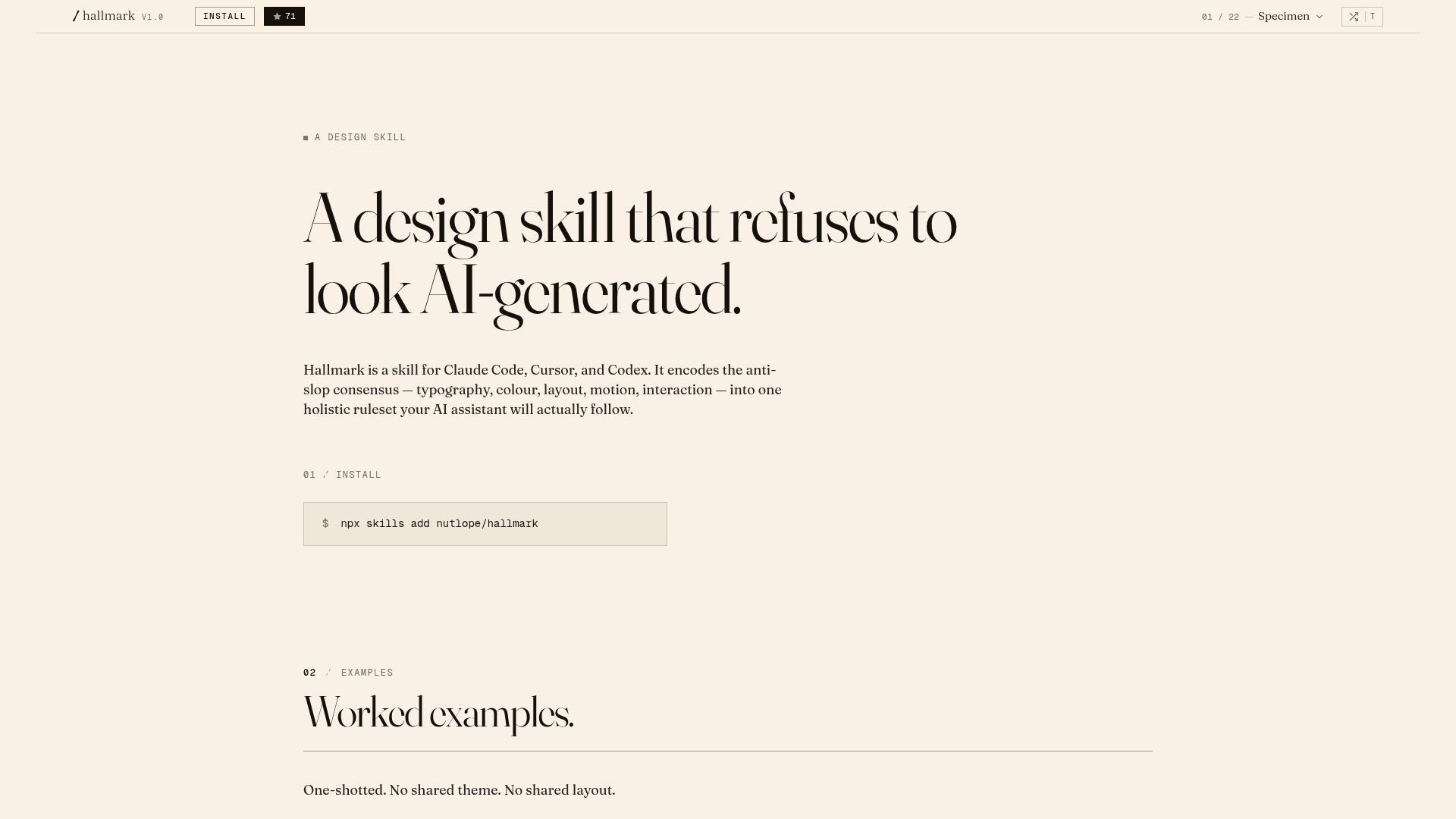
An open-source design skill for Claude Code, Cursor, and Codex that encodes anti-AI-slop design rules into a holistic ruleset with 22 themes, 65 slop-test gates, and 4 verbs.
At a Glance
About Hallmark
Hallmark is an open-source design skill made by Together AI, installable into Claude Code, Cursor, and Codex via a single npx skills add command. It encodes opinionated anti-AI-slop design rules — covering typography, colour, layout, motion, and microinteractions — into a structured ruleset that AI coding assistants will follow when generating UI. The project is MIT-licensed and hosted on GitHub under the Nutlope/hallmark repository.
What It Is
Hallmark is a "skill" — a rule file that attaches to an AI coding assistant and changes how it generates front-end UI. Rather than letting the model reach for its trained defaults (purple-to-pink gradient heroes, Inter as both display and body font, centred-everything layouts), Hallmark intercepts the design decision and routes it through a six-step flow: read the brief, pick a macrostructure from 21 named whole-page shapes, apply one of 22 themes across four genres, run a 65-gate slop test, and emit a stamped, working page. The core rule-set lives in SKILL.md and a references/ directory of opinionated sub-rules.
Four Verbs and What They Do
Hallmark exposes one default behaviour and three explicit verbs:
- Default — build new UI from a brief; asks for audience, use, and tone; picks macrostructure and theme; runs the slop test before returning.
hallmark audit <target>— scores existing code against named anti-patterns and structural sameness; returns a punch list, no edits.hallmark redesign <target> [--mood <name>]— discards the structure, keeps copy and information architecture, rebuilds with a deliberately different fingerprint.hallmark study <screenshot | URL>— the differentiator; extracts design DNA (macrostructure, type-pairing, colour anchor) from a screenshot or live URL; image mode names font roles without guessing font IDs; URL mode reads HTML/CSS via WebFetch and names exact fonts and tokens; refuses paid templates and competitor pages outright.
The Slop-Test Architecture
Before every output, Hallmark runs 65 named gates. A single "yes" fails the build. Gates cover typography discipline (max three font families per page), input-state correctness (focus ring via outline not border, helper-text slot reserves height), APCA/WCAG contrast thresholds, structural fingerprints (AI nav shape, AI footer shape, hero centred-everything), honest-copy enforcement (no invented metrics, no re-drawn UI chrome), and layout-safety checks (1fr image-track overflow, missing overflow-x: clip). The gate list has grown across versions — gates 56–60 were added in v1.0.0 and cover honest copy, re-drawn chrome, mid-render token improvisation, two-line clickable text, and emoji-as-feature-icon.
Genres, Themes, and Macrostructures
Hallmark routes each brief through one of four genres before picking a theme:
- Editorial (default) — the canonical anti-slop voice; bans radial blooms and pure-white backgrounds.
- Modern-minimal — Stripe/Linear/ElevenLabs school; allows pure white and pill CTAs.
- Atmospheric — Suno/Runway/dark-AI-tool school; allows radial blooms.
- Playful — post-Linear soft school.
Twenty-two themes are clustered across these genres (e.g., Specimen, Editorial, Atelier, Newsprint, Salon, Linen, Almanac, Garden, Studio, Sport, Riso, Brutal, Manifesto in editorial; Quiet, Coral, Violet in modern-minimal; Midnight, Terminal, Bloom, Aurora, Halo in atmospheric; Plume in playful). A per-project .hallmark/log.json records each run's macrostructure and theme so consecutive outputs in the same project don't repeat shapes.
Update: v1.0.0
The repository was created in April 2026 and last pushed in May 2026. Version 1.0.0 introduced pre-emit critique on six axes, honest-copy enforcement, locked-token discipline, a re-drawn-chrome ban, a no-wrap rule for clickable text, and five new slop-test gates (56–60). The project is actively maintained with 62 stars and 3 forks as of the last recorded update.
Setup Path
Installation is a single command: npx skills add nutlope/hallmark. For Claude Code, the skill lands in ~/.claude/skills/hallmark/ and is auto-detected. For Cursor, the body of SKILL.md goes into .cursor/rules/hallmark.mdc (no frontmatter). For Codex and other agents, the repository can be cloned and the skill directory copied manually. Re-running the install command pulls the latest version.
Community Discussions
Be the first to start a conversation about Hallmark
Share your experience with Hallmark, ask questions, or help others learn from your insights.
Pricing
Open Source
Fully free and open source under the MIT License. Install via npx and use without restriction.
- 22 design themes
- 65-gate slop test
- 4 verbs (default, audit, redesign, study)
- 21 named macrostructures
- Per-project design memory
Capabilities
Key Features
- 22 design themes across 4 genres (editorial, modern-minimal, atmospheric, playful)
- 65-gate slop test runs before every output
- 21 named macrostructures for whole-page shapes
- 4 verbs: default build, audit, redesign, study
- study verb extracts design DNA from screenshots or live URLs
- Per-project .hallmark/log.json memory to avoid repeating shapes
- Portable design.md lock-the-system flow
- 40 component archetypes with variation knobs
- OKLCH colour palettes with single anchor hue
- Microinteractions default-on for SaaS-shaped archetypes
- Pre-emit self-critique on six axes
- Honest-copy enforcement (no invented metrics)
- Theme-diversification rule across consecutive runs
- URL mode reads HTML/CSS via WebFetch for exact fonts and tokens
- MIT licensed and open source