HashCortX
A local-first, MIT-licensed AI desktop app for macOS with ten workspaces, twelve AI providers, an autonomous coding agent, and multi-agent swarms — no backend, no telemetry, no account required.
At a Glance
About HashCortX
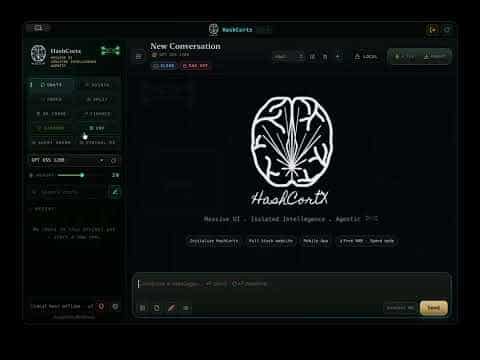
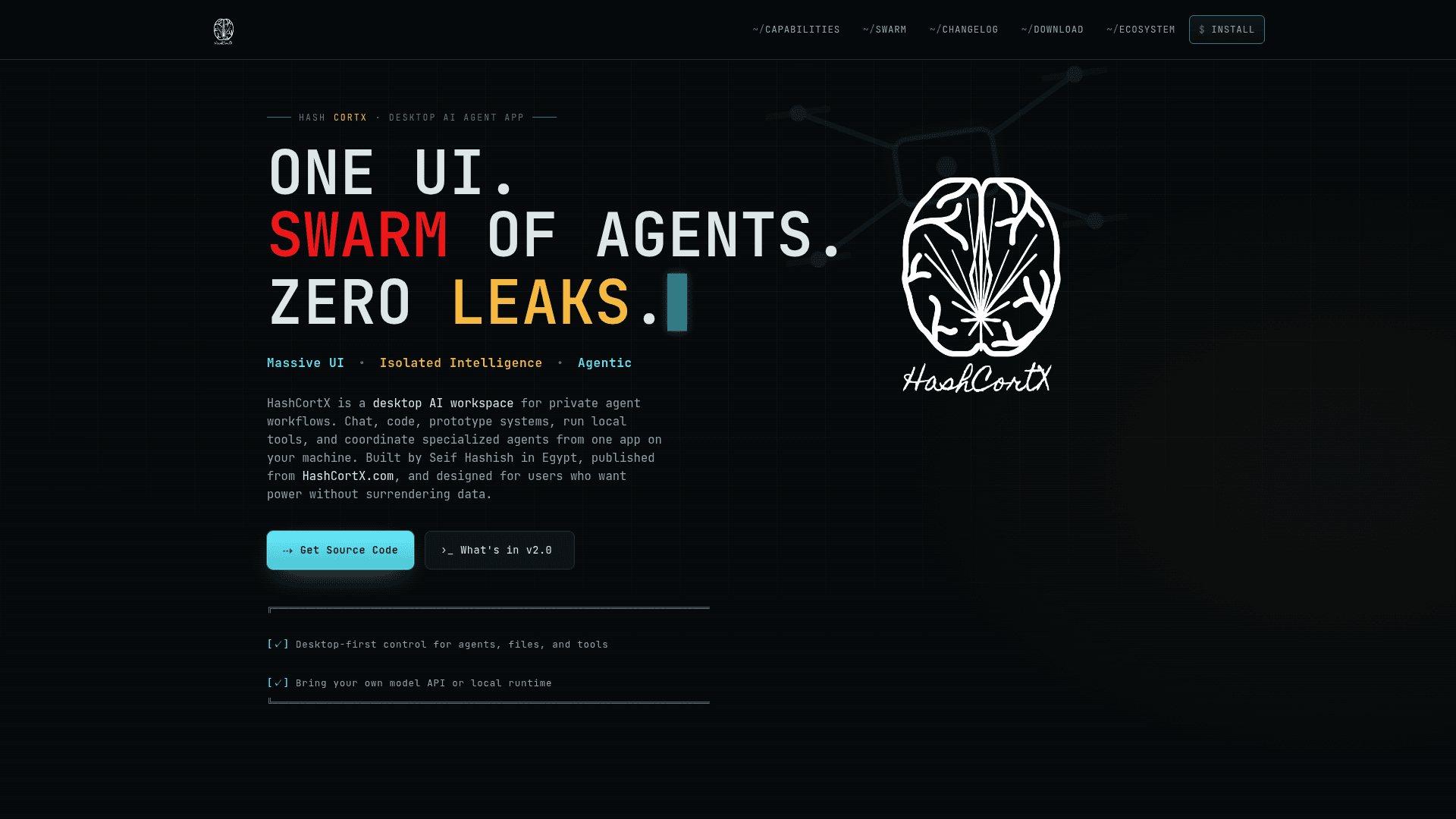
HashCortX is a native desktop application built with Tauri v2 (Rust + vanilla JavaScript) that brings multi-provider AI chat, an autonomous coding agent, and multi-agent swarms into a single window. Created by independent developer Seif Hashish and released under the MIT license, it is designed around a strict local-first principle: every AI request travels directly from your machine to the provider whose API key you entered, with no HashCortX infrastructure in between. The current release is v2.0.0 (May 2026), weighing 8 MB, and targets macOS Apple Silicon as its primary supported platform.
What It Is
HashCortX is an open-source AI workspace that packages ten distinct workspaces — chat, a coding agent, multi-agent swarms, specialist agents, a Python sandbox, financial document analysis, a security scanner, 3D planning, an ERP prototyper, and a virtual project desktop — behind one native window. It supports eleven cloud providers (Groq, Gemini, OpenAI, Anthropic, Moonshot, DeepSeek, Mistral, Cerebras, SambaNova, OpenRouter, NVIDIA NIM) plus Ollama for fully offline use. The codebase is approximately 30,600 lines of JavaScript and 1,820 lines of Rust, with no bundler, no framework, and no minified application code, making it fully auditable.
The Ten Workspaces
Each workspace addresses a distinct use case rather than being a generic chat interface:
- Chats — Multi-provider chat with projects, attachments, slash commands, and full history
- Agents — Nine built-in specialist agents plus a no-code builder for custom ones
- Coder — Autonomous coding agent with file tree, real file edits, shell access, and a browser panel
- Split — One prompt streamed side by side across two models simultaneously
- 3D Forge — Structured node and mesh plans for game levels and spatial design
- Finance — Parses statements, CSV, PDF, and XLSX into KPIs and charts; source-grounded to never fabricate numbers
- Sandbox — Agents scanning untrusted code for malware, prompt injection, and suspicious logic
- ERP — Describe a workflow, receive a working interactive prototype
- Agent Swarm — Chain mode, vote mode, and automatic provider failover mid-run
- Virtual OS — A simulated project desktop that an agent works inside
Security and Permission Architecture
The Coder agent's file and shell calls pass through a Rust permission gate (HC.guard.request()) backed by a compiled denylist in security/denylist.rs. Sensitive paths — ~/.ssh, ~/.aws, ~/.gnupg, system directories, and HashCortX's own stored keys — are refused unconditionally, whether the path arrives as a file operation or embedded inside a shell command. Every guarded action is logged to ~/.hashcortx/audit.log. Commands are bounded by a five-minute timeout, closed stdin, and a 512 KB output cap. The README notes that API keys are not encrypted (stored in an app-scoped local directory rather than Keychain) because the build is currently unsigned, and explains the reasoning in full in SECURITY.md.
Local Knowledge Base and Offline Search
HashCortX ships the bge-small-en-v1.5 embedding model (MIT-licensed, 34 MB) compiled directly into the binary and run via ONNX Runtime in Rust. This enables semantic search over anything you ingest — results are ranked by both meaning and keyword, then fused, so rare error codes still match exactly while paraphrased questions still surface the right passage. No first-run download is required, no data is sent over the network, and the knowledge base works fully offline from first launch.
Update: v2.0.0 and Active Development
The latest downloadable release is v2.0.0 (May 2026). The README explicitly notes that the main branch is ahead of the release — it includes an offline knowledge base, security fixes, and cross-platform work not yet packaged into a DMG. The repository was last pushed on August 4, 2026, and the project roadmap lists code signing and notarization, a new release cut from main, and Permission Guard coverage for Virtual OS and 3D Forge as near-term priorities. HashCortX is part of a four-app local-first ecosystem by the same author, alongside HashCerebrum, HashMeterAi, and Hash D Island, which interoperate through files on disk rather than any shared service.
Community Discussions
Be the first to start a conversation about HashCortX
Share your experience with HashCortX, ask questions, or help others learn from your insights.
Pricing
Open Source
Fully free and MIT-licensed. No paid tier, no usage caps. You pay AI providers directly, or use Ollama for free.
- All ten workspaces
- 11 cloud AI providers plus Ollama
- Autonomous coding agent
- Multi-agent swarms
- Offline semantic knowledge base
Capabilities
Key Features
- Ten distinct AI workspaces in one native desktop app
- Supports 11 cloud AI providers plus Ollama for offline use
- Autonomous coding agent with file edits, shell access, and diff view
- Multi-agent swarms with chain mode, vote mode, and provider failover
- Built-in semantic knowledge base using bge-small-en-v1.5 (offline, no download)
- Rust-based permission gate with compiled denylist for filesystem and shell calls
- Finance workspace parses CSV, PDF, XLSX into KPIs and charts without fabricating data
- Python sandbox via Pyodide (CPython on WebAssembly) with pandas, numpy, matplotlib
- Security sandbox for scanning untrusted code for malware and prompt injection
- 3D Forge workspace for spatial and game-level planning
- Split workspace for side-by-side model comparison
- Nine built-in specialist agents plus no-code custom agent builder
- No backend, no telemetry, no account required
- MIT-licensed with no bundler and fully auditable source code
- Usage logging to local JSONL file with no prompt or file content captured
Integrations
Demo Video