
Hillock
A lightweight, 100% local neuro-symbolic memory engine combining hyperdimensional computing, Hebbian plasticity, and SQLite knowledge graphs for offline AI agents.
At a Glance
Fully free and open-source under AGPL-3.0. Clone, use, modify, and distribute according to the license terms.
Engagement
Available On
Listed Sep 2026
About Hillock
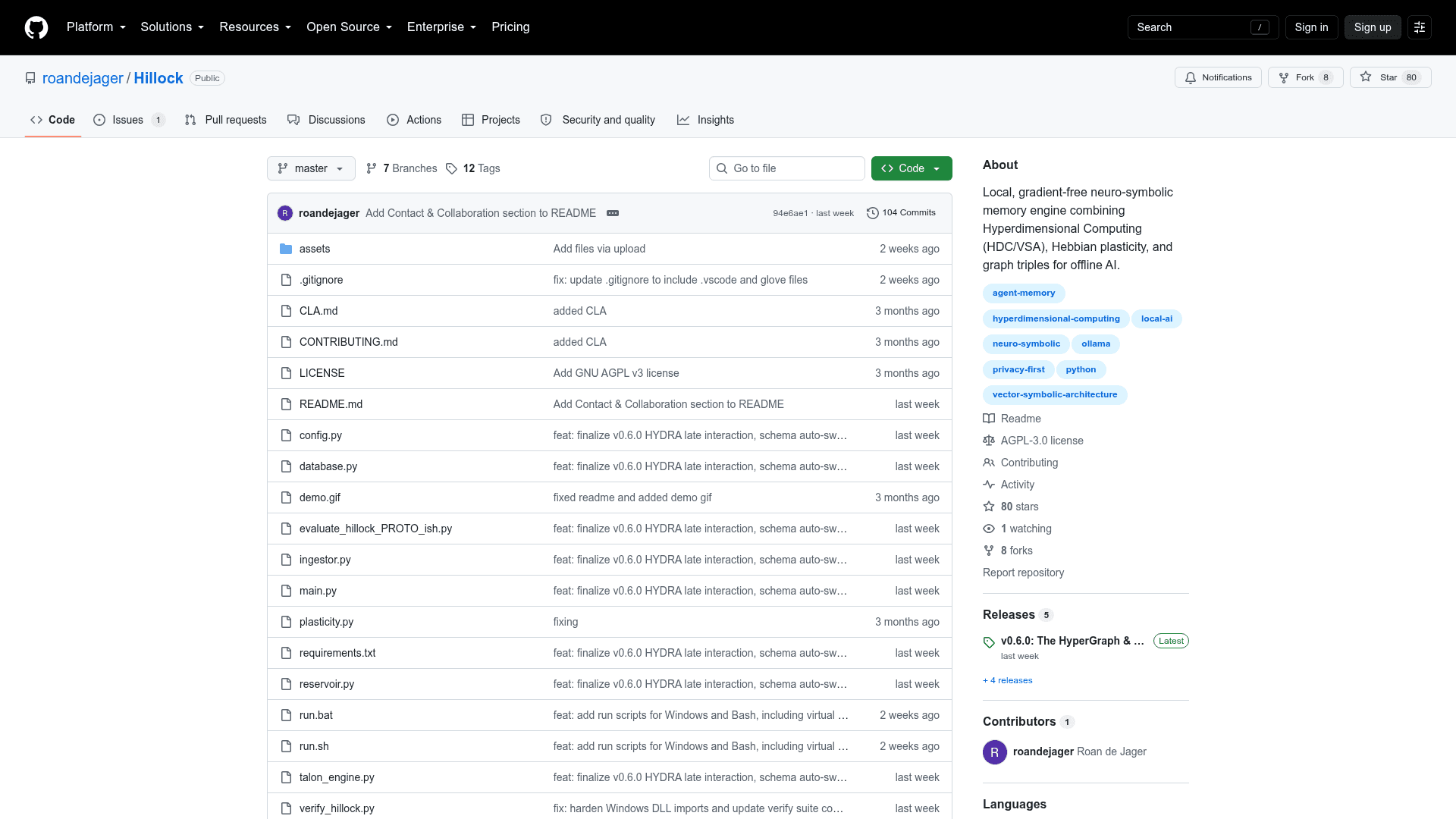
Hillock is an open-source, local memory engine built by Roan de Jager for edge hardware and privacy-first AI workflows. It replaces vector databases and LLM-based extraction pipelines with a three-tier neuro-symbolic architecture that runs entirely offline, requiring less than 1.2 GB of VRAM. The project is licensed under AGPL-3.0 and is actively developed on GitHub, currently at version 0.6.0.
What It Is
Hillock is a local agent memory system that answers queries from a deterministic knowledge graph rather than approximate vector similarity. It ingests text and PDF documents using the TALON extraction pipeline — a three-stage process combining coreference resolution (Fastcoref), a bi-encoder predicate router (MiniLM), and a zero-shot relation extractor (GLiREL Large) — without ever calling a generative LLM during ingestion. A local LLM via Ollama is invoked only once a query has already passed a hard similarity gate, ensuring the model only generates responses grounded in verified facts.
Three-Tier Memory Architecture
Hillock's memory system is composed of three complementary layers that work together:
- SQLite Knowledge Graph: Stores ground-truth facts as Subject-Predicate-Object (SPO) triples in relational tables, eliminating vector drift and approximation errors for factual recall.
- Hebbian Plasticity Engine: Tracks co-occurring concepts across conversation turns using gradient-free synaptic learning (η=0.15, decay γ=0.01) to mimic associative memory, surfaced live via the
/inspectcommand. - Hyperdimensional Reservoir (VSA/HDC): A 10,000-dimensional bipolar hypervector space that compresses conversation context with fading-memory decay, resolves pronouns, binds multi-hop relational paths via positional permutations, and hard-blocks unanswerable queries in under a millisecond.
HYDRA Gating and Hallucination Prevention
The HYDRA (Bipolar Late-Interaction MaxSim Gating) system is the core anti-hallucination mechanism. It replaces legacy single-vector query bundling with token-level MaxSim scoring natively in 10,000-D bipolar space. A Sub-Dimensional Projection Cascade evaluates MaxSim across a 2,000-D slice first to early-reject approximately 95% of candidate facts in ~0.5ms. The gate is a hard cutoff at HDC_THRESHOLD = 0.55 — queries that do not clear this threshold receive a hardcoded refusal ("I do not have verified information about that.") rather than a hallucinated answer, consuming zero GPU generation cycles.
Edge Hardware Design and Performance
Hillock was explicitly designed for mid-range and low-power hardware. The README reports the following benchmark comparisons between standard local RAG and Hillock's TALON+HDC pipeline:
- Ingestion latency for a 30-sentence document: ~5 seconds at 6.3 sentences/sec (GPU) vs. 15–30 minutes for an 8B LLM pipeline.
- VRAM footprint: under 1.2 GB (tested on a GTX 1070) vs. 5.8–16 GB+ for LLM-based extraction.
- CPU-only execution: fully supported; the complete ingestion and benchmark suite runs on a standard laptop CPU with no GPU requirement.
- Sub-second retrieval: the 2,000-D projection cascade evaluates 32 queries in approximately 1.16 seconds (~0.036s per query) on CPU.
Update: v0.6.0 — The HyperGraph & Late-Interaction Expansion
Version 0.6.0, published on August 29, 2026, is described in the README as the largest architectural update to Hillock to date. Key changes include:
- HYDRA late-interaction gating replacing legacy single-vector bundling, eliminating query-length decay.
- HYPERGRAPH-HDC multi-hop path reasoning using Positional Permutation (cyclic coordinate shifts) to break Hadamard binding commutativity, enabling 2-hop and 3-hop relational reasoning during ingestion without LLM calls.
- Hybrid Edge Storage Schema constraining SQLite strictly to 1-hop SPO triples while storing multi-hop paths as bit-packed BLOBs in a dedicated
hdc_reservoirstable. - 21-point verification suite (
verify_hillock.py) upgraded with permutation orthogonality and sequential path validation checks, safe to wire into CI without a GPU runner.
Benchmark results for v0.6.0 show extraction recall of 59.1%, hard-negative block rate of 60.0%, and retrieval accuracy of 54.5% on the project's current fixed benchmark of one 32-sentence academic text with 22 answerable and 10 hard-negative queries. The README explicitly notes these numbers are directional rather than statistically robust, with a larger benchmark planned before any v1.0 claims.
Setup and CLI Workflow
Hillock ships with one-click launcher scripts (run.bat for Windows, run.sh for Linux/macOS) that create a virtual environment, install dependencies, and check for the spaCy en_core_web_sm model automatically. Manual setup requires Python 3.10+, PyTorch with optional CUDA support, and a locally running Ollama instance with at least one instruct-tuned model. The interactive CLI supports commands for document ingestion (/ingest), personality mode switching (/mode strict|balanced|conversational), live model switching (/model), entity inspection (/inspect), and debug verbosity control (/debug).
Community Discussions
Be the first to start a conversation about Hillock
Share your experience with Hillock, ask questions, or help others learn from your insights.
Pricing
Open Source
Fully free and open-source under AGPL-3.0. Clone, use, modify, and distribute according to the license terms.
- Full source code access on GitHub
- 100% local offline execution
- Three-tier neuro-symbolic memory engine
- TALON extraction pipeline
- HYDRA MaxSim gating
Capabilities
Key Features
- 100% local, offline execution with zero cloud dependencies
- Three-tier memory: SQLite knowledge graph, Hebbian plasticity engine, and 10,000-D HDC reservoir
- TALON extraction pipeline (Fastcoref + MiniLM + GLiREL Large) without LLM ingestion
- HYDRA bipolar late-interaction MaxSim gating to prevent hallucinations
- Multi-hop relational path reasoning via positional permutation (2-hop and 3-hop)
- Sub-dimensional projection cascade for sub-millisecond query rejection
- Hard similarity gate with hardcoded refusal for unanswerable queries
- Streaming response generation via local Ollama LLM
- Interactive CLI with /ingest, /inspect, /mode, /model, /debug commands
- 21-point GPU-free verification suite (verify_hillock.py)
- CPU-only execution supported
- Under 1.2 GB VRAM footprint
- One-click launcher scripts for Windows and Linux/macOS
- AGPL-3.0 open-source license with CLA for contributors