
Hindsight
An open-source agent memory system that gives AI agents long-term, learning memory using biomimetic data structures, multi-strategy retrieval, and observation consolidation.
At a Glance
About Hindsight
Hindsight is an MIT-licensed agent memory system built by Vectorize, Inc. that enables AI agents to retain, recall, and reflect on information across sessions. It is available as a self-hosted open-source project (deployable via Docker, Kubernetes, or pip) and as a managed cloud service. The project claims state-of-the-art performance on the LongMemEval benchmark, with a reported score of 94.6%, independently reproduced by research collaborators at Virginia Tech's Sanghani Center for Artificial Intelligence and Data Analytics and The Washington Post.
What It Is
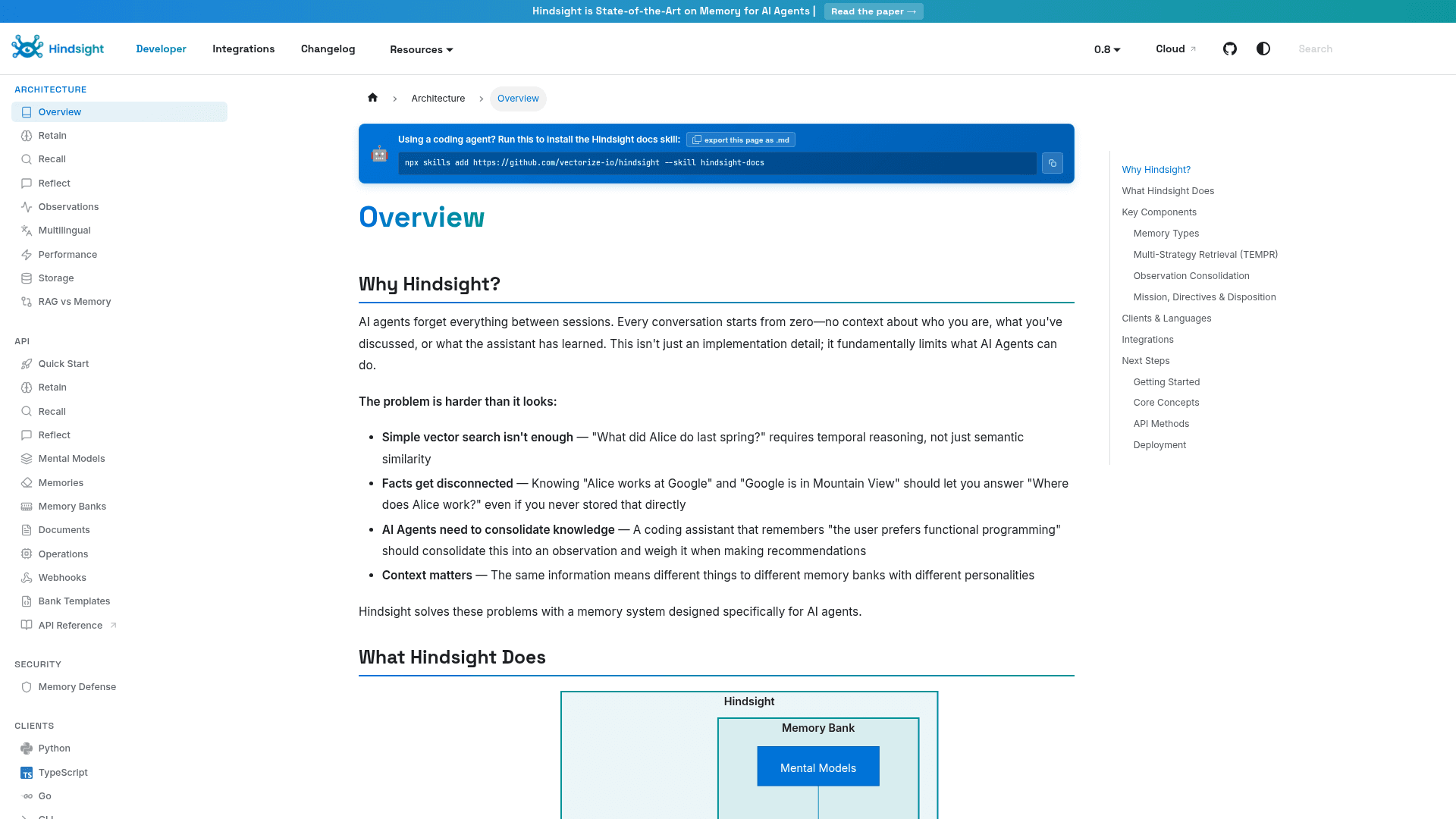
Hindsight is a purpose-built memory layer for AI agents, distinct from traditional RAG (Retrieval-Augmented Generation) systems. Where RAG retrieves document chunks, Hindsight stores structured facts, builds consolidated observations over time, and uses a graph-based event-centric architecture to track how knowledge evolves. The core API exposes three operations: retain (store information), recall (search and retrieve memories), and reflect (generate disposition-aware answers grounded in memory). Memory is organized into banks — isolated stores that can be configured with a mission, directives, and disposition traits to shape how the agent reasons.
Architecture: Four Memory Networks
Hindsight organizes knowledge into a hierarchy of memory types:
- Mental Models — user-curated summaries for common queries
- Observations — automatically consolidated, deduplicated beliefs built from raw facts over time, with evidence tracking and freshness awareness
- World Facts — objective facts received (e.g., "Alice works at Google")
- Experience Facts — the agent's own actions and interactions (e.g., "I recommended Python to Bob")
Retrieval uses a four-strategy parallel system called TEMPR: Semantic (vector similarity), Keyword (BM25 exact matching), Graph (entity and causal links), and Temporal (time-range filtering). Results are merged via reciprocal rank fusion and a cross-encoder reranker. The graph is event-centric — entities attach to memory units rather than connecting directly to each other — which preserves historical state without requiring manual rewrites when facts change.
Deployment Model
Hindsight supports multiple deployment paths:
- Docker — single command, embedded PostgreSQL, runs on Linux, macOS (Apple Silicon and Intel), and Windows
- Kubernetes / Helm — production-grade with StatefulSet worker identity management
- Bare metal (pip) —
pip install hindsight-allfor Python-embedded use with no separate server - Hindsight Cloud — fully managed, usage-based billing on token consumption with no fixed monthly fee
Client SDKs are available for Python, TypeScript/Node.js, Go, and CLI. The system integrates with over 40 agent frameworks and tools including LangGraph, LlamaIndex, CrewAI, AutoGen, OpenAI Agents SDK, Claude Agent SDK, Cursor, Cline, n8n, Zapier, and many others.
Update: v0.8.3
The latest release is v0.8.3, published on June 18, 2026. The GitHub repository was created in October 2025 and has accumulated over 16,700 stars and 975 forks as of late June 2026, with active pushes as recently as June 20, 2026. The project also claims the #1 position on the BEAM benchmark as of April 2026, per a blog post on the Hindsight site. The current documentation version is 0.8, with archived versions for 0.7 and 0.6 also available.
Security and Isolation
Hindsight includes a Memory Defense layer for security. User data isolation is handled through memory banks — each bank is fully isolated with no data leakage. Developers can create per-user banks for maximum privacy or use a single bank with tag-based filtering for cross-user analytics. Entity labels with tag: true enable controlled-vocabulary classification at retain time and deterministic SQL-level filtering at recall time, which is more reliable than scoring-based approaches for strict memory-type separation.
Community Discussions
Be the first to start a conversation about Hindsight
Share your experience with Hindsight, ask questions, or help others learn from your insights.
Pricing
Self-hosted
Run Hindsight on your own infrastructure with a single Docker command. MIT licensed, no restrictions.
- MIT open source license
- Single Docker command to deploy
- All four memory networks
- Retain, Recall, and Reflect APIs
- MCP server built in
Hindsight Cloud
Managed Hindsight with zero infrastructure. Billed on token usage — no fixed monthly fee, no seat pricing.
- Everything in Self-hosted
- Usage-based billing on tokens
- Start for free
- Managed infrastructure
- Automatic scaling
- Daily backups
- Dashboard and usage analytics
- Team collaboration
- Support SLA available
- 99.9% uptime guarantee
Enterprise
Custom deployment, dedicated support, and SLAs for production workloads at scale.
- Everything in Cloud
- Bring-your-own-cloud deployments
- On-premises deployment
- Dedicated infrastructure
- Custom SLA (up to 99.95%)
- Up to 24×7 support
- 30-minute response SLA
- SSO and RBAC
- Custom integrations
- Onboarding and training
Capabilities
Key Features
- Retain, Recall, and Reflect APIs
- Multi-strategy retrieval (TEMPR: Semantic, Keyword, Graph, Temporal)
- Observation consolidation with deduplication and evidence tracking
- Memory banks with mission, directives, and disposition configuration
- Mental models for consolidated knowledge patterns
- Event-centric graph with causal and semantic memory links
- Tag-based metadata filtering
- Entity label extraction with controlled vocabulary
- MCP server built in
- Python, TypeScript, Go, and CLI SDKs
- Docker, Kubernetes, and bare metal deployment
- Python embedded mode (no server required)
- Multilingual support
- Webhook support
- Memory defense / security layer
- 50-500ms recall latency
- Cross-encoder reranking
- Temporal reasoning for time-aware retrieval
- Per-user memory bank isolation
- Admin CLI for zombie operation recovery