
Huzzah
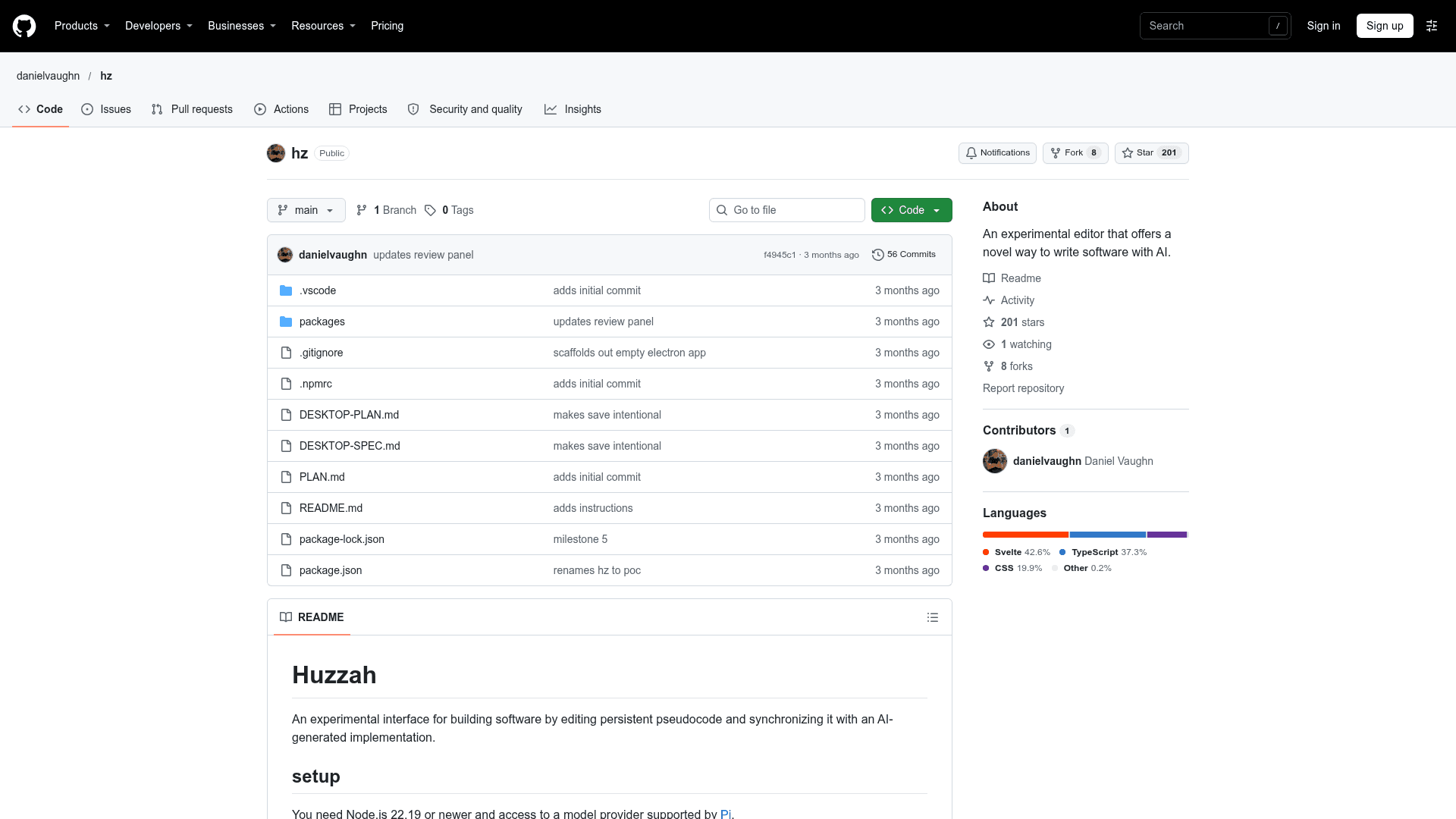
An experimental editor for building software by editing persistent pseudocode that is synchronized with an AI-generated implementation.
At a Glance
The repository can be accessed without payment. No license is specified, so this must not be described as an open-source grant. Model-provider subscriptions, API usage and local compute remain separate.
Engagement
Available On
Listed Nov 2026
About Huzzah
Huzzah (hz) is an experimental interface by danielvaughn for building software by editing persistent pseudocode and synchronizing it with an AI-generated implementation. It runs as a local web app that uses Pi for model provider configuration.
What It Is
Huzzah is an experimental editor that offers a different way to write software with AI. Instead of prompting a chat and editing generated code directly, you maintain specs written as pseudocode, and the tool reconciles them with a generated implementation. The README describes reconciliation and semantic highlighting steps that run through your chosen model.
Setup Path
It requires Node.js 22.19 or newer. You clone the repository, run npm install, configure Pi, and start the app with npm run dev, which serves at http://localhost:5173. Authentication works through a provider API key environment variable or through a subscription login via Pi's /login flow. A default provider and model can be set in ~/.pi/agent/settings.json.
Model Access and Privacy
Huzzah does not require a particular model vendor. It uses Pi's provider, credential, and model configuration, including providers such as Anthropic, OpenAI, Google, Azure OpenAI and Amazon Bedrock, plus local models such as Ollama, LM Studio and vLLM through Pi's models.json. Specs and current generated source are sent to the selected model provider. Accepted AI-generated JavaScript runs locally in a Web Worker, which the README describes as experimental containment rather than a sandbox for hostile code.
Example Uses
The README suggests starter ideas such as a shopping cart with discount and tax rules, a task scheduler, a rate limiter, a meeting-room allocator, a data validator and a turn-based combat system.
Community Discussions
Be the first to start a conversation about Huzzah
Share your experience with Huzzah, ask questions, or help others learn from your insights.
Pricing
Public repository access
The repository can be accessed without payment. No license is specified, so this must not be described as an open-source grant. Model-provider subscriptions, API usage and local compute remain separate.
- Public source and setup instructions
- Local experimental editor
Capabilities
Key Features
- Persistent pseudocode specs as the editing surface
- Synchronization with AI-generated implementation
- Semantic highlighting
- Model-vendor agnostic via Pi
- Supports API key and subscription authentication
- Supports local models through Pi
- Runs accepted generated JavaScript locally in a Web Worker