
hydra-acp
A session manager, multiplexer and TUI daemon that lets multiple clients share live ACP coding agent sessions.
At a Glance
Self-hosted hydra-acp CLI/daemon/TUI under the MIT License. Hydra has no model of its own; agent/model costs are external.
Engagement
Available On
Listed Nov 2026
About hydra-acp
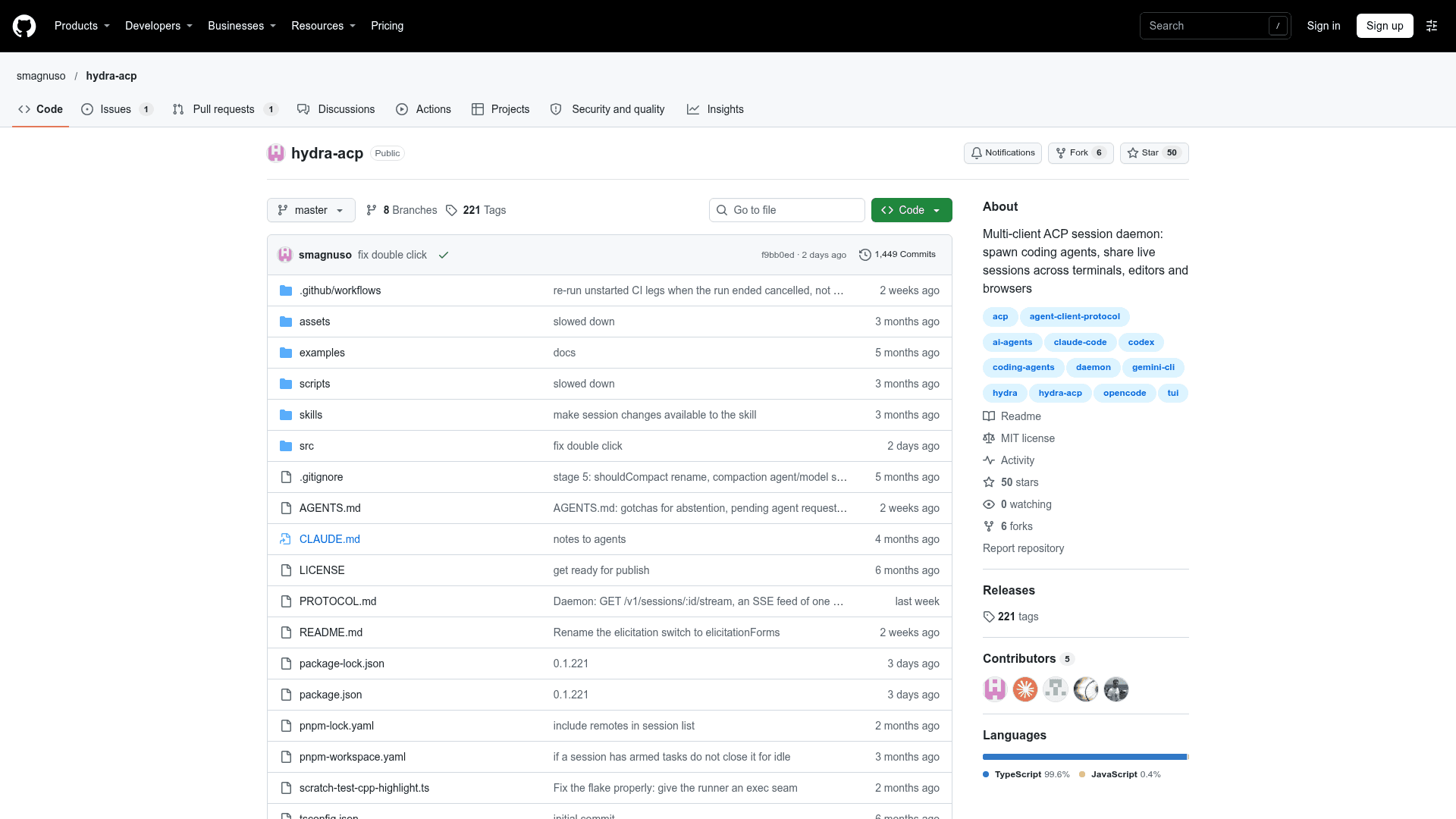
hydra-acp is an experimental, MIT-licensed daemon and CLI built on the Agent Client Protocol (ACP). One daemon owns your coding agents, so a session is not tied to the terminal or editor window that started it. A TUI, editors, a browser, and Slack can attach to the same live session at once.
What It Is
hydra-acp is a session manager, multiplexer, and terminal UI for AI coding agents. It has no model of its own: every session is a real ACP agent running as a child process, such as opencode (the default), Claude, Codex, pi, or anything in the ACP registry. Agents are downloaded on first use, and hydra inherits the login and config you already have for them. The daemon starts itself on first use, and config and a bearer token are written automatically.
How Sessions Work
Events broadcast to all attached clients, prompts serialize through a per-session queue, and permission requests race so the first response wins. Sessions are listable, nameable, exportable as .hydra bundles, and resurrectable after the terminal closes. hydra-acp session share prints a hydra:// URL for handing a session to another machine or person, and remote add federates daemons, with the daemon's listen command enabling remote access over TLS. Editors point their ACP agent command at hydra-acp acp or hydra-acp launch <agent>.
Long Sessions and Workspaces
History compacts as it nears the context window, and the agent can recall summarized history. Slash commands such as /hydra uncompact, /hydra fork, and /hydra agent <id> roll back compaction, branch a conversation, or swap agents mid-session while keeping the transcript. Isolated workspaces run a session in its own git worktree, with start, merge, apply, sync, detach, clean, and discard operations. The cat mode acts as a unix filter that feeds stdin to an agent and streams text back.
Extensions and Transformers
Daemon-managed extensions ship under the @hydra-acp npm scope: Slack bridge, browser web UI, desktop notifier, permission auto-approver, cross-machine session archiver, a VS Code agent host via the Agent Host Protocol, and a multi-agent planner. Transformers are middleware that intercept ACP messages in both directions.
Community Discussions
Be the first to start a conversation about hydra-acp
Share your experience with hydra-acp, ask questions, or help others learn from your insights.
Pricing
Open Source
Self-hosted hydra-acp CLI/daemon/TUI under the MIT License. Hydra has no model of its own; agent/model costs are external.
- MIT-licensed core
- Session manager, multiplexer and TUI
- Extensions: Slack bridge, web UI, notifier, auto-approver, sync
- Works with Claude, Codex, opencode, pi or any ACP registry agent (agent licenses/costs are external)
Capabilities
Key Features
- Session manager with listing, naming, export/import and resurrection
- Multi-client multiplexing of live sessions with first-response-wins permissions
- Full terminal UI with session picker, sidebar and themes
- Compaction with recall of summarized history, plus uncompact and fork
- Mid-conversation agent swap via /hydra agent
- Isolated git-worktree workspaces
- Session sharing via hydra:// URLs and federation of remote daemons over TLS
- Headless cat mode for piping stdin to an agent
- Extensions and transformers managed by the daemon
- Agent downloads from the ACP Registry on first use