
intentic
An open-source workspace that orchestrates parallel coding agents, each in a sandbox on your own machine.
At a Glance
All of intentic is MIT licensed; every sandbox, capability, automation and shared workspace is free on your own hardware, with no feature tiers and no card.
Engagement
Available On
Listed Oct 2026
About intentic
intentic is an open-source workspace for coding agents that runs on hardware you choose. It puts several agents, such as Claude Code, Codex, Cursor and Gemini, on one board, each working on its own git worktree inside a Docker sandbox. Nothing lands until the user has approved a plan and read the diff. The project is MIT-licensed, and its README and site describe it as new.
What It Is
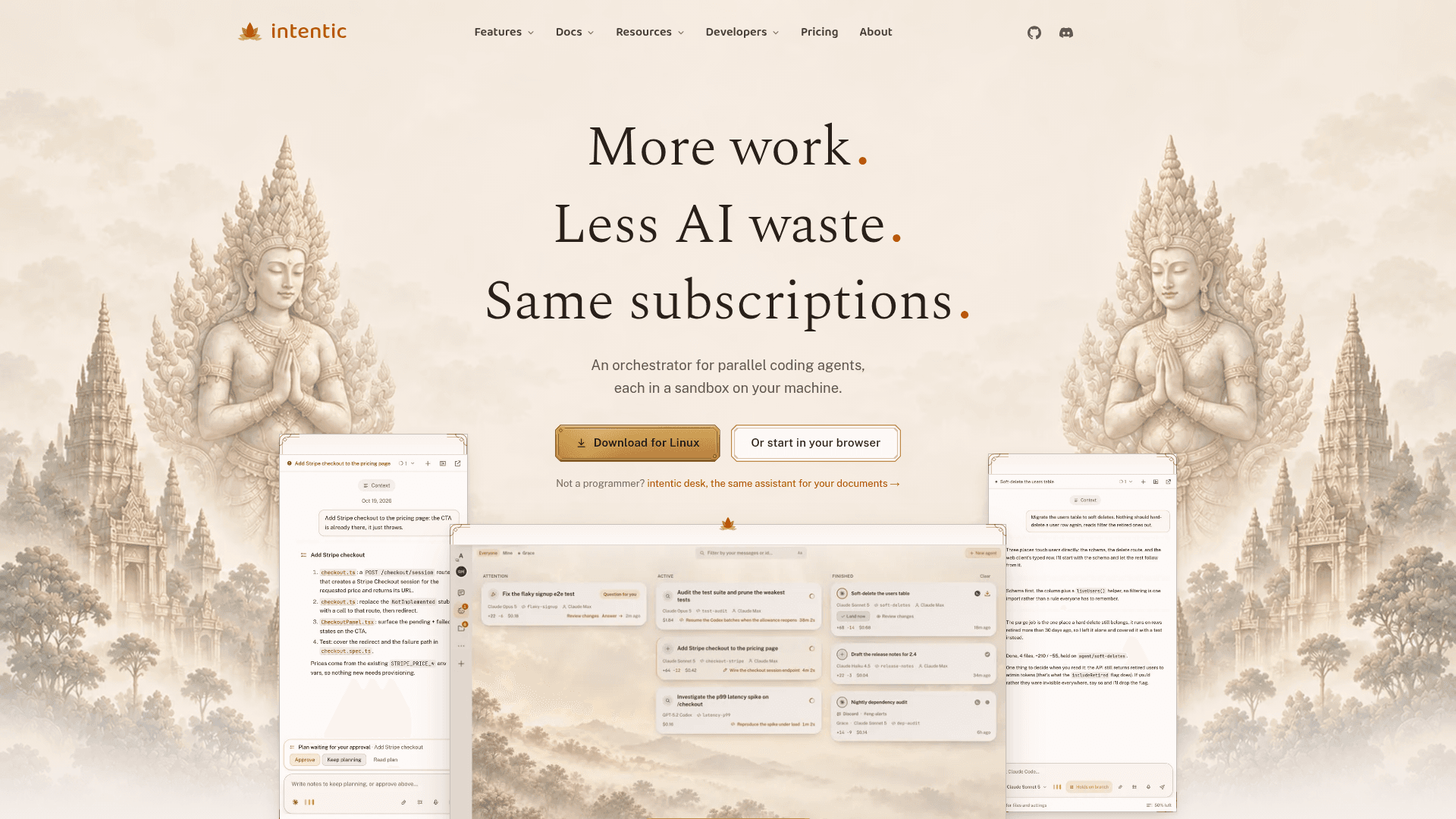
intentic is an orchestrator for parallel coding agents. A sandbox is a Docker container on a laptop, desktop or server that holds the agents, repositories, terminals, credentials and tools needed for a job. The user controls it from a browser, desktop app or phone, and the agents keep working when the browser closes. The hosted platform stores only the user's sign-in identity and the sandbox's address, not code or commands.
How the Workflow Runs
A user hands out tasks, and each agent reads the code and writes a plan that waits for approval. Permission modes range from plan-only to fully automatic, set per turn. One board sorts agents by who needs attention, showing model, branch, diff size and cost on each card. Finished work waits on its own branch with the agent's report, and the user can land or discard it after reading the diff file by file.
Integrations and Automations
Agents can be connected to GitHub, GitLab, PostgreSQL, Sentry, Stripe, Discord, Slack, SSH, a VPN or any MCP server, with credentials kept inside the sandbox. Automations wake an agent on a schedule, a push, a failed pipeline, an alert, a payment, an email or a chat message. An optional check command decides whether each event starts a run.
Models and Accounts
Agents run on the user's own plans, including Claude, ChatGPT, Cursor, Google, Grok, Kimi and Z.ai accounts. Any ACP agent can connect as a capability, and local models run through llama.cpp or OpenAI-compatible endpoints. The site states that intentic does not meter tokens or add a markup.
Setup Path
Users sign in with Google or an emailed code, then start a sandbox through the desktop app for Windows and Linux, a one-line setup command, Docker Compose or plain docker run. Docker is required, and the installer offers to install it if missing. A hosted-sandbox option and a browser-based demo workspace are also offered.
Community Discussions
Be the first to start a conversation about intentic
Share your experience with intentic, ask questions, or help others learn from your insights.
Pricing
Self-hosted (Open Source)
All of intentic is MIT licensed; every sandbox, capability, automation and shared workspace is free on your own hardware, with no feature tiers and no card.
- As many sandboxes as your hardware will run
- Every capability, extension and automation
- Shared workspaces: teammates by email
- The desktop app, the sandbox API and the whole source tree
- Unlimited hours
Hosted Sandbox Free
Free hosted sandbox for an account with Google linked.
- One sandbox on 4 shared vCPUs, 4 GB memory, 10 GB disk
- 40 awake hours a month (10 in your first week)
- Removed after 3 weeks unopened
- Sleeps after 20 minutes away; a sleeping machine spends no hours
- Every feature included
Hosted Sandbox (larger machines)
Paid hosted machines of ours, bigger with more awake hours, never removed; from $20 a month. Exact per-size prices are not published in the supplied evidence.
- 8 shared vCPUs, 8 GB memory, 25 GB disk: 220 awake hours a month
- 8 shared vCPUs, 16 GB memory, 50 GB disk: 320 awake hours a month
- Kept for as long as you keep it
- Every feature on every size
Capabilities
Key Features
- Parallel coding agents on one board, each on its own git worktree
- Plan approval before any code changes
- Diff review before landing changes
- Agents keep running after the browser closes
- Integrations with GitHub, PostgreSQL, Stripe, Sentry, Discord and any MCP server
- Event and schedule automations with optional check commands
- Per-turn permission modes
- Usage and cost tracking per agent
- Self-hosting on your own machine or server
- Extension development and sandbox API
- Optional hosted sandbox