
JARVIS
A voice assistant for Claude Code on macOS that brainstorms projects with you, drives builds, and alerts you out loud when a Claude Code session needs attention.
At a Glance
Free for personal, non-commercial use. Requires your own Claude subscription and Fish Audio API key.
Engagement
Available On
Alternatives
Listed Sep 2026
About JARVIS
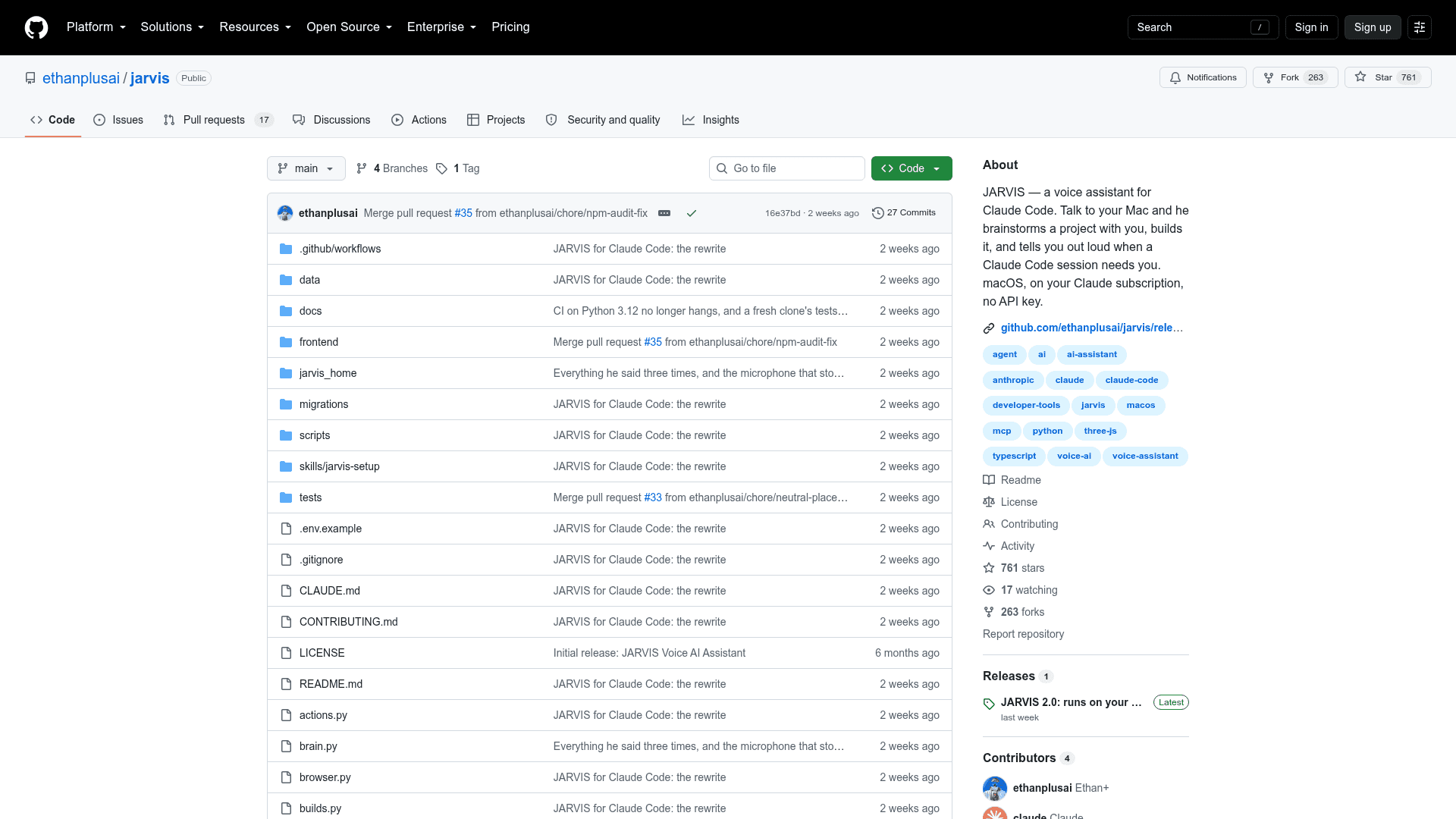
JARVIS (Just A Rather Very Intelligent System) is an open-source voice layer that sits on top of Claude Code, letting macOS users talk to their development environment in natural language. Built by Ethan Rogers and released under a personal-use license, it runs entirely on your existing Claude subscription — no separate Anthropic API key is required or even possible. The project reached v2.0.0 in September 2026 and has accumulated over 760 GitHub stars.
What It Is
JARVIS is a voice-driven AI development assistant styled as a British butler. It wraps Claude Code's CLI (claude -p) with a conversational interface: you speak, it brainstorms, it writes a design document to disk, then it drives a real Claude Code session through a plan → review → execute pipeline. It also watches every Claude Code session running on your machine and tells you out loud — or via macOS notification — when one is blocked waiting for human input. The frontend is a Three.js particle orb rendered in Chrome; the backend is a FastAPI Python server communicating over WebSocket.
Architecture and Key Components
JARVIS is built around a single long-lived claude -p brain process that receives your speech via Chrome's Web Speech API, processes it, and streams replies back sentence-by-sentence so the first words are spoken while the rest is still being written. Key layers include:
- Voice path: Chrome Web Speech API → WebSocket → FastAPI (
server.py) → brain (brain.py) → Fish Audio TTS → speaker - Build pipeline:
builds.pywrites a spec todocs/superpowers/specs/, spawns aclaude -prun, and tracks progress via plan checkboxes - Session watcher:
session_watch.pymonitors every Claude Code conversation on the machine;session_steer.pycan post messages into a running session - Storage: SQLite for runs and usage; plain Markdown files for long-term memory
- Dashboard: Six-tab web UI (Runs, Sessions, Memory, Specs, Projects, Usage) built in vanilla TypeScript with no framework
The environment management in claude_env.py deliberately strips all ANTHROPIC_* and CLAUDE_CODE_* variables from every spawned child process to prevent accidental API key billing.
Platform Constraints and Requirements
JARVIS is explicitly macOS-only. Terminal control, window listing, screenshots, and notifications all go through AppleScript, and there is no Linux or Windows path. Google Chrome is required (not optional) because the microphone relies on the Web Speech API (SpeechRecognition / webkitSpeechRecognition), which Firefox has never implemented. Additional requirements include Claude Code CLI (v2.1.224 or newer), Python 3.11+, Node.js 18+, and a Fish Audio API key for text-to-speech — there is no fallback voice if the Fish Audio key is absent.
Security Model and Trust Decisions
The README documents five deliberate trust trade-offs. Every spawned run passes --dangerously-skip-permissions because there is no TTY to answer permission prompts, giving each run full filesystem privileges in the target directory. A taint gate blocks all acting tools for any turn that reads from a web page, file, screenshot, or external MCP server — but this stops action, not persuasion, since planted suggestions remain in the brain's context until you speak again on a clean turn. Loopback (127.0.0.1) is trusted by default; --host 0.0.0.0 widens trust to the LAN with a printed warning.
MCP Integration and Extensibility
JARVIS ships with no external connections by default. Any MCP server can be added by dropping its mcpServers block into data/jarvis/connections.json; JARVIS runs with --strict-mcp-config so nothing from ~/.claude.json or Claude Desktop reaches it unless explicitly configured. The README notes that each loaded MCP tool costs approximately 250 tokens of brain context per turn. Key customization seams are deliberately exposed: personality lives in jarvis_home/CLAUDE.md, voice synthesis is isolated in tts.py (one HTTP call, ~60 lines), and the Three.js orb is self-contained in frontend/src/orb.ts.
Update: JARVIS 2.0
Version 2.0.0, published September 10, 2026, is the current release. The release is titled "JARVIS 2.0: runs on your Claude subscription," signaling a shift away from any separate API key model to running entirely on the user's Claude Max or Pro subscription. The project has an active test suite of approximately 1,640 tests and an open issues count of 17 as of the last update. The README explicitly invites contributions for non-macOS system integration, alternative TTS engines, and a mobile client.
Community Discussions
Be the first to start a conversation about JARVIS
Share your experience with JARVIS, ask questions, or help others learn from your insights.
Pricing
Personal Use
Free for personal, non-commercial use. Requires your own Claude subscription and Fish Audio API key.
- Full voice assistant functionality
- Claude Code session management
- Dashboard with Runs, Sessions, Memory, Specs, Projects, Usage tabs
- MCP server integration
- Long-term memory
Commercial License
Commercial use requires a license. Contact ethanplus.ai for inquiries.
- Commercial use rights
- Derivative works permitted
- SaaS hosting permitted
Capabilities
Key Features
- Voice-driven brainstorming and project design via conversation
- Writes design specs to disk as Markdown before starting any build
- Drives Claude Code sessions through plan → review → execute pipeline
- Watches all Claude Code sessions on the machine and alerts when one needs input
- macOS notifications when no browser tab is open
- Long-term memory as plain Markdown files
- SQLite run history with full event streams and token usage
- Six-tab dashboard: Runs, Sessions, Memory, Specs, Projects, Usage
- MCP server integration via connections.json
- Taint gate blocks acting tools after reading untrusted content
- ANTHROPIC_* environment variable scrubbing to prevent accidental API billing
- Three.js particle orb voice UI
- Subscription usage gauges (5-hour and 7-day windows)
- Customizable personality via CLAUDE.md
- Swappable TTS engine via tts.py