
jCodeMunch
An MCP server that cuts AI token costs 95%+ on code exploration by retrieving exact symbols via tree-sitter AST parsing instead of reading entire files.
At a Glance
Free for personal, academic, research, or other non-commercial use.
Engagement
Available On
Alternatives
Listed Sep 2026
About jCodeMunch
jCodeMunch is an MCP (Model Context Protocol) server built by J. Gravelle (jMunch LLC) that replaces file-based code reading with surgical symbol-level retrieval, reducing AI token consumption by an average of 96.5% against a grep-and-read agent baseline. It indexes a codebase once using tree-sitter AST parsing and then lets AI agents fetch exact functions, classes, methods, and constants by name — returning tens of lines instead of thousands. The tool is free for personal use and requires a commercial license for for-profit use.
What It Is
jCodeMunch is a token-efficiency layer for AI coding agents that operate over large codebases. Instead of having an agent open and scan entire source files, jCodeMunch builds a persistent local symbol index and exposes MCP tools like search_symbols, get_symbol_source, find_importers, and get_blast_radius. When an agent needs to understand how dependency injection works in a 214K-token codebase, jCodeMunch returns the relevant function bodies in roughly 480 tokens rather than requiring the agent to read every file. It works with any MCP-compatible client, including Claude Code, Cursor, Windsurf, VS Code, Codex CLI, Continue, and Gemini CLI.
How Symbol Retrieval Works
The architecture follows a three-step pattern:
- Index once: Run
index_code_folder(path)to parse all source files with tree-sitter and store structured symbol metadata (signature, kind, qualified name, byte offsets, summaries) in a local index at~/.code-index/. - Query by intent: The AI calls
search_symbols(query)orget_symbol(id). The server performs semantic and keyword search against the index in milliseconds using a bundled ONNX local model (all-MiniLM-L6-v2, 384-dim) for zero-config semantic search. - Surgical retrieval: Only the matching symbol's source and metadata is returned — not the surrounding file, not unrelated classes. A 6,000-token file read becomes a ~400-token symbol pull.
Symbol summaries fall through a 4-tier chain — Anthropic → Gemini → OpenAI-compatible (Ollama, LM Studio, OpenRouter) → signature-only fallback — so it works with whatever LLM is available, or none. The index format has gone through 9 generations and remains fully backward-compatible.
Benchmark Evidence
The vendor publishes reproducible benchmarks measured with tiktoken cl100k_base across three public repositories pinned to upstream commits (expressjs/express, fastapi/fastapi, gin-gonic/gin), run on v1.108.316. Against a grep-top-3 baseline (the approach a competent agent without the tool actually uses):
- expressjs/express: 15.5x fewer tokens
- fastapi/fastapi: 38.4x fewer tokens
- gin-gonic/gin: 20.3x fewer tokens
- Grand total (15 task-runs): 28.3x fewer tokens (96.5% reduction)
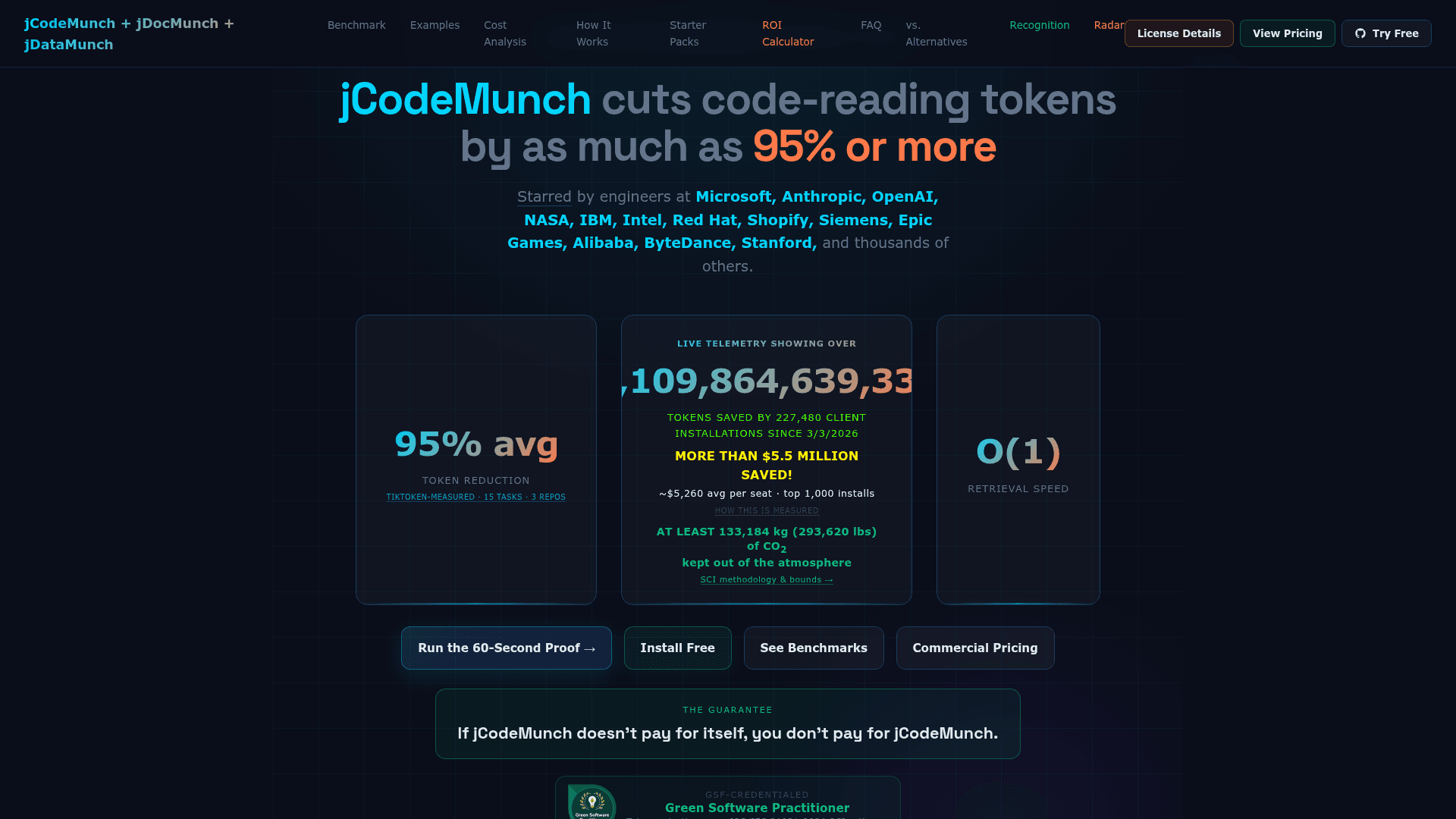
Per-query results range from 7.6x to 81.2x (median 26.1x). An independent 50-iteration A/B test on a Vue 3 + Firebase production codebase showed an 80% vs 72% success rate and a 32% vs 40% timeout rate in favor of jCodeMunch. The vendor also reports live telemetry showing over 1.1 trillion tokens saved across 227,000+ reporting installs since March 2026, though these figures are vendor-published and self-reported.
Structural Capabilities Beyond Search
jCodeMunch exposes over 90 MCP tools. Several answer questions that grep-based approaches cannot:
get_blast_radius— shows what breaks if a symbol changesfind_importers— traces who imports a given symbol across the import graphget_call_hierarchy— maps call chains through exact function bodiesfind_dead_code— surfaces unreachable symbolscheck_edit_safe/check_delete_safe— preflight risky changes with terminal verdictsget_changed_symbols— diffs symbol-level changes between commitssearch_ast— anti-pattern sweeps across the AST
The tool also ships Claude Code hooks: PreToolUse intercepts large file reads and routes to symbol retrieval; PostToolUse auto-reindexes edited files; SubagentStart injects a condensed repo orientation into every spawned subagent.
Companion Tools and Starter Packs
jCodeMunch ships alongside two companion MCP servers: jDocMunch for surgical retrieval of Markdown and documentation sections, and jDataMunch for querying CSV, Excel, Parquet, and JSONL datasets without reading entire files. All three conform to the vendor-published jMRI v1.0 (Munch Retrieval Interface), an Apache-2.0 open retrieval spec.
Pre-built starter packs provide symbol indexes for popular frameworks (Node.js, FastAPI, Django, Flask, React, LangChain, Anthropic SDK, MCP SDK, Laravel, Spring Boot) without requiring a local clone. The Node.js pack (76,700+ symbols) is free. Packs are rebuilt weekly from the latest tagged releases.
Update: v1.108.318 (September 2026)
The latest release is v1.108.318, published 2026-09-11, with the note "the process is code that cannot skip a step, and the field is measured from result files." Recent prior releases include v1.108.317 (2026-09-04, CI harness runs on every change) and v1.108.316 (2026-09-02, benchmark display fix). The project has 2,683 GitHub stars and 366 forks as of the last data snapshot. Language support covers 70+ languages via tree-sitter, including Python, JavaScript/TypeScript, Go, Rust, Java, C/C++, C#, PHP, Ruby, Swift, and Kotlin.
Community Discussions
Be the first to start a conversation about jCodeMunch
Share your experience with jCodeMunch, ask questions, or help others learn from your insights.
Pricing
Personal / Non-Commercial
Free for personal, academic, research, or other non-commercial use.
- Full jCodeMunch MCP server
- Symbol-level code retrieval
- 70+ language support via tree-sitter
- Bundled ONNX semantic search
- Free Node.js starter pack (76,700+ symbols)
Builder
Commercial use license for 1 developer. jCodeMunch only.
- Commercial use for 1 developer
- Full jCodeMunch MCP server
- All symbol retrieval tools
- All starter packs
Trio Builder
Commercial use bundle of jCodeMunch + jDocMunch + jDataMunch for 1 developer.
- jCodeMunch Builder License
- jDocMunch Builder License
- jDataMunch Builder License
- Code, docs, and data retrieval in one
- Commercial use for 1 developer
Studio
Commercial use license for up to 5 developers. jCodeMunch only.
- Commercial use for up to 5 developers
- Full jCodeMunch MCP server
- All symbol retrieval tools
- All starter packs
Trio Studio
Commercial use bundle of jCodeMunch + jDocMunch + jDataMunch for up to 5 developers.
- jCodeMunch Studio License
- jDocMunch Studio License
- jDataMunch Studio License
- Full retrieval suite for AI-enabled teams
- Org-wide token-savings rollup across all seats
Platform
Org-wide commercial use license. jCodeMunch only.
- Unlimited commercial use company-wide
- Full jCodeMunch MCP server
- All symbol retrieval tools
- All starter packs
Trio Platform
Org-wide commercial use bundle of jCodeMunch + jDocMunch + jDataMunch.
- jCodeMunch Platform License
- jDocMunch Platform License
- jDataMunch Platform License
- Full retrieval suite, org-wide, all three tools
- Org-wide token-savings rollup across all seats
Enterprise
Custom enterprise terms or deployment arrangement. Contact for pricing.
- Custom enterprise licensing terms
- Custom deployment arrangements
- All jMunch suite tools
Capabilities
Key Features
- Symbol-level code retrieval via tree-sitter AST parsing
- 96.5% average token reduction vs grep-and-read agent baseline
- search_symbols and get_symbol_source MCP tools
- get_blast_radius for impact analysis before refactoring
- find_importers for import graph traversal
- find_dead_code detection
- check_edit_safe and check_delete_safe preflight tools
- get_call_hierarchy for call chain tracing
- assemble_task_context for single-call context assembly
- Bundled ONNX local model (all-MiniLM-L6-v2) for zero-config semantic search
- 4-tier LLM summary chain (Anthropic → Gemini → OpenAI-compatible → signature fallback)
- Claude Code hooks (PreToolUse, PostToolUse, SubagentStart, TaskCompleted, PreCompact)
- Pre-built starter packs for popular frameworks
- jDocMunch companion for documentation retrieval
- jDataMunch companion for data file querying
- jMRI v1.0 open retrieval spec compliance
- Embedding drift canary detection
- Groq Remote MCP cloud-hosted option
- Per-project .jcodemunch.jsonc configuration overlay
- Incremental indexing and watch modes
- MUNCH compact wire encoding
- 70+ language support via tree-sitter
- Monorepo support with workspace-member detection
- Anonymous savings telemetry with opt-out
- SCIP import for compiler-verified references
- Secret redaction before LLM exposure
- 9 generations of backward-compatible index format