
web-researcher-mcp
An open-source MCP server that gives AI assistants real web search with verified citations, full-article reading, and trusted source filtering via search lenses.
At a Glance
Fully free and open-source under the MIT license. No cost, no usage limits imposed by the project itself.
Engagement
Available On
Alternatives
Listed Jun 2026
About web-researcher-mcp
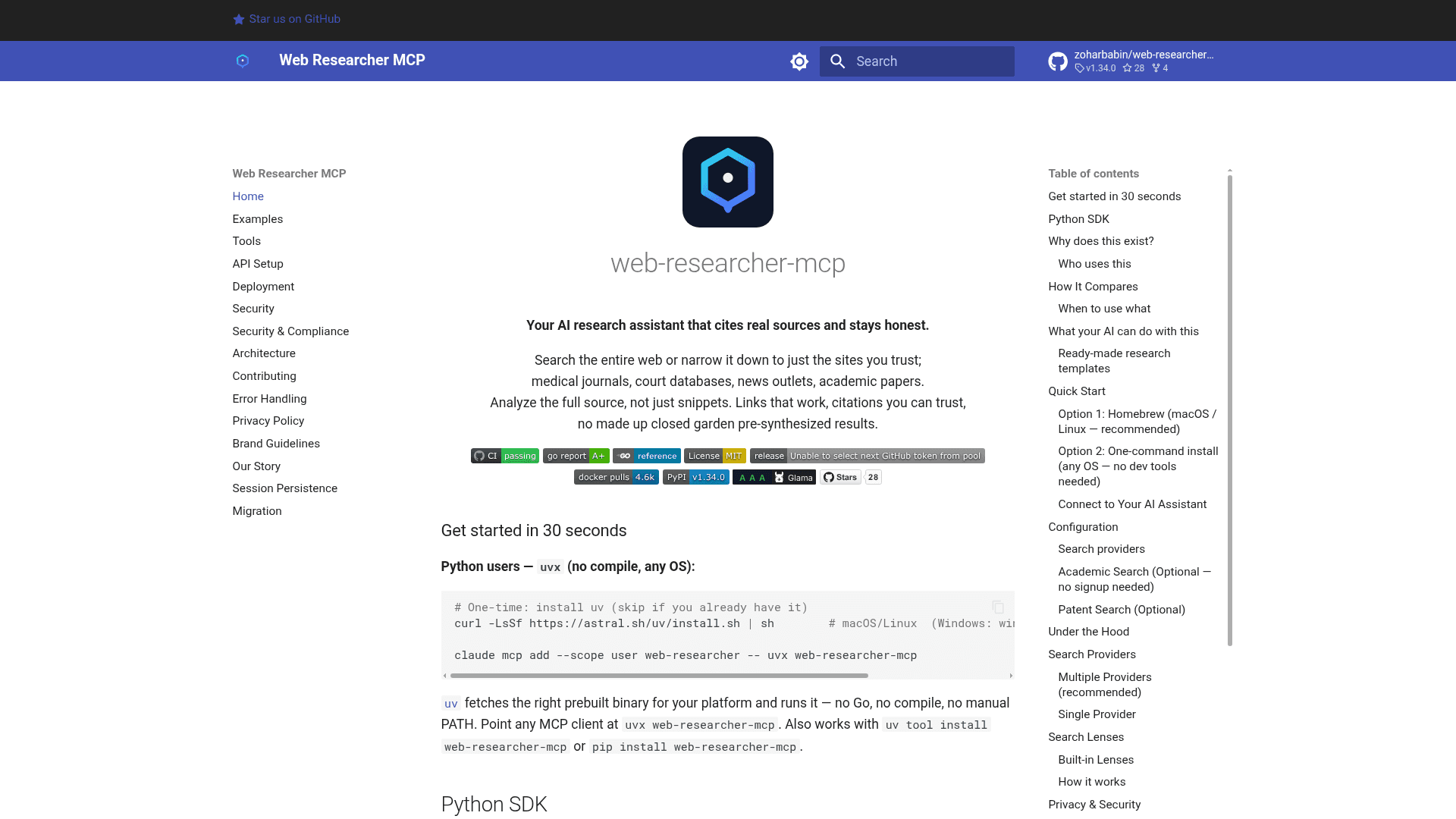
web-researcher-mcp is an open-source Model Context Protocol (MCP) server written in Go that equips AI assistants like Claude, Cursor, and any MCP-compatible client with honest, citation-verified web research capabilities. Built by Zohar Babin and released under the MIT license, it runs entirely on the user's machine — queries never pass through a third-party server. The latest release is v1.34.0, published June 16, 2026, which added a Python SDK.
What It Is
web-researcher-mcp is an MCP server that plugs into AI assistants and gives them a suite of research tools: web search, full-page scraping, academic paper lookup, patent search, SEC filing retrieval, US court record search, citation verification, and more. Unlike AI search products that synthesize results from opaque indexes, this tool fetches and reads primary sources directly, returning working links and properly formatted citations (APA, MLA, BibTeX, RIS, CSL-JSON). The core design goal is eliminating hallucinated citations — every result must be a real, verifiable URL.
How Search Lenses Work
A central feature is "search lenses" — curated domain lists that restrict which websites an AI is allowed to search. Instead of querying the open web and surfacing SEO spam or AI-generated content, a lens limits results to trusted sources for a given field:
medical— PubMed, WHO, NIH, and clinical sourceslegal— law databases, case repositories, statutesacademic— preprint servers, open-access journals, repositoriessecurity— CVEs, advisories, vulnerability researchfinance— SEC EDGAR, market filingsjournalism— public records, FOIA, corporate filings
Users can also define custom lenses by listing trusted domains in a JSON file. Lenses work with every supported search provider.
Tool Suite and Research Capabilities
The server exposes over 20 tools to connected AI assistants, covering the full research workflow:
web_search/search_and_scrape— web search with optional lens filtering and quality scoringscrape_page— full-text extraction of web pages, PDFs, Word docs, YouTube transcripts, and Hacker News threadsacademic_search— real papers with DOIs, authors, citation counts, and open-access links via OpenAlex/CrossRefcitation_graph— walks a paper's citation neighborhood with intent/influence signalspatent_search— US, European, and international patent officesfiling_search— SEC EDGAR filings (10-K, 10-Q, 8-K) and structured XBRL company factslegal_search— US court opinions and dockets via CourtListenerverify_citation/audit_bibliography— checks whether citations exist, match real records, and are not retractedanswer— synthesized factual answers with citations (requires Exa provider)sequential_search— multi-step deep research with session persistenceresearch_export— exports sessions as markdown or JSON reports with full provenance
Guided prompt templates (comprehensive-research, fact-check, competitive-analysis, literature-review) are also bundled and surface as slash commands in supported AI apps.
Deployment and Setup Paths
The server ships as a single signed binary with multiple install paths:
- Python/uvx —
uvx web-researcher-mcp(no Go required, cross-platform) - Homebrew —
brew install zoharbabin/tap/web-researcher-mcp(macOS/Linux) - One-command shell installer — curl/PowerShell scripts for macOS, Linux, and Windows
- WinGet / Scoop — Windows package managers
- Docker —
zoharbabin/web-researcher-mcpimage with Chromium bundled - Go install —
go installfrom source - One-click buttons — deep-link installers for Cursor, VS Code, and LM Studio
DuckDuckGo is the zero-config default (no API key needed). Optional providers — Google PSE, Brave, Serper, Tavily, Exa, SearXNG, SearchAPI.io, and Hacker News — can be added by setting environment variables. Multiple providers can be configured for automatic failover via SEARCH_ROUTING.
Update: v1.34.0 — Python SDK
The v1.34.0 release (June 16, 2026) introduced a Python SDK (web-researcher-mcp on PyPI) with an async WebResearcherClient and a sync wrapper for scripts and notebooks. The SDK is installable via pip, uv, or uvx, and the PyPI wheels vendor the compiled Go binary so no Go toolchain is required. The project also ships an HTTP server mode with OAuth 2.1 support for team deployments, and the repository shows active development with 27 stars and 4 forks as of the latest data.
Community Discussions
Be the first to start a conversation about web-researcher-mcp
Share your experience with web-researcher-mcp, ask questions, or help others learn from your insights.
Pricing
Open Source
Fully free and open-source under the MIT license. No cost, no usage limits imposed by the project itself.
- All research tools included
- DuckDuckGo zero-config default
- Support for 9 search providers
- Search lenses for trusted source filtering
- Full-article scraping including PDFs and YouTube transcripts
Capabilities
Key Features
- Web search with configurable search providers (DuckDuckGo, Google PSE, Brave, Serper, Tavily, Exa, SearXNG, SearchAPI.io, Hacker News)
- Search lenses for restricting results to trusted domain lists by field
- Full-page scraping of web pages, PDFs, Word docs, YouTube transcripts, and Hacker News threads
- Academic paper search with real DOIs, authors, citation counts, and open-access links
- Citation graph traversal with intent and influence signals
- Patent search across US, European, and international patent offices
- SEC EDGAR filing search and structured XBRL company facts
- US court opinion and docket search via CourtListener
- Economic data lookup (World Bank, OECD, Eurostat, FRED)
- ClinicalTrials.gov search for clinical trial registrations
- Citation verification and bibliography auditing
- AI recommendation list auditing for conflicts of interest and dead links
- Internet Archive snapshot capture via Save Page Now
- Synthesized factual answers with citations (requires Exa)
- Structured JSON extraction from search results
- Multi-step sequential deep research with session persistence
- Research session export as markdown or JSON with full provenance
- Bibliography formatting in APA, MLA, BibTeX, RIS, and CSL-JSON
- Guided prompt templates for comprehensive research, fact-checking, competitive analysis, and literature review
- Multi-provider automatic failover routing
- HTTP server mode with OAuth 2.1 for team deployments
- Python SDK with async and sync wrappers
- SSRF protection, rate limiting, and content sanitization
- Disk-based result caching
- JavaScript-heavy site rendering via headless Chromium