
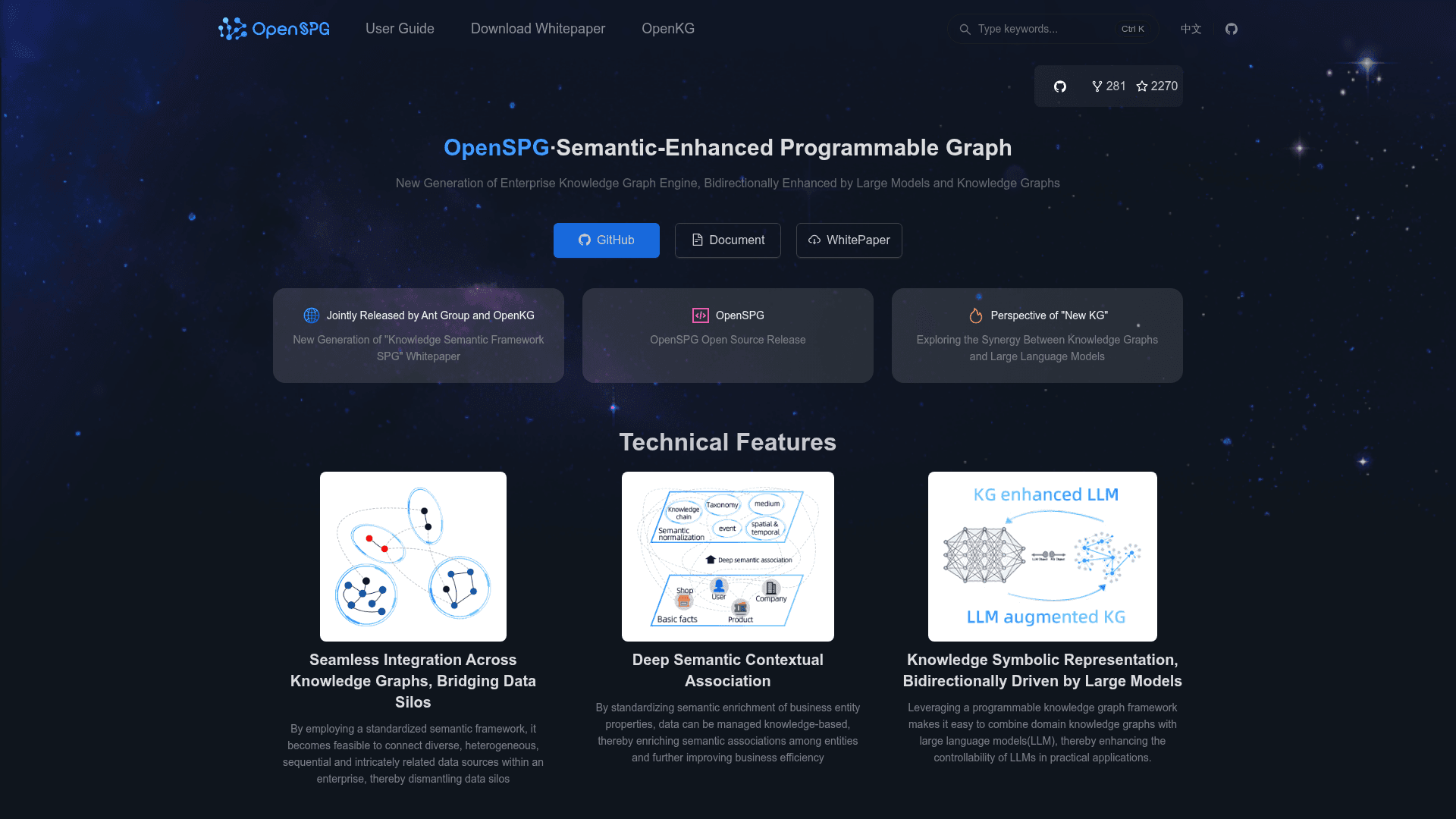
Open-source logical-form-guided reasoning and retrieval framework built on the OpenSPG engine and LLMs for professional-domain knowledge base Q&A.
At a Glance
KAG core framework is released under the Apache License 2.0, free to use, modify and distribute when self-hosted.
Engagement
Available On
Alternatives
Listed Nov 2026
About KAG
KAG (Knowledge Augmented Generation) is an open-source framework from the OpenSPG project for building logical reasoning and factual question-answering solutions over vertical-domain knowledge bases. It combines the OpenSPG knowledge graph engine with large language models. The latest release listed in the repository is v0.8.0, published in June 2025.
What It Is
KAG is a knowledge-enhanced LLM service framework for professional domains. The README says it aims to overcome the ambiguity of vector-similarity retrieval in traditional RAG and the noise that OpenIE introduces into GraphRAG. It supports logical reasoning and multi-hop fact Q&A over private knowledge bases that mix unstructured data, structured data, and expert rules.
How It Works
The framework has three parts: kg-builder, kg-solver, and kag-model. Only kg-builder and kg-solver are covered by the release described in the README.
- kg-builder builds an LLM-friendly knowledge representation based on the DIKW hierarchy. It uses layout analysis, knowledge extraction, property normalization, and semantic alignment to turn raw data and expert rules into a unified knowledge graph. It supports schema-free extraction and schema-constrained construction, with mutual indexing between graph structure and source text chunks.
- kg-solver is a logical-form-guided hybrid reasoning engine. Planning, reasoning, and retrieval operators turn natural-language questions into solving steps that can use exact-match retrieval, text retrieval, numerical calculation, or semantic reasoning.
Update: Version 0.8.0
The 0.8.0 release, dated 2025-06-27 in the README, adds private and public-network knowledge base modes, and public data sources such as LBS and web search can be integrated through MCP. Built-in index types include Outline, Summary, KnowledgeUnit, AtomicQuery, Chunk, and Table. Knowledge bases are now decoupled from applications, and KAG-powered inference Q&A can run inside agent workflows over MCP. The release also adapts the KAG-Thinker model. Version 0.7 added static and iterative task planning, Simple and Deep Reasoning modes, streaming output, and a Lightweight Build mode, which the README says cuts knowledge-construction token cost by 89%.
Setup Path
Users can run the product mode by launching the engine and dependent images with Docker Compose and opening the web UI at a local address. Developers can instead install the toolkit with pip from a cloned repository on Python 3.10 or later. The project is licensed under Apache 2.0.
Community Discussions
Be the first to start a conversation about KAG
Share your experience with KAG, ask questions, or help others learn from your insights.
Pricing
Open Source (Apache-2.0)
KAG core framework is released under the Apache License 2.0, free to use, modify and distribute when self-hosted.
- Apache License 2.0
- Self-hosted framework based on OpenSPG engine
- Logical form-guided reasoning and retrieval
- MCP protocol support
- LLM/inference costs are external and not sold by the project
Capabilities
Key Features
- Logical-form-guided hybrid reasoning and retrieval
- Multi-hop fact Q&A
- Knowledge and chunk mutual indexing
- Schema-constrained knowledge construction
- Conceptual semantic alignment to reduce OpenIE noise
- Built-in index types (Outline, Summary, KnowledgeUnit, AtomicQuery, Chunk, Table)
- Private and public-network knowledge base modes
- MCP support for agent workflows
- Simple and Deep Reasoning modes with streaming output
- Lightweight Build mode
- Docker Compose product mode and pip-installable developer toolkit