
Kangentic
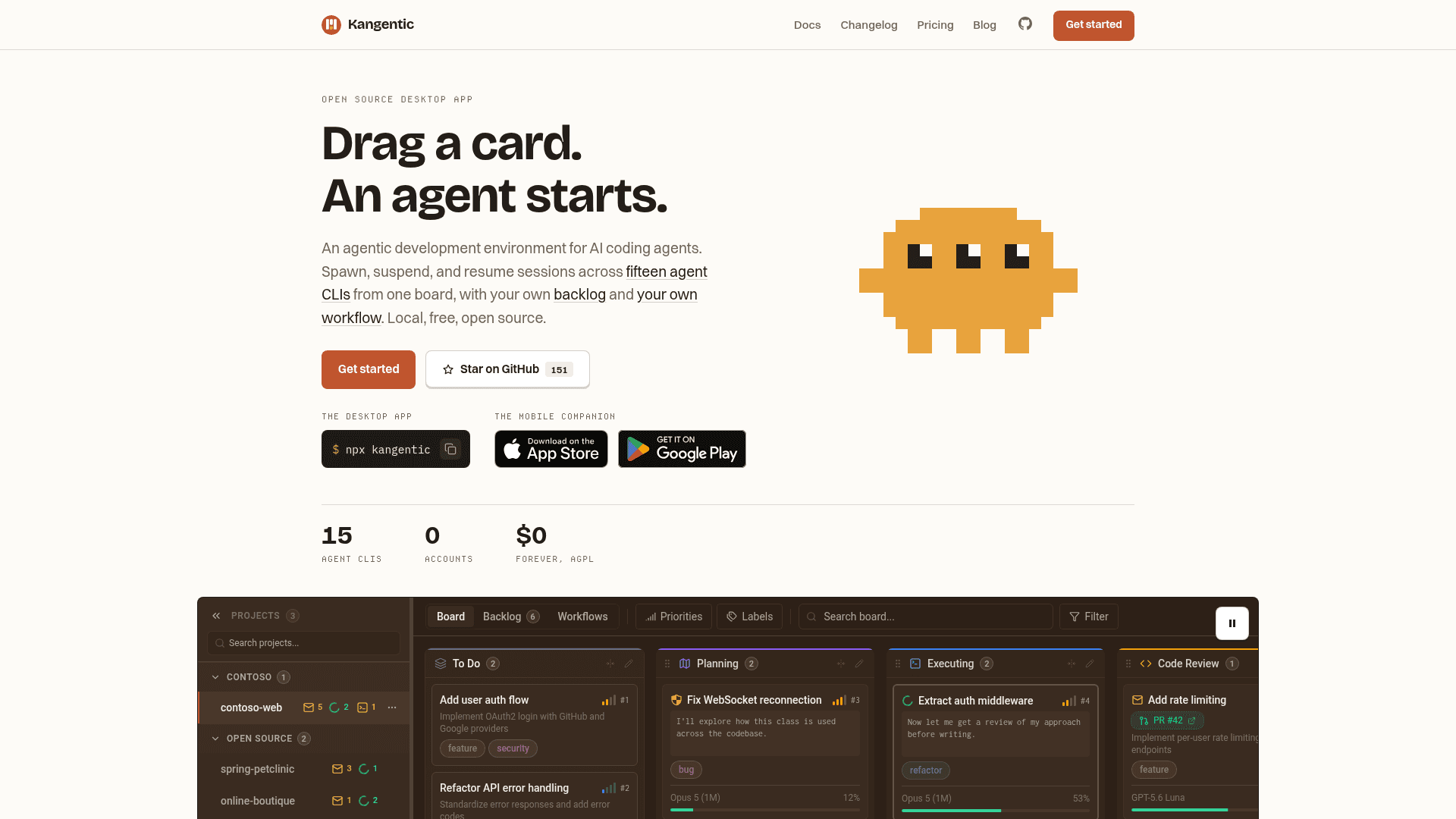
Open source desktop app that runs AI coding agent CLIs from a Kanban board, with each task in its own git worktree.
At a Glance
The full Kangentic desktop app, open source under AGPL-3.0, with every feature included and no account required.
Engagement
Available On
Listed Nov 2026
About Kangentic
Kangentic is an open source agentic development environment for AI coding agents, published under AGPL-3.0 with a copyright notice from VORPAHL LLC. Users drag a card on a board to spawn, suspend, or resume sessions across fifteen agent CLIs, using the CLIs and credentials they already have. A mobile companion app for iOS and Android pairs with the desktop app. The latest release listed is v0.61.0.
What It Is
Kangentic is a cross-platform Electron desktop app that puts every coding agent session on one board. Each card shows its agent, model, context-window use, and the agent's last message, with a mark on sessions that need the user. Dragging a card into an active column creates a git worktree on a new branch, applies the column's permission mode, and starts the configured agent in a live terminal. The project's own folder stays untouched, so parallel agents do not collide.
Workflow and Automation
The board is user-defined. Columns carry their own agent, model, effort, permissions, and automations, and the configuration is stored in kangentic.json so a team can share it through the repo. Automations can run when a task enters a column, when an agent finishes a turn, or when a task leaves. They can message the agent, run a script, call a webhook, notify the user, or move the card. Linked-task workflows start each task once the tasks it depends on reach Done. A built-in MCP server lets agents create tasks, move their own cards, search past sessions, and message other agents. Handoff context passes one agent's conversation history to the next agent when a card changes agents.
Agents, Backlogs, and Review
Supported CLIs include Claude Code, Codex CLI, Gemini CLI, Cursor CLI, GitHub Copilot CLI, Grok Build, Antigravity, Goose, OpenCode, Aider, Qwen Code, Kimi Code, Factory Droid, Warp (Oz CLI), and Ollama for single-turn chat. Tasks can be imported from GitHub Issues and Projects, Azure DevOps, Asana, Jira, Linear, Trello, GitLab, an Obsidian vault, or a repo folder. A Changes panel shows diffs and commit history, and linked GitHub or Azure DevOps pull requests show their status on the card. Further features include an Agent Monitor across projects, usage stats, Quick Find, a Knowledge Graph, browser annotations, SSH remote hosts, and voice dictation.
Setup and Privacy
Install with npx kangentic, which downloads the release for the platform. Git 2.26 or later and at least one signed-in agent CLI are required. Boards, tasks, and transcripts stay in a local SQLite database. By default the app sends anonymous usage events and error reports, which an environment variable turns off.
Community Discussions
Be the first to start a conversation about Kangentic
Share your experience with Kangentic, ask questions, or help others learn from your insights.
Pricing
Free
The full Kangentic desktop app, open source under AGPL-3.0, with every feature included and no account required.
- Unlimited projects, tasks, and agent sessions
- Every supported agent CLI
- Every current and future feature included
- Local-first storage, no account required
- AGPL-3.0 licensed (OSI-approved); commercial license available via licensing@kangentic.com for proprietary modifications
Capabilities
Key Features
- Kanban board that spawns, suspends, and resumes agent CLI sessions by dragging cards
- Support for fifteen agent CLIs
- Per-task git worktree isolation
- Per-column agent, model, effort, and permission settings
- Column automations: messages, scripts, webhooks, notifications, card moves
- Linked-task workflows
- Built-in MCP server for agents to manage the board
- Handoff context between agents
- Backlog import from GitHub, Azure DevOps, Asana, Jira, Linear, Trello, GitLab, Obsidian
- Changes panel for diff review and PR status tracking
- Agent Monitor across projects
- Usage stats for tokens and cost
- Knowledge Graph search over past conversations, tasks, and commits
- Embedded browser with annotations
- SSH remote hosts
- Session persistence
- Voice dictation
- Mobile companion app with end-to-end encrypted pairing