
Kapitsa
Open-source Apple Silicon inference engine that runs Qwen, Nemotron and Flint models locally for coding agents with OpenAI and Anthropic-compatible APIs.
At a Glance
Self-hosted Kapitsa inference engine for Apple silicon, licensed under Apache License 2.0.
Engagement
Available On
Alternatives
Listed Oct 2026
About Kapitsa
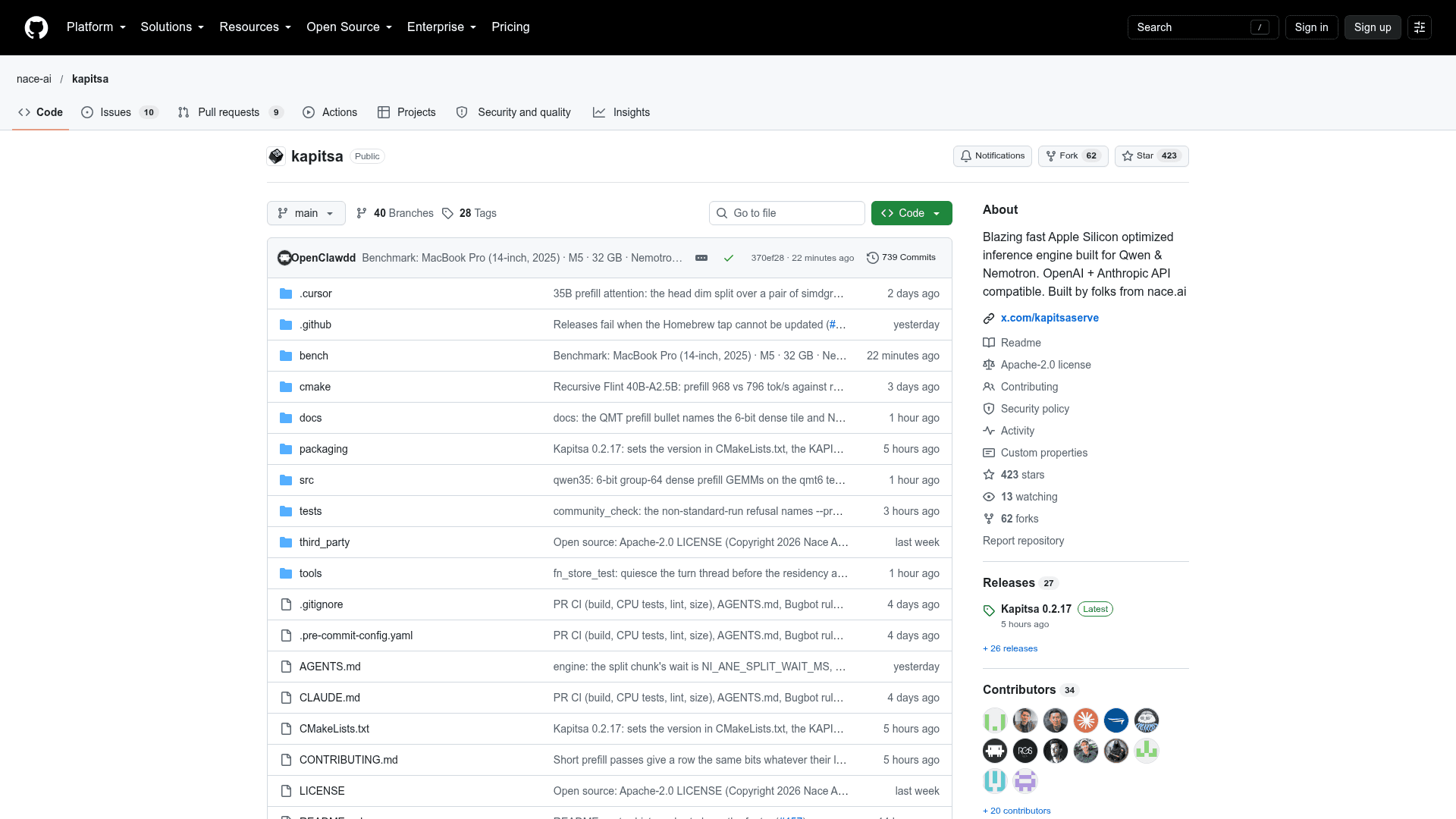
Kapitsa is an open-source inference engine for Apple silicon, published by Nace AI under the Apache 2.0 license. It runs Qwen, Nemotron and Recursive's Flint models locally and is built for coding agents. It can launch opencode, Claude Code, Codex or pi on a local model, and it serves OpenAI and Anthropic APIs. The latest listed release is v0.2.17.
What It Is
Kapitsa is a local LLM runtime for Macs with Apple silicon (M1 or newer) on macOS 14 Sonoma or later. Users install it through Homebrew or an install script, then start a model with a command such as kapitsa serve or kapitsa claude. The server exposes a chat interface plus OpenAI- and Anthropic-compatible APIs at a local address, so existing agent tooling can point at a local model. Its decoding path uses hand-written Metal code.
How KFlash Decoding Works
Kapitsa decodes with KFlash, a tree-based form of speculative decoding. A draft model guesses upcoming tokens with several candidates per position, and the large model verifies a best-first tree of those candidates in a single pass, so more tokens survive each pass. The README states that the tree size is measured per Mac and that output is unchanged, because the big model checks every token. It works with published drafters including z-lab's DFlash and DFlash2 and NVIDIA's DSpark and LiLiCorr.
CLI and Workflow
The command line covers serving, launching agents (claude, codex, opencode, pi), downloading and listing models (pull, list, rm), and importing Qwen or Flint GGUF files from LM Studio, Ollama or llama.cpp. kapitsa doctor reports the Mac's GPU and memory and which models fit. kapitsa cluster finds other Macs on the network running Kapitsa, and a Mac that cannot hold a model can use another one on the network. kapitsa bench benchmarks the machine, and bench compare runs the same test against other installed engines.
Models and Benchmarks
The catalog includes Qwen3.5-4B and 9B, Qwen3.8-27B, Qwen3.6-35B-A3B, Qwen3.8-Flash-Next, several Nemotron models, and Recursive Flint 40B-A2.5B, with 2-bit GGUF variants for 16-24 GB Macs. The project's own benchmarks across M1 Pro to M5 Max MacBook Pros claim the fastest decode in 32 of 36 model and Mac pairs against nine engines; these are vendor-published measurements. Other documented features include an SSD prefix cache, prefix reuse for subagents, and image input on most models.
Community Discussions
Be the first to start a conversation about Kapitsa
Share your experience with Kapitsa, ask questions, or help others learn from your insights.
Pricing
Open Source
Self-hosted Kapitsa inference engine for Apple silicon, licensed under Apache License 2.0.
- Apache License 2.0 (OSI-approved)
- Runs Qwen, Nemotron and Flint models locally on Apple silicon
- OpenAI and Anthropic compatible APIs
- Launches opencode, Claude Code, Codex or pi on a local model
- Requires a Mac with Apple silicon (M1 or newer) and macOS 14 Sonoma or later
Capabilities
Key Features
- KFlash tree speculative decoding
- Hand-written Metal kernels for Apple silicon
- OpenAI and Anthropic compatible APIs
- Launches opencode, Claude Code, Codex and pi on local models
- SSD prefix cache
- Prefix reuse for subagents
- Multi-Mac clustering over the network
- GGUF import from LM Studio, Ollama and llama.cpp
- Built-in benchmarking and engine comparison
- Image input on most models
- Multiple precisions per model