
KinoPipe
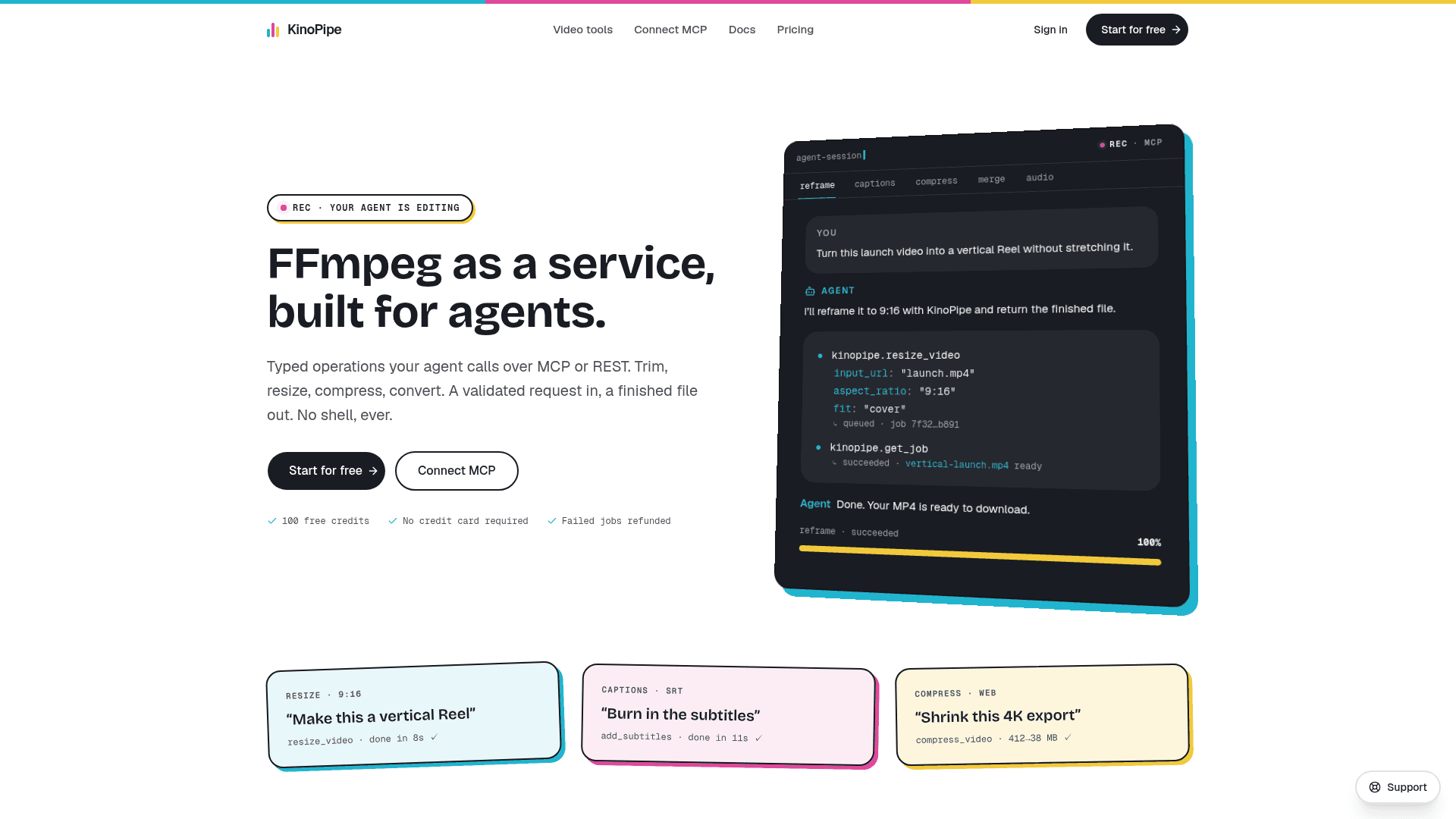
FFmpeg as a service built for AI agents — 48 typed video editing tools accessible over MCP or REST API, with no shell commands required.
At a Glance
For prototypes and first agent edits.
Engagement
Available On
Alternatives
Listed Aug 2026
About KinoPipe
KinoPipe is an FFmpeg-as-a-service platform built specifically for AI agents and developer backends. Created and run by independent developer Nicolas Coutureau, it exposes 48 typed video editing operations — trim, resize, compress, captions, scene splitting, and more — through a remote MCP server and a REST API, so agents never need to touch a shell or bundle an FFmpeg binary.
What It Is
KinoPipe sits between an AI agent (or any backend) and the complexity of video processing. Instead of generating FFmpeg shell commands, an agent sends a validated JSON request to a typed endpoint and receives a finished file URL in return. Every operation is a stable, bounded contract: named inputs, typed options, and a predictable response shape. The platform runs hosted FFmpeg 9 workers with GPU encoders, handling the rendering infrastructure entirely on its side.
How the Agent Workflow Works
The typical flow has three steps: describe the edit (send a video URL and typed options), wait for rendering (KinoPipe processes in a single pass on its workers), and retrieve the file (a download URL or a signed webhook fires when the job is done). Agents connect via the remote MCP server at kinopipe.com/mcp using OAuth 2.1, which means no API key to paste into a prompt. REST API callers use bearer keys and can attach idempotency keys for safe retries. The Jobs API accepts multi-operation pipelines — trim then resize, for example — processed in order in one encode.
The 48 Typed Tools
Each tool is a focused endpoint with its own page, stable slug, and narrow option set. The available prebuilt tools include:
- Trim, resize, compress, crop — core editing primitives
- Add subtitles — burn SRT or WebVTT into video
- Merge videos — normalize and join two to six clips
- Split by scenes / segment duration — up to 50 output files
- Convert to GIF — palette-optimized animated GIF
- Add music, watermark, picture-in-picture — compositing operations
- Extract audio, remove audio, generate thumbnails — utility tools
The Jobs API also supports composing these as operations in a single request for advanced pipelines.
MCP and Agent Client Support
KinoPipe publishes a remote MCP server with OAuth 2.1 and Streamable HTTP transport. The About page and homepage list supported clients: Claude, Claude Code, Cursor, Windsurf, GitHub Copilot, Codex, ChatGPT, and n8n (via a community node). One command or config entry adds every tool to the agent's discovery context. The same operations are available over plain REST for backends that don't use MCP.
Design Philosophy and Tradeoffs
The About page is explicit about the product's constraints and values. KinoPipe never accepts shell commands — only bounded, validated operations — which limits surface area and reduces the risk of injection or unexpected behavior in agent loops. Files are not retained: direct uploads are deleted after 24 hours, outputs are served through expiring signed URLs for up to 12 months, and media is never used to train models. Failed jobs automatically refund their credits. The product is built and supported by a single founder, who the About page notes answers support chat directly.
Current Status
KinoPipe is actively available with a free tier requiring no credit card. The homepage cites a 325-run benchmark covering cold, warm, and burst phases, with a reported p50 render time of 8.2 seconds for a 1080p edit and a 100% success rate across those benchmark runs. The platform is positioned as production-ready for agent workflows, with an OpenAPI 3.1 spec published at /openapi.json for client generation.
Community Discussions
Be the first to start a conversation about KinoPipe
Share your experience with KinoPipe, ask questions, or help others learn from your insights.
Pricing
Free
For prototypes and first agent edits.
- 100 credits once, about 10 edits
- Complete video API
- No credit card required
Starter
For side projects and first automations.
- 1,500 credits / month, about 150 edits
- No surprise overages
- Community support
Developer
For agents editing video in production.
- 5,000 credits / month, about 500 edits
- No surprise overages
- Email support
Pro
For video-heavy agent workflows.
- 25,000 credits / month, about 2,500 edits
- Best price per credit
- Priority support
Credit Pack
One-time credit top-up for bursts without a subscription. Credits never expire.
- 1,000 credits, about 100 edits
- Credits never expire
- No subscription required
Capabilities
Key Features
- 48 typed video editing tools over MCP and REST API
- Remote MCP server with OAuth 2.1 authentication
- Hosted FFmpeg 9 workers with GPU encoders
- Single-pass rendering — no re-encoding chains
- Jobs API for multi-operation pipelines
- Prebuilt tools: trim, resize, compress, captions, merge, split, GIF, watermark, PiP, and more
- Asynchronous jobs with status polling and signed webhooks
- Idempotency keys for safe retries
- Direct file uploads (up to 300 MB) with signed storage policy
- Automatic credit refund for failed jobs
- No shell commands — bounded, validated operations only
- OpenAPI 3.1 spec for client generation
- Browser playground to test edits before automating
- Files deleted after 24 hours — media never used for training
- Hard stop at zero credits — no surprise overages