
Kiro Crew
Open source persistent development workspace that remembers context, learns from corrections, and runs agent tasks across sessions, on schedules, and via webhooks.
At a Glance
Kiro Crew application is open source under Apache License 2.0 with no separate subscription or fee; running agents requires a separate Kiro plan (inference via your Kiro account) and your own hardware.
Engagement
Available On
Alternatives
Listed Oct 2026
About Kiro Crew
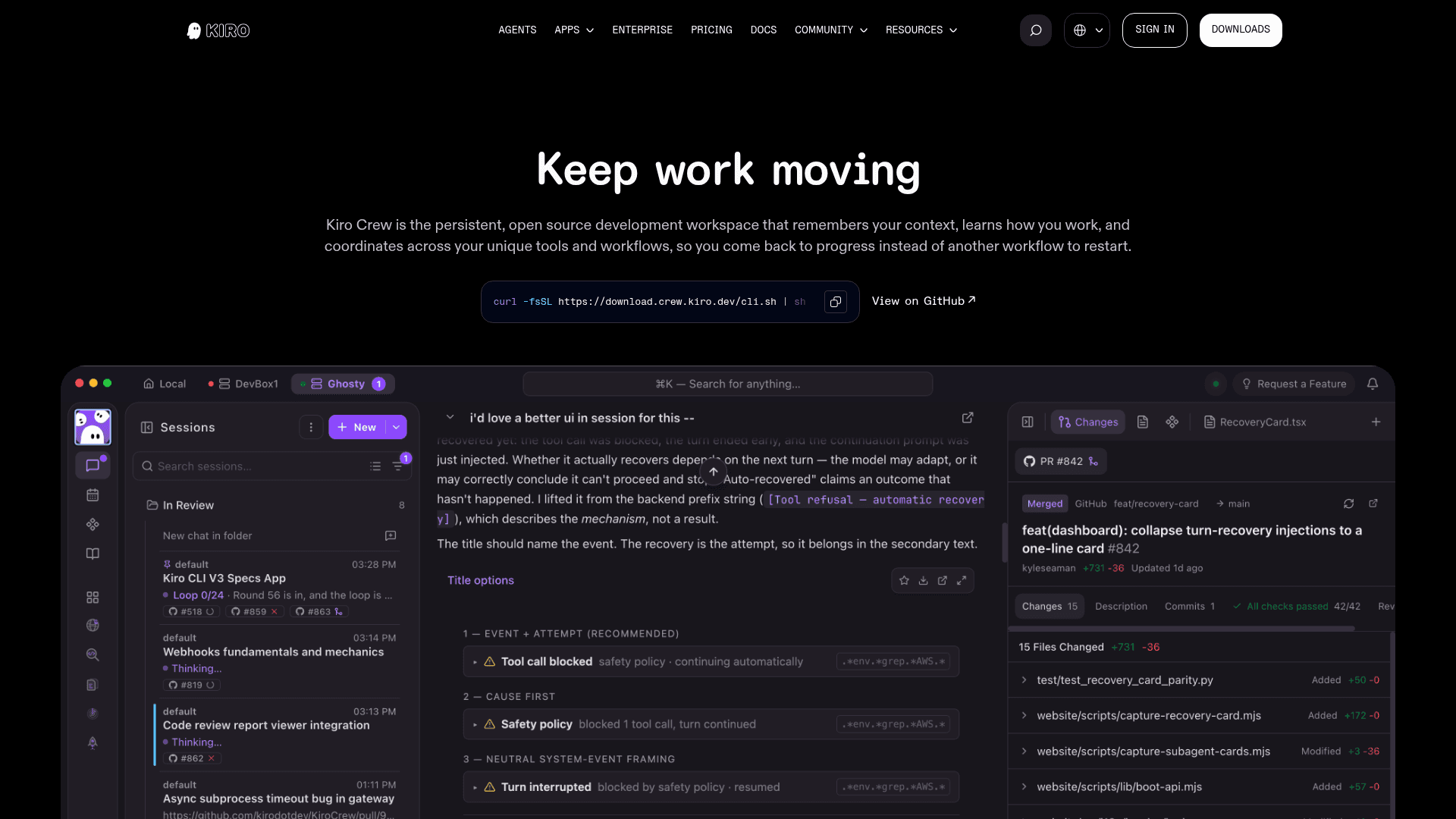
Kiro Crew is an open source development workspace from the Kiro team that runs locally or on remote hardware you control. It keeps memory, lessons, skills, schedules, and task checkpoints across sessions, so work continues after a chat closes. It is available as a desktop app, web dashboard, and CLI, and can also be driven through messaging tools such as Slack and Discord. The repository's latest listed release is v0.8.0, and the code is licensed under Apache 2.0.
What It Is
Kiro Crew is a persistent agent workspace for software development. A Gateway process holds sessions, memory, policy, approvals, schedules, and apps, while agent sessions run through the Agent Client Protocol (ACP). The default agent runs on the Kiro CLI, which is installed and signed in to separately with a Kiro account. Its FAQ states that model usage counts against a Kiro plan.
Typical work includes long-running tasks that plan, execute, validate, retry, and resume from checkpoints, plus delegation to isolated subagents for parallel work.
Memory, Lessons, and Skills
Corrections and task failures become durable lessons, and repeated workflows can be synthesized into named skills. Lessons and skills are Markdown files that can be inspected, edited, scoped to a workspace, or deleted, and they use the same steering file format as the Kiro IDE and CLI. Project context also lands in a knowledge graph backed by vector embeddings and full-text search.
Unattended Work and Triggers
Timezone-aware cron schedules support per-job timeouts, jitter, and skip dates. Authenticated webhooks start work when external events arrive, and heartbeat monitors watch state changes in pull requests, deployments, and pipelines. The site describes automations that scan issues, watch for codebase drift, and react to CI/CD failures.
Apps and Extensibility
Apps combine a purpose-built interface with agents, skills, schedules, and integrations. An App SDK offers TypeScript and Python bindings for the agent runtime, skill system, and event bus. Example apps named on the site include Agent Worlds, Research Lab, and Code Review Sage. Kiro Crew also works with existing skills, MCP servers, and hooks.
Security and Control
The project documents eight layers of defense, including tool approval, OS sandboxing, sensitive-path protection, denied command patterns, input validation, output credential redaction, and signed audit logs. The dashboard binds to loopback by default. It also sends an anonymous daily usage heartbeat that can be disabled in settings or via an environment variable.
Setup Path
Install with a one-line script, a macOS or Windows desktop package, the Docker image, or a source build requiring Python 3.12+ and Node.js 22.12+. After installing, run kirocrew setup, kirocrew doctor, and kirocrew gateway, then open the dashboard on localhost.
Community Discussions
Be the first to start a conversation about Kiro Crew
Share your experience with Kiro Crew, ask questions, or help others learn from your insights.
Pricing
Open Source (Apache 2.0)
Kiro Crew application is open source under Apache License 2.0 with no separate subscription or fee; running agents requires a separate Kiro plan (inference via your Kiro account) and your own hardware.
- Licensed under Apache License 2.0
- No separate subscription or fee for the application
- Requires a Kiro plan for agent inference (model requests count against your Kiro plan)
- You provide the hardware (laptop, home server, or cloud instance)
- Runs on Kiro CLI
Capabilities
Key Features
- Persistent sessions with memory that survives restarts
- Lessons learned from corrections stored as editable Markdown
- Self-synthesized reusable skills
- Knowledge graph with vector and full-text search
- Long-running tasks with checkpoints, validation, and retries
- Cron schedules, webhooks, and heartbeat monitors
- Parallel subagent delegation
- Installable Apps with TypeScript and Python App SDK
- Eight-layer defense including OS sandbox and credential redaction
- Signed audit logs
- Web dashboard, desktop app, and CLI
- Slack, Discord, and Telegram messaging surfaces
- Remote instances over SSH tunnels
- MCP server and skill compatibility