
LaVague
Open-source Large Action Model framework for building AI web agents that turn objectives into browser actions.
At a Glance
About LaVague
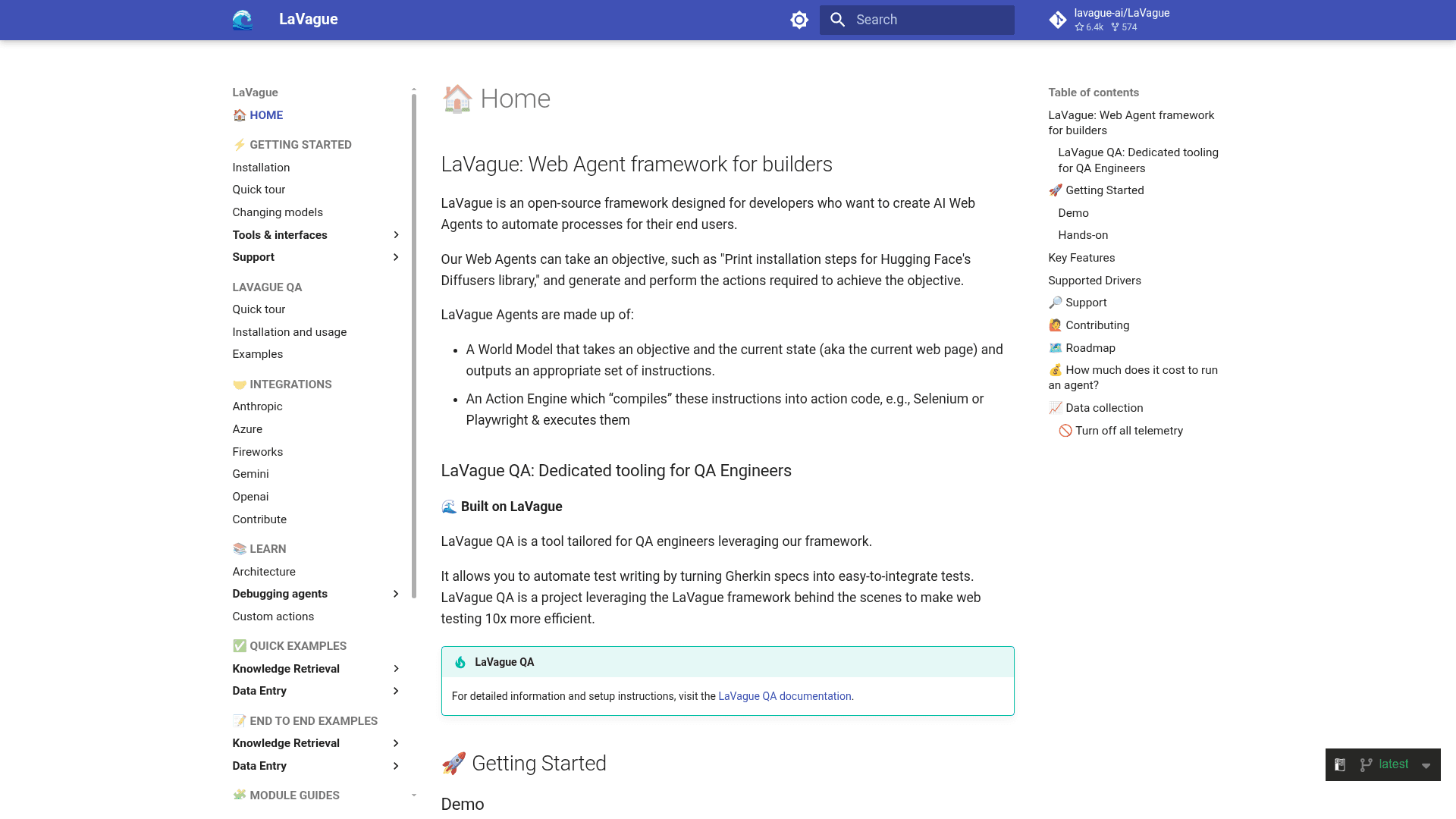
LaVague is an open-source Python framework from the lavague-ai organization for developers who build AI web agents to automate processes for their end users. An agent takes an objective, such as "Print installation steps for Hugging Face's Diffusers library", and generates and performs the browser actions needed to achieve it. The project is released under the Apache 2.0 license.
What It Is
LaVague is a web agent framework installed with pip install lavague. Each agent is built from two parts: a World Model, which takes an objective and the current web page and outputs a set of instructions, and an Action Engine, which compiles those instructions into action code (for example Selenium or Playwright) and executes it. Developers wire these together with a driver and a WebAgent, then call methods like get and run to point the agent at a site and give it an objective. By default it uses OpenAI models, but the model configuration is customizable.
Drivers and Tooling
Three driver options are supported: Selenium, Playwright and a Chrome extension. Support varies by driver. Headless agents are supported on Selenium, with Playwright listed as coming soon. Handling iframes works on Selenium and Playwright but not the Chrome extension. The framework also includes built-in contexts, a test runner for benchmarking, a Token Counter for estimating token usage and cost, logging and debugging tools, and an optional Gradio interface for interactive demos.
LaVague QA
LaVague QA is a separate tool built on the framework for QA engineers. It automates test writing by turning Gherkin specs into tests that are easy to integrate. The docs describe it as making web testing 10x more efficient, which is a vendor claim.
Model Access and Telemetry
Docs include integration guides for Anthropic, Azure, Fireworks, Gemini and OpenAI. Run cost depends on the chosen models, the complexity of the objective and the website. LaVague collects telemetry by default, including objectives, generated actions, URLs and token usage. It can be disabled by setting the LAVAGUE_TELEMETRY environment variable to NONE. The docs advise against including personal information in objectives.
Community Discussions
Be the first to start a conversation about LaVague
Share your experience with LaVague, ask questions, or help others learn from your insights.
Pricing
Open Source
Open-source LaVague framework under Apache License 2.0; LLM/API costs are external (default OpenAI gpt4-o, customizable).
- Apache License 2.0
- Selenium, Playwright and Chrome extension drivers
- Token Counter for estimating token usage and costs
- Test runner for benchmarking
- Optional Gradio interface
Capabilities
Key Features
- World Model and Action Engine agent architecture
- Selenium, Playwright and Chrome extension drivers
- Built-in contexts and customizable configuration
- Test runner for benchmarking
- Token Counter for usage and cost estimation
- Logging and debugging tools
- Optional Gradio interface
- Chrome extension
- LaVague QA: Gherkin specs to tests
- Custom actions
- Optional telemetry opt-out