
LibreChat
An open-source, self-hosted AI chat platform that unifies all major AI providers—OpenAI, Anthropic, Google, Azure, and more—in one customizable, privacy-focused interface.
At a Glance
Fully free and open-source under the MIT License. Self-host on your own infrastructure with no restrictions.
Engagement
Available On
Alternatives
Listed Sep 2026
About LibreChat
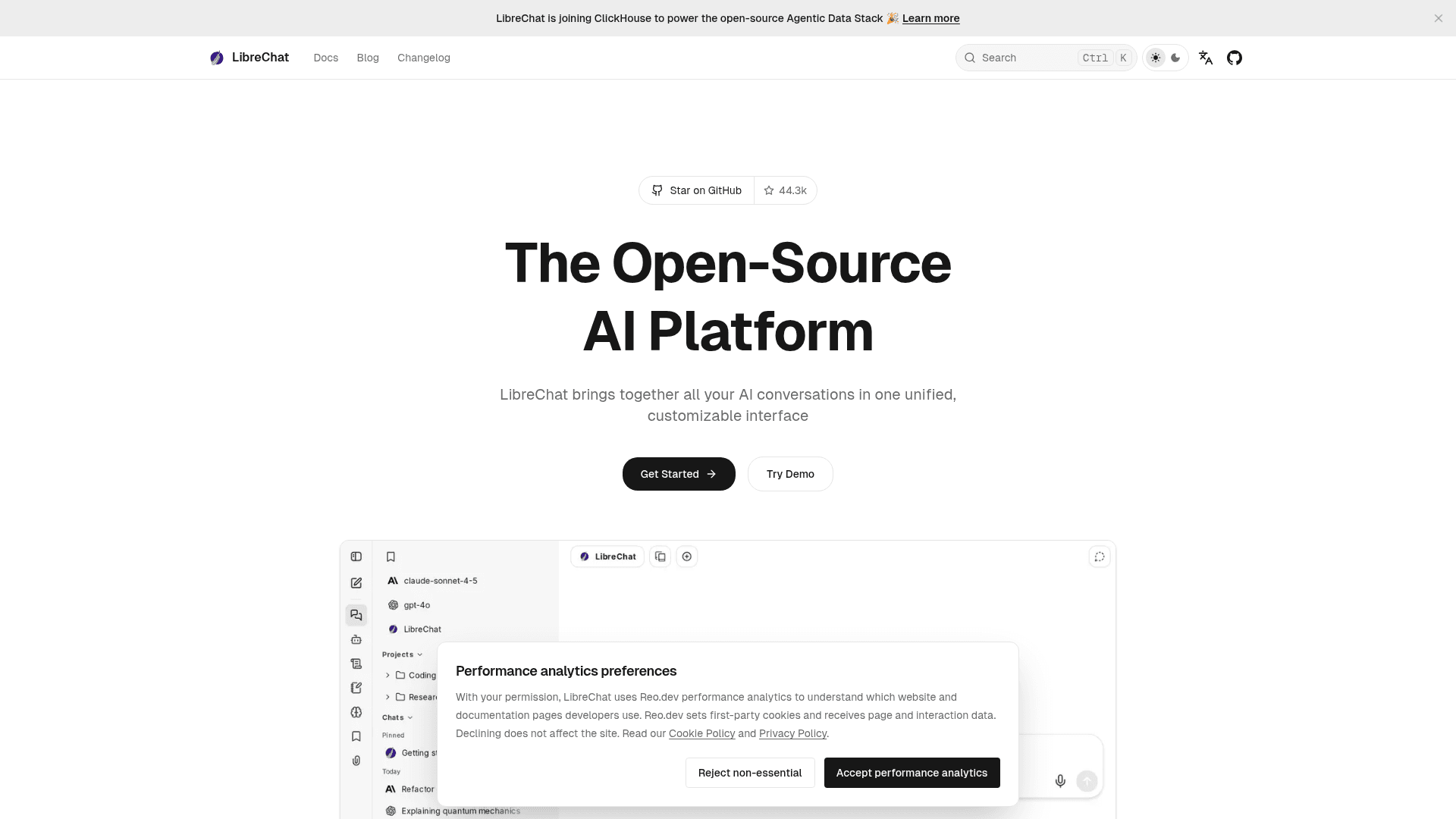
LibreChat is a free, MIT-licensed, self-hosted AI chat platform that brings together language models from every major provider into a single unified interface. Originally created by a single developer, it has grown into a community project with over 413 contributors and, according to the project's own homepage, 44,300+ GitHub stars and 53.1 million Docker pulls. The project is joining ClickHouse to power what they describe as the open-source Agentic Data Stack.
What It Is
LibreChat is a self-hosted web application—not a native desktop app—that acts as a universal front-end for AI models. Users deploy it via Docker, npm, or cloud hosting, then connect it to any combination of AI providers without vendor lock-in. It is released under the MIT License, meaning it is free to use, modify, and distribute.
Multi-Provider Model Access
One of LibreChat's defining features is its breadth of supported AI backends:
- Commercial APIs: OpenAI (including GPT-5 and Responses API), Anthropic (Claude), Google (Gemini, Vertex AI), Azure OpenAI, AWS Bedrock
- Custom & local endpoints: Ollama, Groq, Mistral AI, Cohere, Deepseek, Qwen, OpenRouter, Perplexity, koboldcpp, together.ai, Apple MLX, and more
- Any OpenAI-compatible API can be added as a custom endpoint without a proxy
Users can switch between models and endpoints mid-conversation, save presets, and share configurations across teams.
Agents, MCP, and Extensibility
LibreChat includes a no-code agent builder that supports the Model Context Protocol (MCP), custom skills, subagents, and an agent marketplace for community-built helpers. Key agent capabilities include:
- Skills: Reusable
SKILL.mdinstruction bundles for manual, automatic, or always-on workflows - Subagents: Delegate focused work to isolated child agent runs with their own context windows
- Agent Plugins: Bundle deployment skills and MCP servers into startup-loaded packages
- Attached Code Workspaces: Let agents inspect, search, edit, and run commands in managed workspaces (marked highly experimental)
- Agent Management API: Automate agent, file, and skill management with deployment-bound OIDC clients
Code Interpreter and Artifacts
LibreChat ships a sandboxed Code Interpreter API—powered by the open-source ClickHouse/code-interpreter—that executes Python, Node.js (JS/TS), Go, C/C++, Java, PHP, Rust, and Fortran in fully isolated environments. A Generative UI / Artifacts feature lets models produce interactive React components, HTML pages, and Mermaid diagrams directly in the chat window, with fullscreen preview and SVG/PNG export.
Enterprise and Self-Hosting Features
LibreChat is designed for organizations that need control over their AI infrastructure:
- Authentication: OAuth2, SAML, LDAP, and two-factor auth for enterprise SSO
- Admin Panel: Browser-based UI to manage users, groups, roles, and live configuration overrides without redeploying
- Observability: OpenTelemetry log and trace export; Langfuse integration for agent and model insights
- Resumable Streams: AI responses automatically reconnect if a connection drops; multi-tab and multi-device sync supported
- Multilingual UI: Interface available in 30+ languages with community-driven translations
- S3/CloudFront support for stable media links and edge delivery
Update: v0.8.8-rc3
The latest release candidate (v0.8.8-rc3) introduces an Agent Management API in beta, attached code workspaces (highly experimental), manual context compaction, a unified attachments system, GPT-6 Astra model support via the Responses API, OpenTelemetry observability export, and a range of reliability and security improvements including stronger tenant isolation, Redis liveness detection, and MCP OAuth session hardening. The full changelog is published at librechat.ai/changelog.
Community Discussions
Be the first to start a conversation about LibreChat
Share your experience with LibreChat, ask questions, or help others learn from your insights.
Pricing
Open Source
Fully free and open-source under the MIT License. Self-host on your own infrastructure with no restrictions.
- All features included
- Self-hosted deployment
- MIT License — use, modify, distribute freely
- Multi-provider AI model support
- Agent builder with MCP support
Capabilities
Key Features
- Multi-provider AI model support (OpenAI, Anthropic, Google, Azure, AWS Bedrock, and more)
- Self-hosted deployment via Docker, npm, or cloud
- No-code AI agent builder with MCP support
- Sandboxed Code Interpreter (Python, JS/TS, Go, C/C++, Java, PHP, Rust, Fortran)
- Generative UI with Code Artifacts (React, HTML, Mermaid)
- Web search with reranking
- Persistent memory across conversations
- Image generation and editing (DALL-E, Stable Diffusion, Flux, GPT-Image-1)
- Enterprise SSO with OAuth2, SAML, LDAP, and 2FA
- Admin panel for live user and role management
- Resumable streams with multi-tab and multi-device sync
- OpenTelemetry observability and Langfuse integration
- Conversation import/export (LibreChat, ChatGPT, Chatbot UI formats)
- 30+ language UI with community translations
- Agent marketplace and collaborative agent sharing
- Subagents with isolated context windows
- Skills system with reusable SKILL.md bundles
- Speech-to-text and text-to-speech (OpenAI, Azure, ElevenLabs)
- Conversation branching and forking
- Message and conversation search