
Linkedin Posts Job Radar
An MCP server that scrapes LinkedIn job posts, filters out noise, and provides a local dashboard to triage real openings by market, pay, and verdict.
At a Glance
Fully free and open-source under the ISC License. Self-hosted on your own machine.
Engagement
Available On
Alternatives
Listed Sep 2026
About Linkedin Posts Job Radar
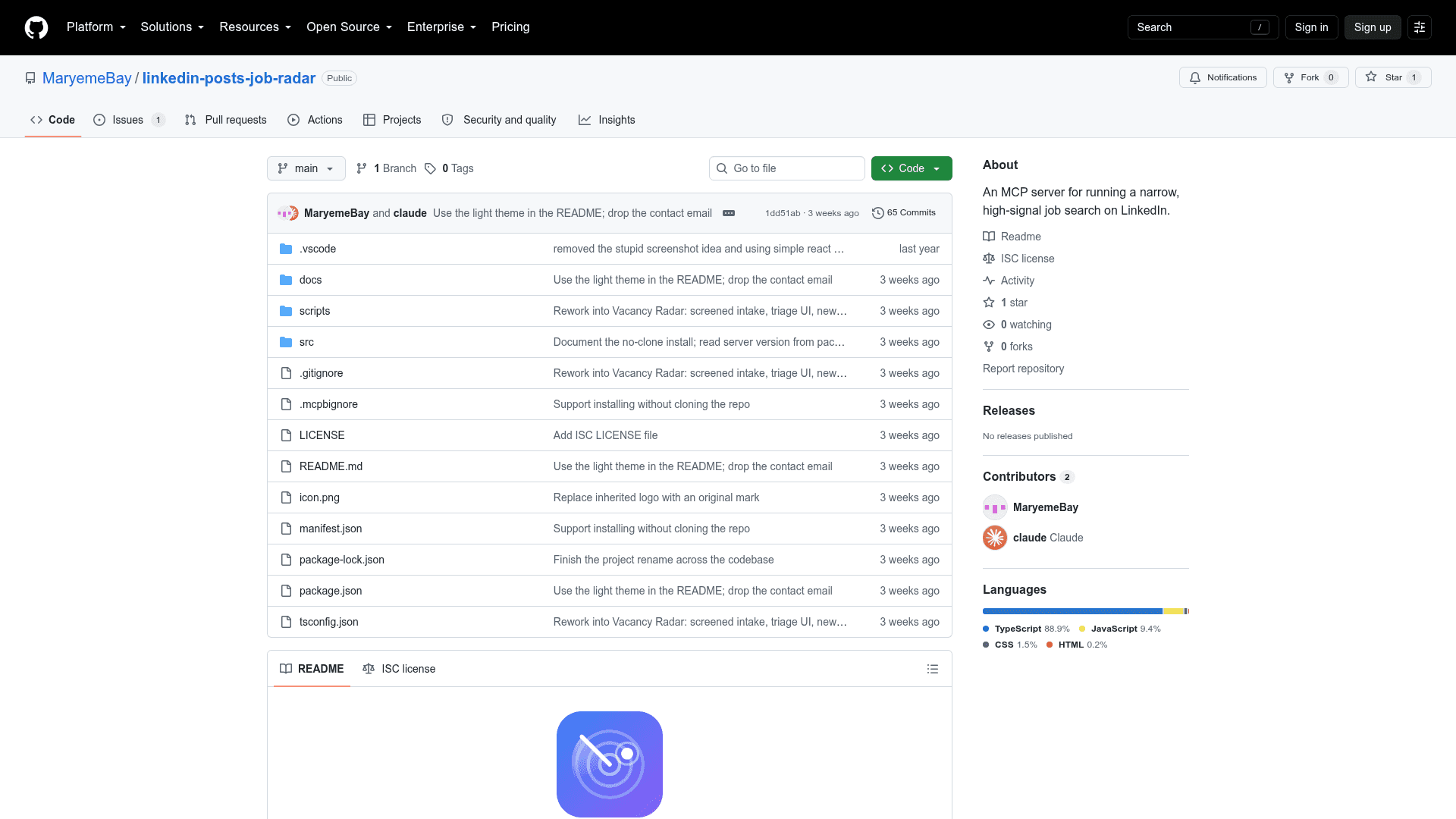
Linkedin Posts Job Radar is an open-source MCP server built by Maryeme Bayri that connects your AI assistant to LinkedIn, harvests job posts, and runs them through a multi-gate screening pipeline before surfacing them in a local React dashboard. Everything runs on your machine — no external accounts, no cloud servers, and no data leaving your laptop.
What It Is
Linkedin Posts Job Radar solves a specific problem: searching LinkedIn for a role like "Senior Data Scientist" returns a mix of real openings, "open to work" announcements, course ads, newsletter roundups, and staffing-agency reposts — often across countries you can't work in. This tool intercepts that noise at ingestion time, so you triage a short, high-signal list rather than hundreds of raw results. It is implemented as a Model Context Protocol (MCP) server written in TypeScript, using Playwright for browser automation, SQLite for local storage, and a React/Vite/Tailwind dashboard served on localhost.
How the Screening Pipeline Works
Three gates are applied to every post as it arrives:
- Relevance gate — rejects commentary, roundups, and course ads while keeping posts with hiring intent, even when they never use the word "hiring" (e.g.,
Lead Data Analyst opportunity at HelloFresh in Londonpasses). - Author gate — catches "open to work" posts and staffing-agency reposts via wording signals (
our client,on behalf of,C2C,Outside IR35) and recruiter titles, while preserving in-house corporate recruiters. - Market gate — accepts posts that name any country in your configured allowlist; posts with no detectable location are kept rather than discarded.
Location detection covers roughly 105 countries by name and major city, in English, French, German, Spanish, and Portuguese. An explicit location line (e.g., 📍 Location: London, UK) wins over any country mentioned later in the body. Pay detection classifies each currency figure by pay period and rejects amounts that don't make sense for that period, distinguishing a real salary from a welcome bonus or meal voucher.
Setup Path
The tool requires Node.js 18+ and an MCP client such as Claude Code, Claude Desktop, or Cursor. Chromium is downloaded automatically on first use. The quickest install requires no cloning — a single npx command or a JSON config block points the MCP client at the GitHub repo and npm handles the rest. Cloning is only needed if you want to edit the market allowlist (src/intake/market-policy.ts) or tune the screening rules in src/intake/relevance.ts.
An .mcpb bundle can also be produced via npm run bundle for clients that support MCP bundle installs without requiring Node tooling on the target machine.
The Dashboard
The local dashboard runs at localhost:7391 and lets you rate each post as Ok, Maybe, or Not interested. Visual cues — colored accent rails, dimmed "Not interested" cards — keep long lists readable. Applied status is tracked separately from the triage verdict. Every card shows the inferred country and any pay figure extracted from the post text. A table view lets you edit and sort every field. Dark mode follows the OS by default with a manual toggle.
Filters can be changed from the AI conversation itself via the dashboard_filters MCP tool, so you can ask your assistant to show only Ok-rated posts that quote a salary without touching the UI.
Architecture and Data Storage
The MCP server exposes five tools to the assistant: linkedin_session, harvest_posts, vacancies, dashboard_filters, and open_dashboard/close_dashboard. The SQLite database and LinkedIn session credentials are stored under ~/.linkedin-mcp/ and are never committed or transmitted. The store uses sql.js (in-memory SQLite) with a file-fingerprint reload mechanism to prevent data loss when the MCP server and dashboard process run concurrently.
The project is derived from LinkedIn-Posts-Hunter-MCP-Server by Kevin Weitgenant (ISC licence) and substantially reorganized around the intake pipeline, with new screening logic, country and pay inference, a triage verdict system, and a rebuilt dashboard.
Current Status
The repository was created and last pushed on 2026-08-21, making it a very recent release. It is licensed under the ISC License and is free to use, modify, and distribute. The project has one open issue and is actively maintained by its author.
Community Discussions
Be the first to start a conversation about Linkedin Posts Job Radar
Share your experience with Linkedin Posts Job Radar, ask questions, or help others learn from your insights.
Pricing
Open Source
Fully free and open-source under the ISC License. Self-hosted on your own machine.
- LinkedIn post scraping via Playwright
- Three-gate screening pipeline
- Local React dashboard
- Pay and location detection
- MCP server with 5 tools
Capabilities
Key Features
- LinkedIn post scraping via Playwright browser automation
- Three-gate screening pipeline: relevance, author, and market filters
- Local React dashboard at localhost:7391 for triage (Ok / Maybe / Not interested)
- Pay detection with currency, amount, and pay-period classification
- Location detection across ~105 countries in 5 languages
- Applied status tracking separate from triage verdict
- Dark mode with OS-default toggle
- Table view for editing and sorting all fields
- Dashboard filters controllable from AI conversation
- MCP tools: linkedin_session, harvest_posts, vacancies, dashboard_filters, open_dashboard/close_dashboard
- Local-only storage — no data leaves the machine
- SQLite database with cross-process reload safety
- MCP bundle (.mcpb) output for clients without Node tooling
- Configurable market allowlist and screening rules via source edit