
MailFlat
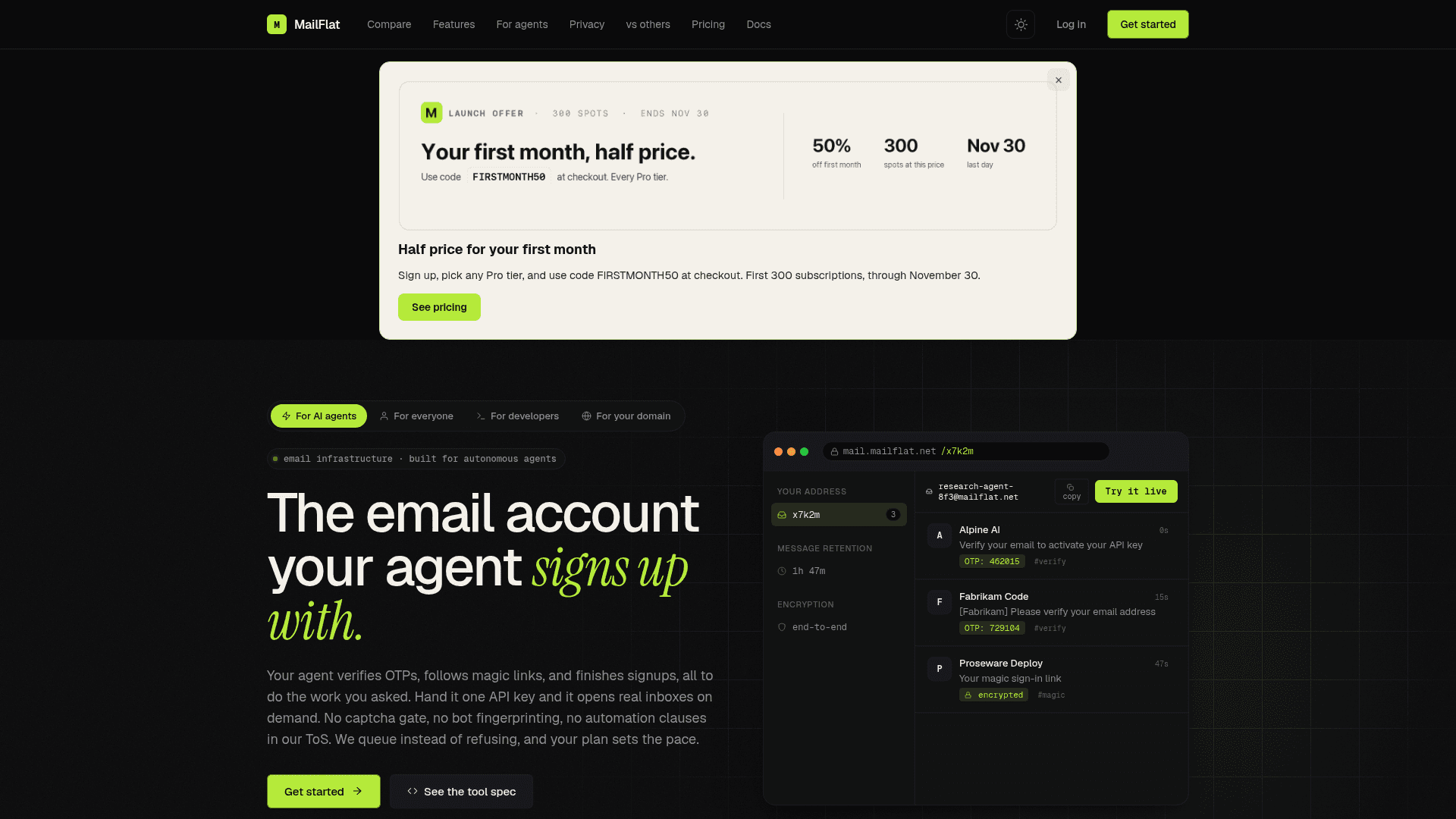
Permanent email inboxes for AI agents, developers, and everyday use — one API call opens a real inbox, and OTP codes and magic links come back as structured data.
At a Glance
About MailFlat
MailFlat is an email infrastructure service built by Yentar Labs LLC that provides permanent, on-demand inboxes for AI agents, test suites, and everyday privacy use. It ships a web inbox, a REST API, an MCP server, and official SDKs for Python, TypeScript/JavaScript, Java, LangChain, and the Vercel AI SDK — all backed by the same inbox engine with real SMTP delivery, SPF, DKIM, and DMARC authentication.
What It Is
MailFlat sits in the intersection of disposable email, email testing infrastructure, and AI agent tooling. Unlike a traditional disposable-email service where the address disappears with the messages, MailFlat keeps addresses permanent while auto-purging message contents on a configurable timer (2 hours by default, up to 30 days on paid plans). The core value proposition is that a test suite, a CI pipeline, or an AI agent can call create_inbox(), receive a real deliverable address, read back the OTP or magic link the target service sent, and move on — with no mock server, no shared mailbox state, and no cleanup logic needed.
Four Surfaces, One Engine
The homepage describes four distinct use modes powered by the same backend:
- Web inbox — A browser-based inbox for everyday privacy use. Users paste the address wherever a site demands an email, let messages auto-clear after two hours, and keep the address indefinitely.
- Developer API — A REST API (
/api/v1) with SDKs for Python, JavaScript/TypeScript, Java, and more. Designed for per-test inbox isolation in Playwright, Cypress, Selenium, pytest, and GitHub Actions workflows. - AI agent tooling — An MCP server (
mailflat-mcp, installable viauvx mailflat-mcp) plus a tool spec compatible with GPT, Claude, and LangChain. Agents register MailFlat as a tool, spin up inboxes on demand, and callwait_for_otp()to retrieve verification codes without any bot-detection friction. The terms of service explicitly permit automation. - Custom domains (BYOD) — Users verify a domain once via DNS records, then spin up addresses like
billing@acme.comon the fly. Free accounts get one custom domain; Pro plans support up to 250.
Architecture and Delivery Model
MailFlat operates real mailboxes on authenticated domains rather than a sandbox or capture proxy. The GitHub README notes that the service itself is closed-source, while the SDKs are MIT-licensed. Inboxes are created in under 80ms according to the homepage. End-to-end encryption is an opt-in feature for personal inboxes: when enabled, messages are sealed on receipt with a key generated locally in the browser, and the server stores only ciphertext. Agent and CI inboxes deliberately remain readable so the API can extract one-time codes and links. Auto-purge keeps agent context windows clean by ensuring old messages do not accumulate.
SDK and Integration Coverage
The official SDK repository (github.com/MailFlat/mailflat-sdks) covers:
- Python —
pip install mailflat, with an optionalmailflat[langchain]extra - JavaScript / TypeScript —
npm i @mailflat/sdk - Vercel AI SDK —
npm i @mailflat/ai-sdk - MCP server —
uvx mailflat-mcpfor Claude Desktop, Cursor, and any MCP-compatible host - Java — available via JitPack, with Maven Central (
net.mailflat) planned as the next distribution target - LangChain — included in the Python package as an optional extra
The docs list 9 language guides and 13 test-framework and CI integration guides, including Playwright, Cypress, Selenium, and pytest.
Update: SDK v0.7.0 (September 2026)
The SDK repository reached v0.7.0 on September 29, 2026, with the Java client migrating to the official MailFlat GitHub organization (coordinate com.github.MailFlat:mailflat-sdks) starting at v0.4.4. The README notes a planned move to Maven Central under net.mailflat to remove the owner-coupling dependency. The repository was created in August 2026, indicating MailFlat is a recently launched product still in early growth.
Community Discussions
Be the first to start a conversation about MailFlat
Share your experience with MailFlat, ask questions, or help others learn from your insights.
Pricing
Free
Everyday inboxes and room to try the API.
- 10 saved inboxes
- 2-hour message retention
- End-to-end encryption
- 1 custom domain (BYOD)
- 2,500 emails / month
Pro
Scales with your volume. Pay as you grow. Volume tiers from 5,000 up to 500,000 emails/month.
- Retention up to 30 days
- Saved inbox addresses that scale with tier
- Custom inbox names
- Custom domain (BYOD) — up to 250 domains
- API keys
- Webhooks
- Agent inboxes included
Enterprise
For organizations running mail infrastructure at scale (1,000,000+ emails/month).
- 1,000,000+ emails/month
- 30-day message retention
- Unlimited custom domains
- Custom contract
- All Pro features
Capabilities
Key Features
- Permanent email addresses with auto-purging messages
- On-demand inbox creation via API in under 80ms
- Built-in OTP extraction (wait_for_otp)
- Magic link parsing for agent workflows
- MCP server for Claude, Cursor, and MCP-compatible hosts
- Tool spec for GPT, Claude, and LangChain agents
- End-to-end encryption (opt-in, per-inbox)
- Custom domain support (BYOD) with SPF, DKIM, DMARC
- Real SMTP delivery on authenticated domains
- SDKs for Python, TypeScript/JavaScript, Java, LangChain, Vercel AI SDK
- Per-test inbox isolation for CI pipelines
- Configurable message retention (2 hours to 30 days)
- No automation clauses in ToS
- Webhooks on paid plans
- Auto-purge keeps agent context windows clean