
marpy
A Python-first AI coding IDE and development platform with guardrails for database migrations, dependency management, secrets, and deployments.
At a Glance
About marpy
marpy is a browser-based AI coding IDE and deployment platform built specifically for Python developers, created by Fiscus Technology LLC. It targets the pain points that generic AI coding tools miss — destructive database migrations, stale package versions, hardcoded secrets, and unpredictable deployments — by wrapping the AI assistant in opinionated guardrails before any damage is done.
What It Is
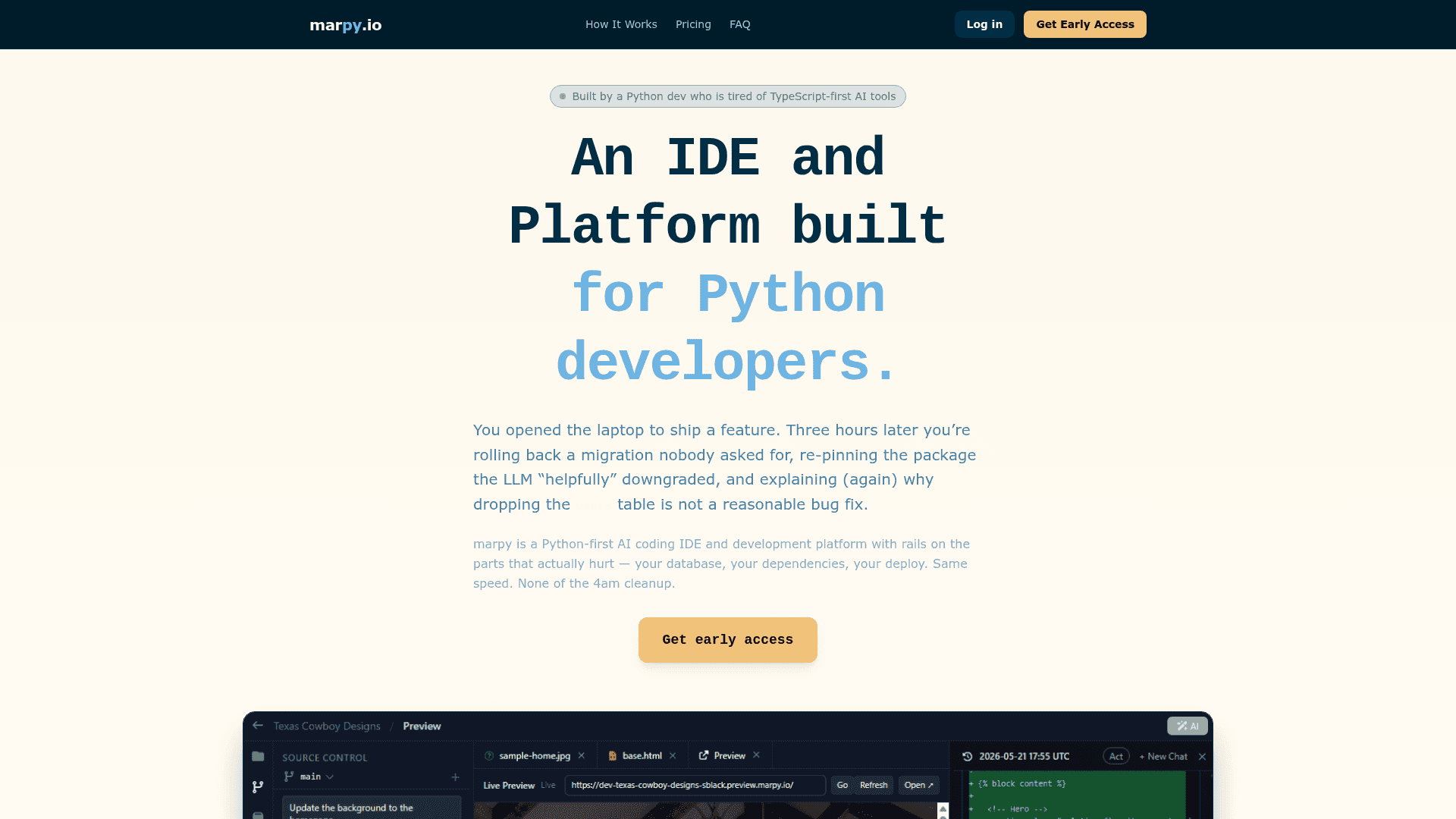
marpy combines a Monaco-based browser IDE, a managed MariaDB database layer, containerized deployments, and an AI coding assistant into a single Python-native platform. Unlike general-purpose AI coding tools that treat Python as a secondary runtime, marpy is built around Flask, FastAPI, and Django workflows from the ground up. The platform intercepts risky LLM-generated actions — such as dropping tables, pinning stale packages, or writing secrets to files — and either blocks them or rewrites them into safe, reviewable alternatives.
How the Guardrails Work
The core differentiator is a set of runtime intercepts that run between the AI assistant and the actual project environment:
- Migration safety: All schema changes are routed through versioned Alembic migrations. Destructive DDL (
DROP TABLE, destructiveALTER) on production is blocked at the gate; ad-hoc DDL is rewritten as a reviewable migration file. - Package freshness: Every
pip installis intercepted, resolved to the current PyPI version, and the package's real documentation is indexed in the background so the assistant writes against the live API. - Sandbox isolation: The project terminal is shell-wrapped to the project root, preventing path traversal outside the project tree.
- Secrets vault: Secrets are stored in a managed vault and injected as environment variables at runtime; the LLM never has read access to secret values in files.
Deployment Model
marpy uses date-based deployment tags (e.g., 202603061430) rather than semantic versioning, triggering containerized builds with a readable deploy log. The platform handles SSL, routing, and process health — described on the site as "like Vercel, but for your Python backend." Managed MariaDB instances include backups and point-in-time recovery, explicitly rejecting the container-local data pattern that causes data loss on restarts.
AI Integration and BYOK
The platform supports two AI usage modes. Users can bring their own API keys (BYOK) for Claude, GPT-4, Gemini, or any OpenAI-compatible endpoint; marpy routes requests via LiteLLM and never bills for tokens in this mode. Alternatively, users can rely on marpy-managed AI tokens included in each plan tier, with transparent overage billing. RAG context injection is included with the managed AI option.
Target Audience and Positioning
marpy explicitly positions itself against JavaScript-first platforms like v0, Replit, and Lovable, arguing that those tools bolt Python on as an afterthought. The site, written in first-person by a self-described "Python dev who is tired of TypeScript-first AI tools," frames the product as opinionated infrastructure for developers who want to ship real Python backends — not toy REPLs or serverless JS wrappers. The FAQ notes it is not aimed at developers whose entire backend is serverless functions behind a JS framework.
Current Status
marpy is in early access as of 2026, with a waitlist signup on the homepage. The site footer credits Fiscus Technology LLC and notes the platform itself is built with Flask and MariaDB. No public version number or changelog is surfaced, but the pricing page is live with defined tiers including a free Starter plan requiring no credit card.
Community Discussions
Be the first to start a conversation about marpy
Share your experience with marpy, ask questions, or help others learn from your insights.
Pricing
Starter
Kick the tires — free with no credit card required.
- 1 project
- 50 pod-hours / month
- 1 GB storage
- 1 managed MariaDB
- 1M AI tokens / month (hard cap)
Solo
Ship Python apps for real — most popular tier.
- 10 projects
- 300 pod-hours / month
- 10 GB storage
- 10 managed MariaDB instances
- 5M AI tokens / month + overage
- BYOK (any LLM)
- 3 environments (dev/staging/prod)
- Custom domains (1 included)
- GitHub / GitLab / Bitbucket
- Remove marpy badge
- Email support (48hr SLA)
- Spend cap controls
- 1 seat (+$10/seat)
Team
Your team's Python platform.
- 50 projects
- 1,200 pod-hours / month
- 50 GB storage
- 50 managed MariaDB instances
- 20M AI tokens / month + overage
- BYOK (any LLM)
- 5 environments per project
- Custom domains (5 included)
- 5 seats included (+$8/seat)
- Role-based access
- Deployment approvals
- Priority support (24hr SLA)
Enterprise
Volume discounts available — contact sales.
- Unlimited projects & seats
- Custom pod-hour quotas
- SSO (SAML 2.0) + SCIM
- Audit log export
- BYO Kubernetes cluster
- Dedicated CSM + Slack channel
- Custom SLAs
- Invoice billing (NET 30)
Capabilities
Key Features
- Python-first browser IDE (Monaco + terminal)
- AI chat and inline code completions
- Alembic migration guardrails (blocks destructive DDL on prod)
- Managed MariaDB with backups and point-in-time recovery
- Versioned containerized deployments with date-based tags
- Managed secrets vault with runtime injection
- Shell-sandboxed project terminal
- pip install interception with PyPI version resolution and doc indexing
- BYOK support via LiteLLM (Claude, GPT-4, Gemini, OpenAI-compatible)
- Flask, FastAPI, and Django scaffolding
- S3-style object storage for blobs
- Structured logs, metrics, and alerts
- Spend cap controls
- GitHub, GitLab, and Bitbucket OAuth connectors
- Role-based access control
- Deployment approval workflows
- Custom domains
- SSO (SAML 2.0) and SCIM (Enterprise)
- Audit log export (Enterprise)
- BYO Kubernetes cluster (Enterprise)