
Maxwell
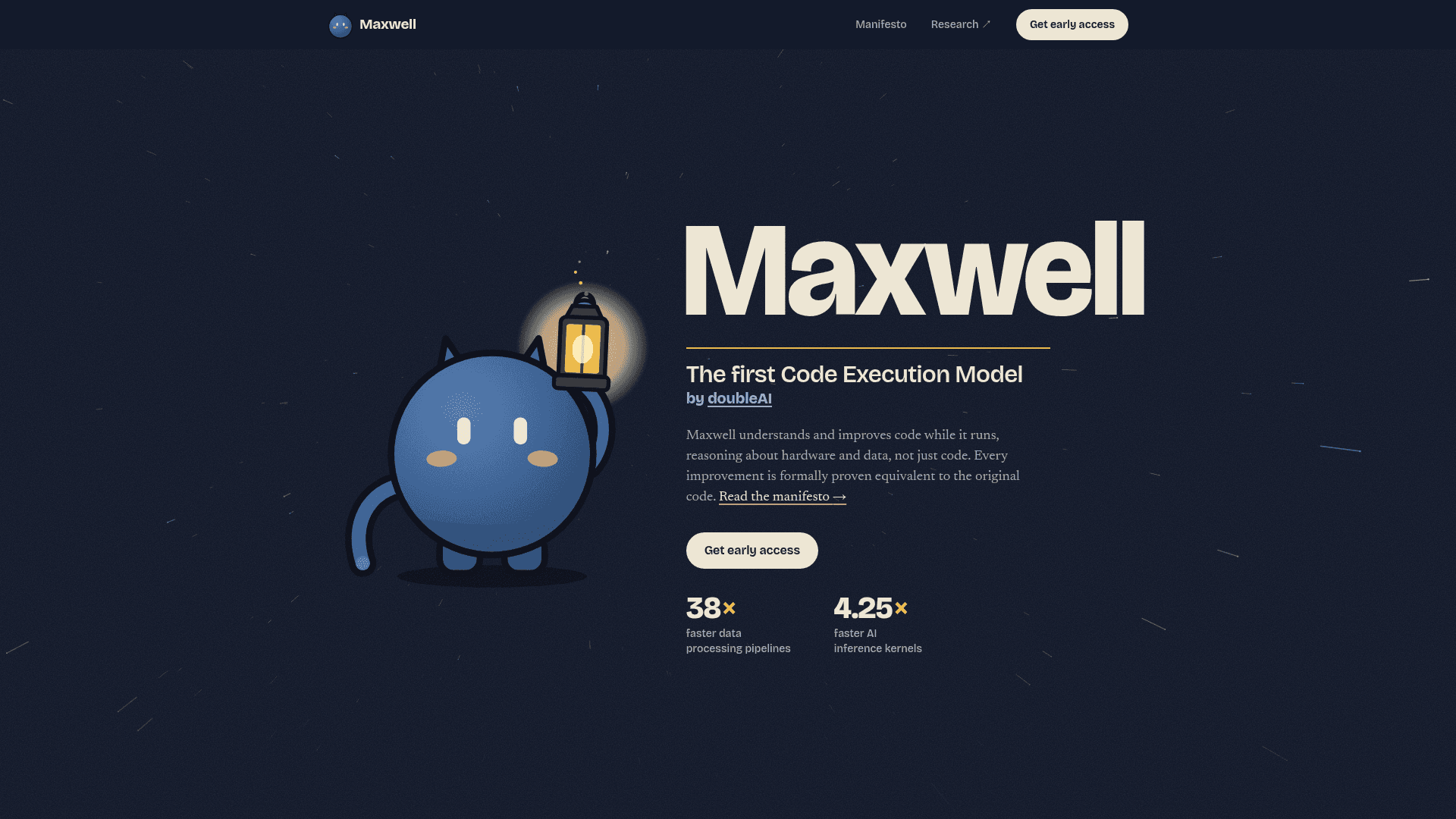
Maxwell is a code execution model from doubleAI that rewrites running programs into faster binaries tailored to the hardware and data, with each change formally proven equivalent.
At a Glance
Engagement
Available On
Listed Nov 2026
About Maxwell
Maxwell is a code execution model (CEM) from doubleAI. It watches a program while it runs and replaces bottlenecks with faster binaries fitted to the exact machine and data, without changing the source code. Each replacement comes with a formal proof of semantic equivalence to the code it replaces. Maxwell is in controlled availability, and early access is by request.
What It Is
Maxwell sits between code and hardware rather than helping write code. While a program runs, it identifies bottlenecks, generates new versions of the algorithms and machine instructions, and emits new binary code, much as a just-in-time compiler does but with more freedom in how the new algorithm looks. The source stays as its authors wrote it, whether written by humans or by a coding agent. The site describes it as complementary to coding agents: they write the program and Maxwell makes it run efficiently.
How Verification Works
Because no human reviews the changes, doubleAI says every replacement is backed by a machine-checked proof that the new code gives the same results and effects as the original. Proofs can be conditional, and a fast guard hands control back to the original code when an assumed precondition no longer holds. doubleAI says it has formalised the Python language, including its dynamic behaviour, so that Python and its rewritten replacement can be proven equivalent. The replacement may be in another language, such as Rust or C.
CPU and GPU Workloads
Maxwell handles both CPU and GPU code. Python code can be swapped for low-level optimised code, including SIMD implementations where relevant, and PyTorch code for kernels specialised to the GPU present. The vendor's demonstrations include Whisper-small speech-to-text on an RTX 4090, going from 106.23 s to 49.82 s with identical transcripts. They also include NetworkX betweenness centrality, going from 61.44 s to 17.50 s. In a featured LTX-2.5 case, doubleAI reports 4K clip generation on two B200s dropping from about 250 s to 134 s. These are vendor-reported figures for specific configurations, not guarantees for every workload.
Research Behind It
The site links doubleAI research posts on Blackwell kernels, a drop-in replacement for NVIDIA cuGraph, and rewritten pandas kernels.
Community Discussions
Be the first to start a conversation about Maxwell
Share your experience with Maxwell, ask questions, or help others learn from your insights.
Pricing
Controlled early access — terms unpublished
Maxwell is in controlled availability and accepts early-access requests. Pricing, billing currency, free entitlement, supported operating systems, and integration packaging are not published. PAID/USD are required catalog placeholders here, not evidence of a charge or a USD quote.
- Early-access request
Capabilities
Key Features
- Runtime optimisation of running programs without changing source code
- Formal proofs of semantic equivalence for every replacement
- Support for both CPU and GPU code
- Guards that fall back to the original code when preconditions change
- Specialisation to the exact hardware and observed data
- Continuous re-optimisation as hardware or data change
- Formalisation of the Python language
- Replacement of PyTorch code with GPU-specific kernels