
MCP Python SDK
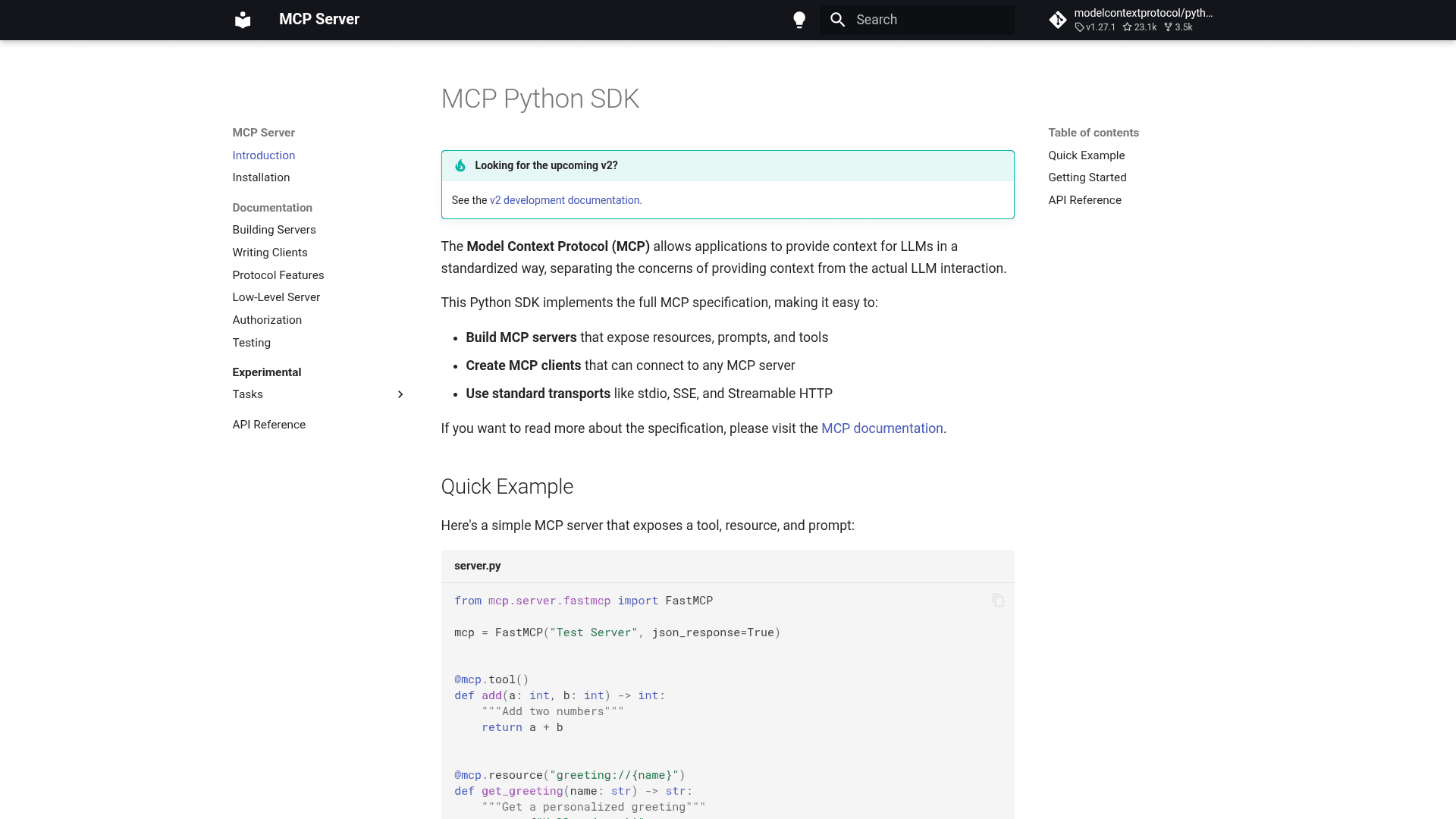
The official Python SDK for building Model Context Protocol (MCP) servers and clients, enabling standardized LLM context integration via tools, resources, and prompts.
At a Glance
About MCP Python SDK
The MCP Python SDK is the official Python implementation of the Model Context Protocol, maintained by the modelcontextprotocol organization on GitHub. It provides everything needed to build MCP servers that expose data and functionality to LLM applications, as well as MCP clients that connect to those servers. The library is published on PyPI as mcp and is licensed under the MIT License.
What It Is
The Model Context Protocol (MCP) is an open standard that lets applications provide context to LLMs in a structured, transport-agnostic way. The Python SDK implements the full MCP specification, covering server construction, client connectivity, transport layers (stdio, SSE, and Streamable HTTP), and all protocol lifecycle events. It ships two server layers: a high-level FastMCP interface for rapid development and a low-level Server class for full protocol control.
Core Primitives and Architecture
The SDK organizes MCP functionality around three protocol primitives:
- Resources — read-only data endpoints (analogous to HTTP GET), used to load information into an LLM's context
- Tools — executable functions with side effects (analogous to HTTP POST), exposed to the LLM for taking actions
- Prompts — reusable interaction templates that define structured conversation patterns
The FastMCP class wraps these primitives with Python decorators (@mcp.tool(), @mcp.resource(), @mcp.prompt()), automatic type-based structured output validation via Pydantic, and a Context object injected into handlers for logging, progress reporting, resource reading, and LLM sampling.
Transport and Deployment Model
The SDK supports three transport mechanisms:
- stdio — for local process-based integrations (e.g., Claude Desktop)
- SSE (Server-Sent Events) — legacy HTTP streaming transport, now superseded
- Streamable HTTP — the recommended production transport, supporting stateful and stateless modes, resumability via event stores, and ASGI mounting into existing Starlette or other ASGI applications
Streamable HTTP servers can be mounted at custom paths, support host-based routing, and can run multiple MCP servers within a single ASGI application. CORS configuration is documented for browser-based clients.
Authentication and Advanced Features
The SDK includes OAuth 2.1 resource server support via mcp.server.auth, where MCP servers act as Resource Servers validating tokens from separate Authorization Servers. It implements RFC 9728 (Protected Resource Metadata) for AS discovery. Client-side OAuth is also supported through OAuthClientProvider. Additional advanced capabilities include:
- Elicitation (form-mode and URL-mode) for requesting structured user input during tool calls
- LLM sampling via
ctx.session.create_message() - Pagination for large dataset list operations
- Structured output with schema validation for tool return types
- Lifespan management for startup/shutdown resource initialization
Update: v1.27.1
The repository's latest stable release is v1.27.1, published on 2026-05-08. The README notes that v1.x is the current stable branch, while v2 is in pre-alpha development on the main branch with separate documentation at README.v2.md. The project was created in September 2024 and has seen rapid iteration, with the GitHub repository reporting over 23,000 stars and more than 3,400 forks as of the last recorded update.
Community Discussions
Be the first to start a conversation about MCP Python SDK
Share your experience with MCP Python SDK, ask questions, or help others learn from your insights.
Pricing
Open Source (MIT)
Fully free and open-source under the MIT License. Install via pip or uv.
- Full MCP specification implementation
- FastMCP and low-level server interfaces
- All transports: stdio, SSE, Streamable HTTP
- OAuth 2.1 support
- Unlimited use, modification, and distribution under MIT License
Capabilities
Key Features
- FastMCP high-level server interface with decorator-based API
- Low-level Server class for full protocol control
- Resources, Tools, and Prompts primitives
- Structured output with Pydantic validation
- stdio, SSE, and Streamable HTTP transports
- ASGI mounting for Starlette and other frameworks
- OAuth 2.1 resource server and client support
- Elicitation (form-mode and URL-mode) for user input during tool calls
- LLM sampling via session.create_message()
- Progress reporting and logging via Context object
- Pagination support for large dataset list operations
- Lifespan management for startup/shutdown resource initialization
- MCP Inspector integration for development and debugging
- Claude Desktop integration via mcp install
- CORS configuration for browser-based clients
- Stateful and stateless Streamable HTTP operation modes
- Resumability with event stores
- Host-based routing for multi-server ASGI deployments