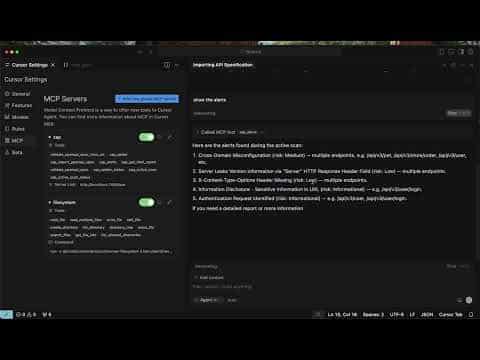
MCP ZAP Server
Self-hosted MCP server that lets AI agents run guided ZAP web security scans, review findings, and generate reports with operator guardrails.
At a Glance
Self-hosted Apache-2.0-licensed open-source core of MCP ZAP Server.
Engagement
Available On
Alternatives
Listed Oct 2026
About MCP ZAP Server
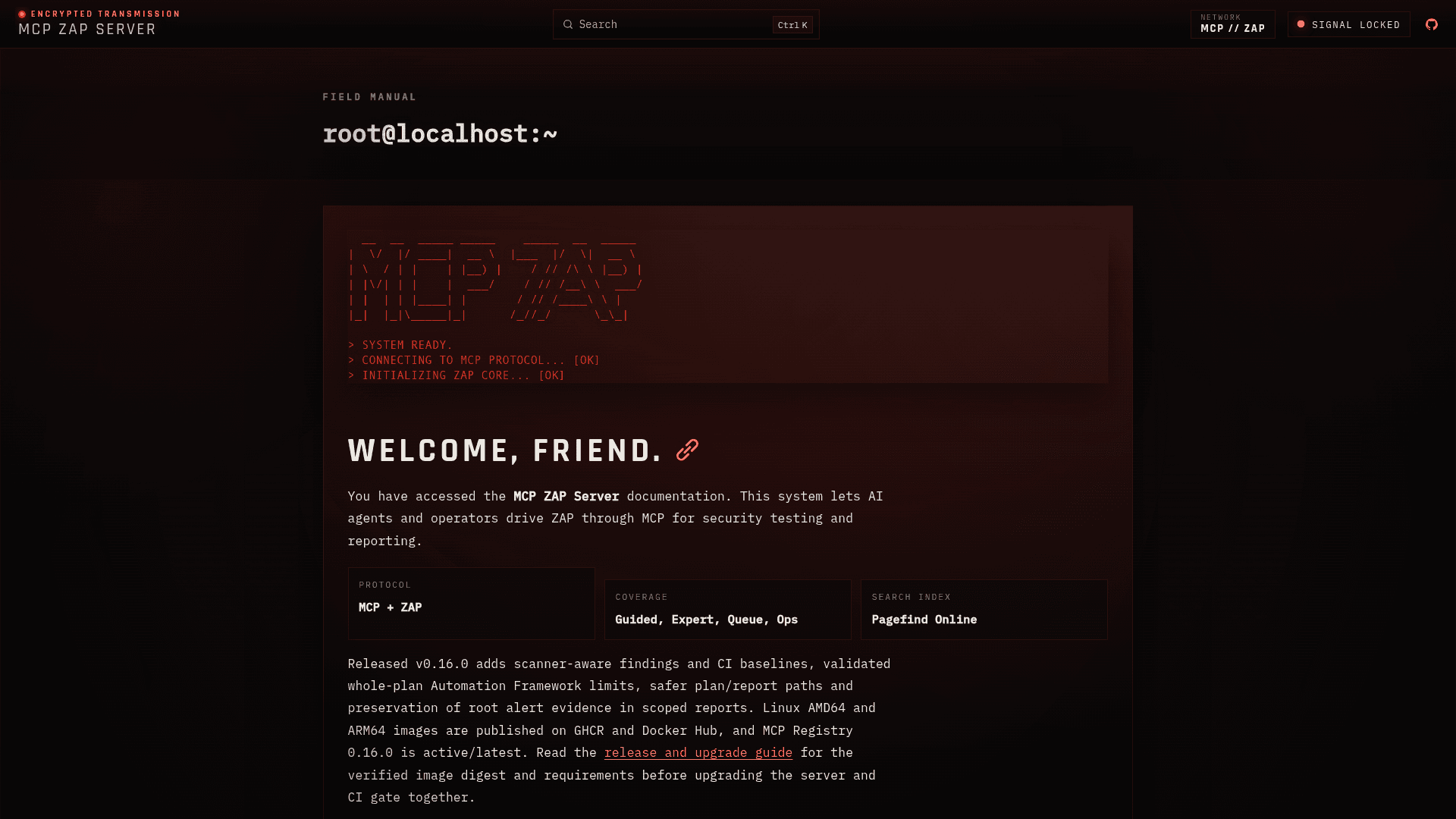
MCP ZAP Server is an open-source, Apache-2.0-licensed project by Daniel Tse that exposes ZAP through MCP over streamable HTTP. AI agents and operators can run spider, active scan, passive scan, API import, findings, and report workflows without custom glue scripts. The latest release listed is v0.16.0, with Linux AMD64 and ARM64 images published on GHCR and Docker Hub. The project states it is independent and not affiliated with or endorsed by the ZAP project.
What It Is
The server is a bridge between an MCP client (one that supports Streamable HTTP and custom headers) and a ZAP instance that scans an authorized target application. It runs alongside ZAP in a Docker Compose stack that also includes demo targets, and the client connects at an MCP endpoint authenticated with an API key sent in the X-API-Key header. Findings, reports, and scan history are returned through MCP so the client can read them back.
Guided and Expert Workflows
Guided tools are intent-first: the server chooses direct or queued execution for crawl and attack steps. Expert tools optionally expose lower-level ZAP context, user, scan, queue, policy, and report controls. Queued jobs cover active scans, traditional spider, AJAX Spider, and Client Spider, with claim-based recovery, durable Postgres state, and evidence export. Optional target form-login lets ZAP authenticate to a target without exposing the password to the AI client.
Guardrails and Deployment
API-key mode is the default, with optional JWT mode supporting refresh and revocation. Operators can apply tool-scope authorization, runtime policy bundles with dry-run and enforcement, rate limits, request body limits, workspace quotas, structured logs, metrics, and audit events. URL validation blocks localhost, private networks, and link-local targets by default. Deployment paths include local Docker Compose and Helm charts for Kubernetes, plus AWS EC2 and EKS starter examples.
Recent Release: v0.16.0
The v0.16.0 release adds scanner-aware findings and CI baselines, whole-plan Automation Framework duration and capability validation, filesystem containment for plans and artifacts, and target-scoped reports that keep root alert evidence. MCP Registry 0.16.0 is listed as active/latest. An extension API offers experimental contracts for policy, protection, evidence, and metadata, and an optional MCP ZAP Connect plugin can guide setup in Codex.
Community Discussions
Be the first to start a conversation about MCP ZAP Server
Share your experience with MCP ZAP Server, ask questions, or help others learn from your insights.
Pricing
Open Source Core
Self-hosted Apache-2.0-licensed open-source core of MCP ZAP Server.
- Apache License 2.0 (OSI-approved)
- Self-hosted via Docker Compose or Helm for Kubernetes
- Guided and expert ZAP scanning tools
- API-key or JWT auth, tool scopes, rate limits, audit events
- Optional paid support from Agentic Lab is separate and unpriced
Capabilities
Key Features
- MCP over streamable HTTP for ZAP
- Guided spider, active scan, passive scan, and API import tools
- Expert ZAP context, user, scan, and report controls
- Scan queue with claim-based recovery and Postgres-backed history
- Client Spider and AJAX Spider crawling
- Optional target form-login authentication
- API key and JWT authentication
- Runtime policy bundles with dry-run and enforcement
- Tool-scope authorization, rate limits, and audit events
- Observability with correlation IDs and metrics
- Findings, HTML reports, and scan-history evidence export
- Seeded API gate and scanner-aware CI baselines
- Automation Framework plan validation
- Extension API contracts
- Docker Compose and Helm deployment
Integrations
Demo Video