Membase
A shared long-term memory layer for AI assistants and agents that you can review, correct, export, and connect through a web app, Chrome extension, MCP, REST API, and SDKs.
At a Glance
Membase is currently not charging for any feature and no payment method is required; future pricing may be introduced with advance notice.
Engagement
Available On
Alternatives
Listed Nov 2026
About Membase
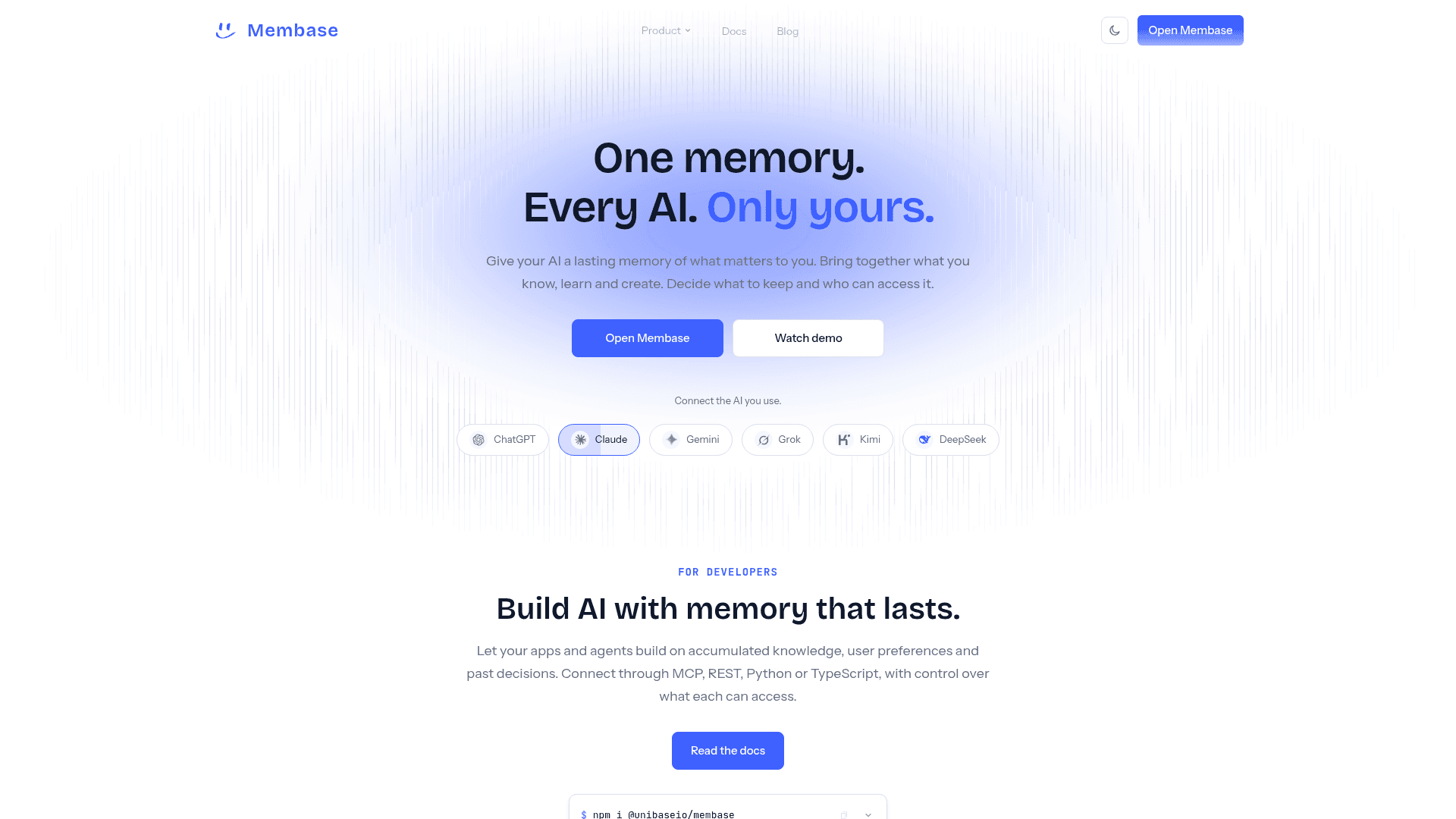
Membase is an AI memory layer built by Unibase. It builds one long-term memory from conversations, web pages, files, and connected apps, and lets the AI tools you connect read it. It is available as a web app, a Chrome extension, and developer interfaces (MCP, REST, CLI, Python and TypeScript SDKs); a desktop app is listed as coming soon.
What It Is
Membase keeps knowledge in one place that multiple AI tools can read, so you do not have to re-explain the same project to each assistant. You add sources, manage what the memory holds, and choose which connected AI can access which memories. Every stored fact can be read, corrected, deleted, and exported.
How the workflow runs
The site describes three steps: add, manage, and connect.
- Add: Save AI conversations and web pages with the Chrome extension, upload documents (PDFs, notes, images, or a zipped notes export), connect supported apps, or let your own agents write through MCP or the API.
- Manage: Review what Membase remembers, correct mistakes, remove outdated information, and ask the built-in assistant questions across saved knowledge.
- Connect: Choose which AI can use which memories, and keep personal, project, and client knowledge separate.
For developers
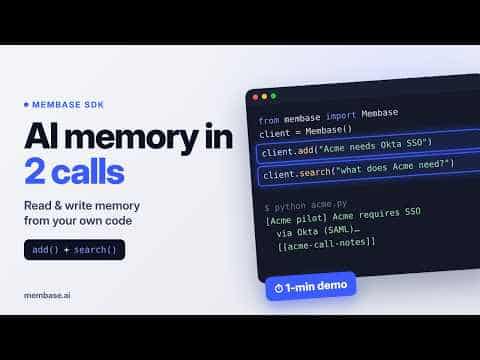
Apps and agents can store and retrieve memory through MCP, REST, Python, or TypeScript. The Python SDK installs with pip (unibaseio-membase) and the TypeScript SDK with npm (@unibaseio/membase). The SDK exposes calls to add memories, search for relevant passages, and ask for an answer. Coding tools such as Claude Code, Cursor, and Codex connect through the Membase MCP server. The Chrome extension works with ChatGPT, Claude, Gemini, Grok, DeepSeek, and Kimi.
Data handling and deployment
The hosted service runs each account's memory in an isolated environment and is not end-to-end encrypted. Membase can also run locally with pip install 'unibaseio-membase[local]' (Python 3.12 or 3.13, with your own OpenAI API key), using the same API and MCP tools. The SDKs, CLI, and MCP server are public on GitHub, while the core memory engine is proprietary. Membase publishes benchmark results for its core memory engine (not the hosted service) on LoCoMo, LongMemEval_S, and DMR, and the site reports reduced context tokens versus full conversation history.
Community Discussions
Be the first to start a conversation about Membase
Share your experience with Membase, ask questions, or help others learn from your insights.
Pricing
Free
Membase is currently not charging for any feature and no payment method is required; future pricing may be introduced with advance notice.
- No payment method required
- Export remains available
- Hosted web app, Chrome extension and API covered by terms
Capabilities
Key Features
- Shared long-term memory across AI tools
- Chrome extension to save conversations and web pages
- Upload PDFs, notes, images, or zipped note exports
- Connect supported apps as memory sources
- Review, correct, delete, and export memory
- Per-AI access control with revocation
- Separate memories for personal, project, and client knowledge
- Built-in assistant to ask questions across saved knowledge
- MCP server, REST API, CLI, Python and TypeScript SDKs
- Hosted or local mode
- Published benchmarks for the core memory engine
Integrations
Demo Video