
Kody
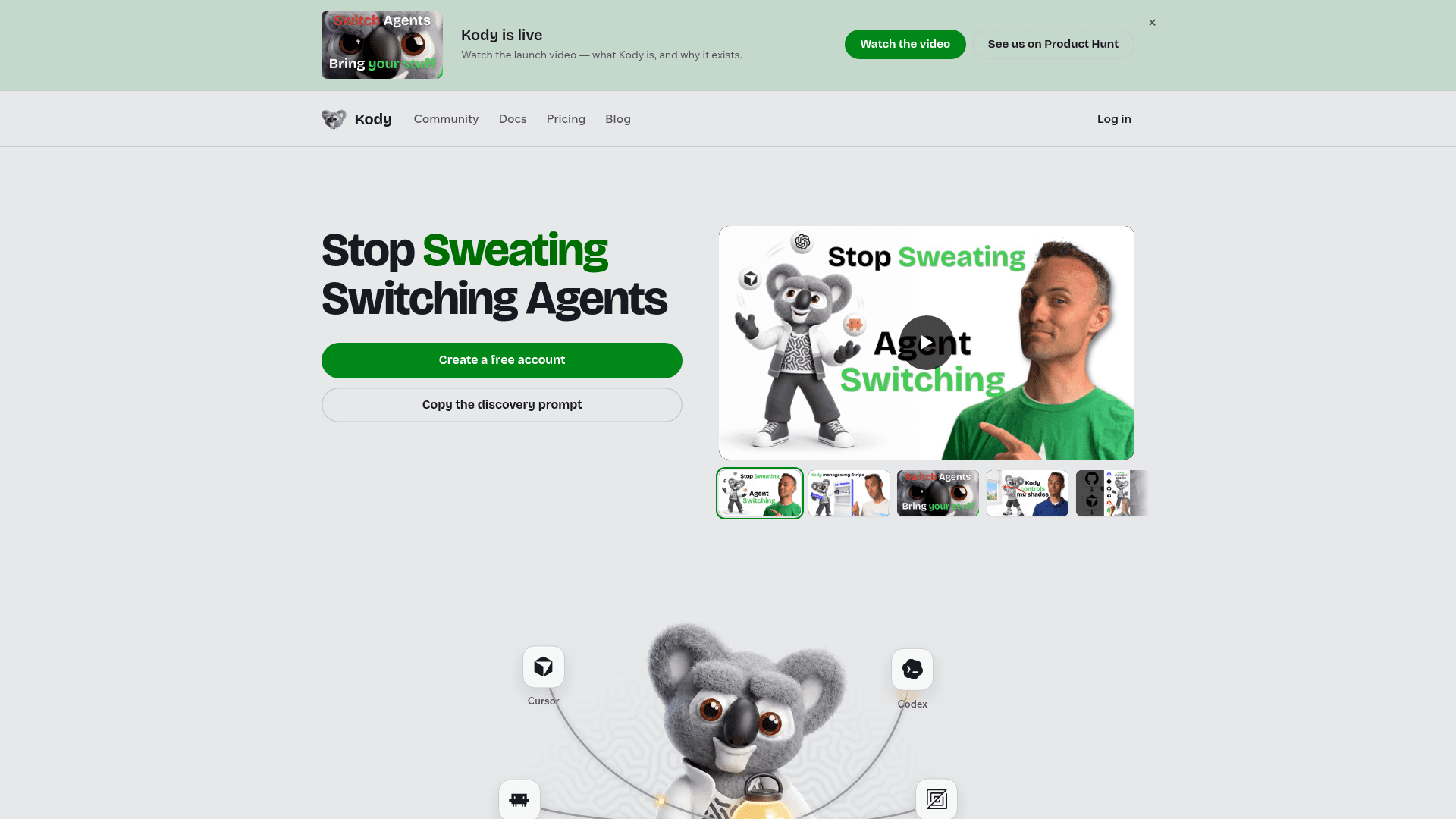
A personal AI agent home that provides durable memory, secrets, packages, and scheduled automations portable across any MCP-capable agent like Claude, Cursor, ChatGPT, or Codex.
At a Glance
The whole factory with volume caps: 10 saved packages, 5 scheduled jobs (no faster than every 15 minutes), 150 execute calls per day.
Engagement
Available On
Alternatives
Listed Sep 2026
About Kody
Kody is a personal assistant platform built by Kent C. Dodds and the Epic Web team, designed to give AI agents a durable home that outlives any single conversation. It runs on Cloudflare Workers and speaks the Model Context Protocol (MCP), making it compatible with Claude, ChatGPT, Cursor, Codex, Copilot, Grok, and any other MCP-capable host. The source is available on GitHub under the Functional Source License (FSL-1.1-ALv2), which converts to Apache 2.0 two years after each release.
What It Is
Kody is not a chat app or an AI agent itself — it is the persistent layer that sits behind the agents you already use. When you connect an agent to your Kody account, that agent gains access to durable memory, encrypted secrets, saved code packages, scheduled jobs, webhooks, and a personal email inbox. The core idea is that one-off agent work should become permanent: your agent explores a problem, saves the result as a package, and Kody runs it on a schedule with no model in the loop and no tokens spent.
How the Architecture Works
Kody is organized as an Nx monorepo deployed across a fleet of Cloudflare Workers:
- kody-production — the origin worker handling the Remix UI, MCP HTTP endpoints, OAuth, email, and queues
- kody-platform — Durable Objects for MCP state, mailboxes, metering, and repo sessions
- kody-runtime — package apps, the invoke API, and StorageRunner
- kody-jobs — cron scheduling and the JobManager
The MCP surface is intentionally compact, favoring powerful search and Code Mode execute flows over a large static tool catalog. Each signed-in user gets a fully isolated assistant with their own packages, jobs, secrets, memories, and storage.
Core Primitives
- Shared memory — durable facts and preferences that follow the account across every connected agent
- Secrets — API keys and OAuth grants that code can reference by name but agents can never read; there is deliberately no
secret_getcapability - Packages — reusable saved code that agents write and improve over time, with exports, scheduled jobs, inbound webhooks, and optional hosted web app surfaces
- Jobs, workflows, and webhooks — cron schedules, deferred one-shot runs, and HTTPS endpoints for providers like Sentry, GitHub, and Stripe
- Personal email inbox — every account gets an email address; inbound mail can trigger automations and outbound mail can send notifications
- Community packages — a public catalog where users can browse, fork, and publish automations
Agent Interoperability
A key design goal is that switching agents should not lose context. Packages, secrets, jobs, and memories stay on the account; connecting a new MCP host immediately surfaces the same home. The homepage lists supported agents including Cursor, Claude Code, ChatGPT, Codex, Warp, Amp, Gemini, and OpenClaw, as well as integrations with GitHub, Linear, Sentry, Cloudflare, and Slack.
Update: v2026.09.11
The latest release is Kody v2026.09.11, published on September 11, 2026. The GitHub repository shows active development with 613 stars and 61 forks as of that date. The tech stack includes TypeScript 6.0, Node 26, Remix 3 (beta), Cloudflare D1 for the database, Cloudflare KV for sessions and OAuth, and Durable Objects for MCP state. The project launched publicly and was featured on Product Hunt alongside a launch video explaining the product direction.
Self-Hosting and Licensing
Kody's source is openly available on GitHub and can be forked and self-hosted. The Functional Source License permits use, modification, and redistribution for any purpose other than competing commercial use, and each version automatically converts to Apache 2.0 on its second anniversary. Account data can be exported as JSON from account settings, though secret values are excluded from exports for security reasons.
Community Discussions
Be the first to start a conversation about Kody
Share your experience with Kody, ask questions, or help others learn from your insights.
Pricing
Free
The whole factory with volume caps: 10 saved packages, 5 scheduled jobs (no faster than every 15 minutes), 150 execute calls per day.
- 20 connected repos
- 10 saved packages
- 5 scheduled jobs
- Fastest job interval: 15 minutes
- 5 active repo sessions
Standard
Same factory with more room for jobs, workflows, and daily volume.
- 200 connected repos
- 50 saved packages
- 15 scheduled jobs
- Fastest job interval: 15 minutes
- 200 active repo sessions
- 10 concurrent workflows
- 500 execute calls per day
- 15,000 outbound fetches per day
- 100 stored secrets
- 1 GiB durable storage
- 200 email sends per day
- 1,000 email receives per day
- 10,000 stored messages
Pro
Same factory with more room for storage, jobs, workflows, and daily volume.
- 400 connected repos
- 200 saved packages
- 75 scheduled jobs
- Fastest job interval: 5 minutes
- 400 active repo sessions
- 50 concurrent workflows
- 1,500 execute calls per day
- 50,000 outbound fetches per day
- 200 stored secrets
- 5 GiB durable storage
- 500 email sends per day
- 2,000 email receives per day
- 25,000 stored messages
Teams / Enterprise
For teams or higher-volume needs. Contact for custom pricing.
- Custom volume and limits
- Team-oriented configuration
Capabilities
Key Features
- Durable agent memory across all connected MCP hosts
- Encrypted secrets vault with no secret_get capability
- Reusable saved code packages with exports and web app surfaces
- Scheduled jobs and cron automation with no model in the loop
- Inbound and outbound email inbox per account
- Webhooks for Sentry, GitHub, Stripe, and other providers
- Community package catalog with fork-and-own model
- Support for Cursor, Claude Code, ChatGPT, Codex, Warp, Amp, Gemini, and more
- Isolated per-user assistant with own packages, jobs, secrets, and storage
- Self-hostable on Cloudflare Workers
- OAuth-protected MCP endpoints
- Ad hoc sandboxed code execution against integrations
- Home MCP server tunnel for local device access
- JSON account export
Integrations
Demo Video