
Memory OS
A 6-layer memory operating system for Hermes Agent that provides persistent, local memory infrastructure with Qdrant vector search, structured facts, and surgical context injection.
At a Glance
Fully free and open-source under the MIT License. Clone, run, and modify locally.
Engagement
Available On
Listed Jun 2026
About Memory OS
Memory OS is an open-source, MIT-licensed memory operating system built by Claudio Drews for Hermes Agent. It runs entirely on your local machine and works with any LLM provider — OpenRouter, OpenAI, Anthropic, Ollama, or local models — with no cloud memory subscription or vendor lock-in. The project was created to solve the persistent problem of agent amnesia: losing context, decisions, and structured knowledge between sessions.
What It Is
Memory OS is a complete local memory infrastructure layer for Hermes Agent, not a simple plugin. It stacks six distinct memory layers — from flat markdown files to a Qdrant vector database — that work in concert to give an agent genuine long-term recall. The system automatically injects the right context at the right moment using relevance-gated retrieval, per-session deduplication, and a social-closer filter that skips trivial messages. The result is what the README describes as "surgical token efficiency": the LLM receives exactly what it needs, nothing more.
The Six-Layer Architecture
Each layer handles a different scope and type of memory:
- Layer 1 – Workspace: Markdown files (
MEMORY.md,USER.md,CREATIVE.md) injected into the system prompt every turn - Layer 2 – Sessions: SQLite with FTS5 full-text search across the entire conversation history
- Layer 3 – Structured Facts: A dedicated SQLite store with entity resolution, trust scoring, and an automatic feedback loop that trains trust scores over time
- Layer 4 – Fabric (Cross-Session): A heavily forked version of the Icarus plugin with LLM-powered session extraction and multi-source injection across 16 tools
- Layer 5 – Vector Database: Qdrant running locally with 4096-dimensional cosine similarity plus BM25 sparse search, a 4-level fallback cascade, weekly decay scanning, and semantic deduplication (cosine > 0.92 triggers a merge)
- Layer 6 – LLM Wiki: A self-curating knowledge vault organized into
concepts/,entities/, andcomparisons/directories, continuously ingested into Qdrant
The flow is: pre_llm_call triggers surgical recall from all four retrieval sources; post_llm_call and on_session_end trigger automatic learning extraction and capture.
Infrastructure and Requirements
Memory OS requires Hermes Agent, Docker (for Qdrant, Redis, and an ARQ Worker), and Python 3.11+. The entire memory stack runs locally — no data leaves the machine. The bundled Icarus fork (icarus/) is not upstream-compatible with the original esaradev/icarus-plugin; key additions include LLM-powered session extraction, multi-source injection, CREATIVE.md isolation, backtick sanitization, a system injection filter, and social closer detection. A companion project, Vault Curator v3 (ClaudioDrews/vault-curator), handles frontmatter enrichment, semantic linking, and MOC index generation for the wiki layer.
How It Differs from Cloud Memory Solutions
The README explicitly positions Memory OS against cloud-first alternatives like mem0, Zep, and Letta, noting that those solutions require cloud memory subscriptions and do not offer full local infrastructure. Memory OS's stated differentiators include: fully local memory infrastructure, no memory subscription, provider-agnostic LLM support, Hermes-native integration, structured facts with trust scores, a self-curating wiki, and intelligent decay with archival — none of which the README attributes to the compared alternatives.
Current Status
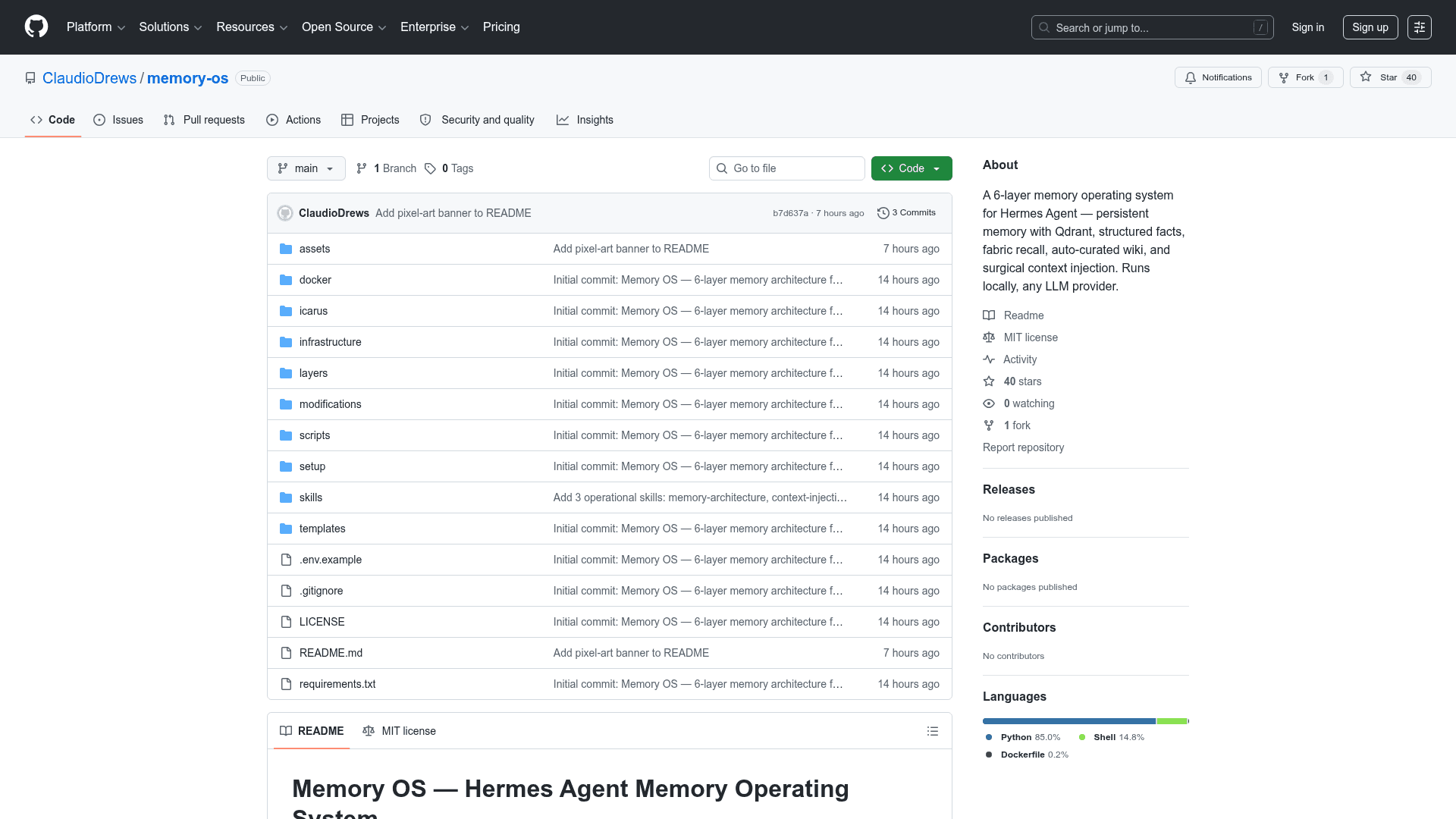
The repository was created on May 31, 2026, and last pushed on June 1, 2026, making it a very recent release. It is written primarily in Python, licensed under MIT, and hosted at github.com/ClaudioDrews/memory-os. At the time of indexing the project had 38 stars and 1 fork with no open issues.
Community Discussions
Be the first to start a conversation about Memory OS
Share your experience with Memory OS, ask questions, or help others learn from your insights.
Pricing
Open Source
Fully free and open-source under the MIT License. Clone, run, and modify locally.
- 6-layer memory architecture
- Local Qdrant + Redis + ARQ infrastructure
- Provider-agnostic LLM support
- Self-curating LLM Wiki
- Structured facts with trust scoring
Capabilities
Key Features
- 6-layer memory architecture
- Local memory infrastructure (no cloud)
- Qdrant vector database with hybrid search (cosine + BM25)
- Structured facts store with trust scoring and entity resolution
- Full-text search across entire conversation history (SQLite FTS5)
- Self-curating LLM Wiki (concepts, entities, comparisons)
- Surgical context injection with relevance gating
- Per-session deduplication
- Social-closer filter for trivial message skipping
- Weekly decay scanner and semantic deduplication
- LLM-powered session extraction via forked Icarus plugin
- 16 Fabric tools (fabric_recall, fabric_write, fabric_brief, etc.)
- CREATIVE.md workspace isolation
- 4-level retrieval fallback cascade
- Provider-agnostic: OpenRouter, OpenAI, Anthropic, Ollama, local models
- ARQ async worker queue via Redis
- Vault Curator v3 integration for wiki enrichment