MemoryLake
A cross-model memory layer that carries one user's memory across every AI (ChatGPT, Claude, Gemini, coding agents) with end-to-end-encrypted, user-owned storage and Git-style version control.
At a Glance
About MemoryLake
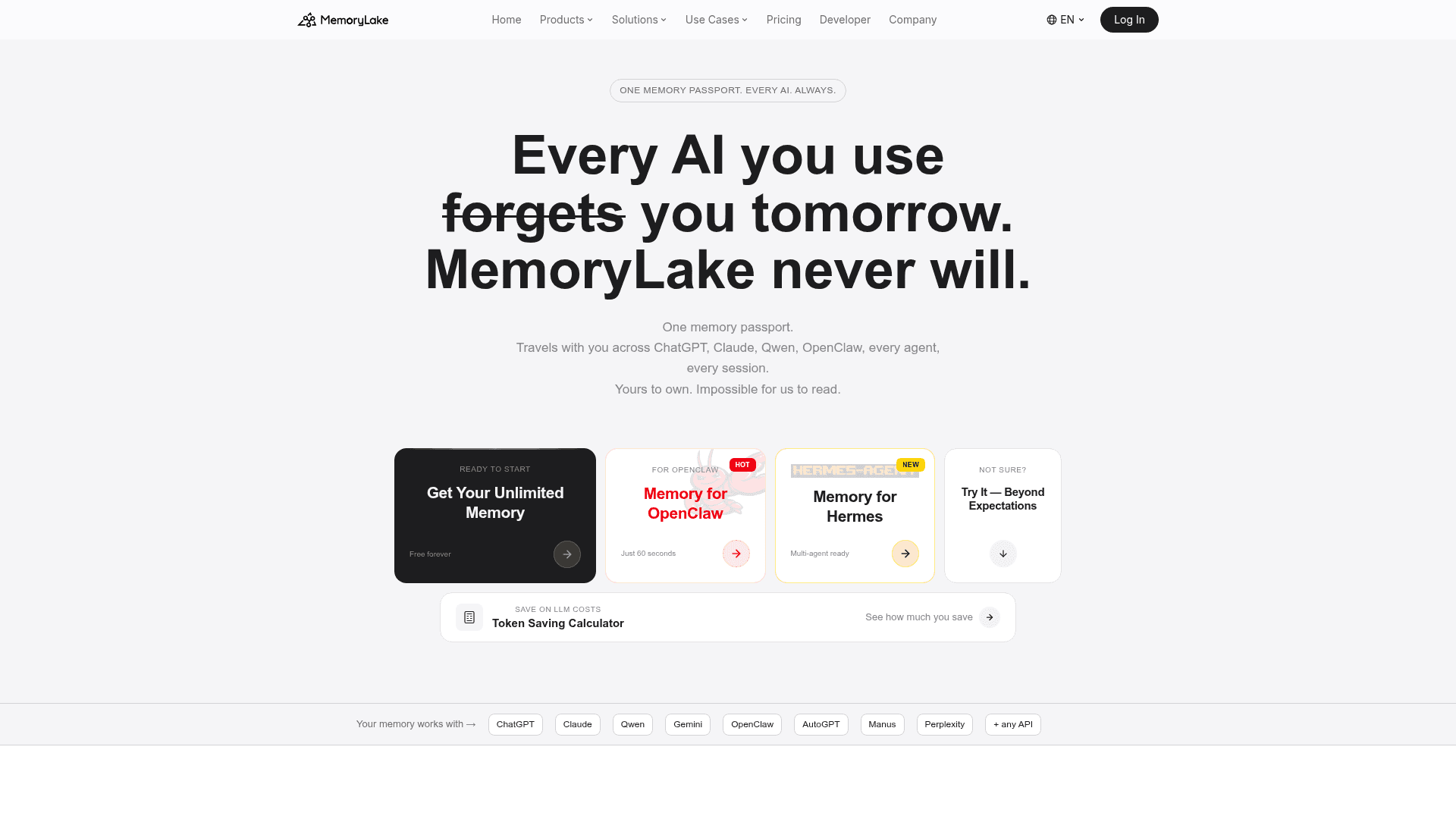
MemoryLake is a persistent, cross-model memory service that gives users a single "memory passport" that travels with them across ChatGPT, Claude, Gemini, Qwen, OpenClaw, AutoGPT, Manus, Perplexity, and any API-connected agent. Built around end-to-end encryption and a triple-party key architecture, the platform is designed so that even MemoryLake itself cannot read a user's stored memories. The service is available as a web app with a free tier and premium plans.
What It Is
MemoryLake sits between a user and every AI they interact with, acting as a shared long-term memory store that any connected model can query. Rather than each AI maintaining its own siloed context window, MemoryLake centralizes memory into six typed layers — Background, Fact, Event, Dialogue, Reflection, and Skill — and makes them available across sessions and across different AI providers. The core design principle is user ownership: users can export everything, control which AI sees what, and permanently delete all data.
Memory Architecture and Types
MemoryLake organizes stored knowledge into distinct memory types, each serving a different purpose:
- Background Memory — static values and world model, manually set, read-only
- Fact Memory — verifiable facts with conflict checking, versioning, and source tracing
- Event Memory — timestamped timeline of what happened and when
- Dialogue Memory — compressed, searchable record of every conversation
- Reflection Memory — deep behavioral patterns the AI has identified
- Skill Memory — reusable methods built once and available across any AI or session
Git-Style Versioning and Conflict Resolution
A distinctive feature is Git-like versioning applied to memory. Every change produces a commit with a full diff, branch, and rollback capability. When memories from different sources or timeframes contradict each other — for example, one AI session recording a preference for dark mode while another records light mode — MemoryLake's conflict engine detects the contradiction in real time, applies a configurable resolution strategy (recency-based, source-priority, confidence-weighted, or manual), and preserves the full audit trail. The platform also provides cryptographic integrity verification and compliance-ready provenance chains.
Security and Ownership Model
MemoryLake's security page states the platform uses triple-party encryption, meaning no single party — including MemoryLake — holds all decryption keys. The service claims ISO 27001, SOC 2 Type II, GDPR, and CCPA compliance, with AES-256 encryption and end-to-end encryption throughout. Users retain three explicit rights: export everything at any time, control per-AI visibility at the architecture level (not just a settings toggle), and permanently delete all data with no copies retained.
Data Integration and Open Data
The platform connects to 20+ data source types via its MemoryLake-D1 VLM engine, covering multimodal files (text, documents, images, video, audio), enterprise databases (MySQL, PostgreSQL, Delta Lake, Hudi, Iceberg), REST API and MCP protocols, and online document suites (Office365, Google Workspace, Dropbox, Lark, DingTalk). MemoryLake also bundles access to large open datasets without additional setup, including 40M+ academic papers (PubMed, arXiv, bioRxiv), 3M+ SEC filings, 500K+ clinical trials, real-time financial feeds, 2M+ drug database compounds, 10M+ US patents, and global economic data.
Benchmark Performance
MemoryLake publishes benchmark results on the LoCoMo (Long-term Conversational Memory) dataset, a rigorous evaluation covering ~300-turn conversations across up to 35 sessions. According to the company's published benchmark repository, MemoryLake scored 94.03% overall F1, ranking first among evaluated systems including Zep (85.22%), MemOS (80.76%), and Mem0 (64.20%). The company attributes particular strength in temporal reasoning (91.28%) and open-domain questions (85.42%), and claims the system outperforms a full-context (no-compression) baseline while using fewer tokens.
Community Discussions
Be the first to start a conversation about MemoryLake
Share your experience with MemoryLake, ask questions, or help others learn from your insights.
Pricing
Free
Get started with MemoryLake at no cost with Best for trying the product and 300,000 tokens per month.
- Best for trying the product
- 300,000 tokens per month
Pro
Professional plan with Best for regular individual or small team usage and 6,200,000 tokens per month for power users.
- Best for regular individual or small team usage
- 6,200,000 tokens per month
Premium
Premium plan with Best for heavy usage and team-scale workloads and 66,000,000 tokens per month.
- Best for heavy usage and team-scale workloads
- 66,000,000 tokens per month
Capabilities
Key Features
- Cross-model memory passport (ChatGPT, Claude, Gemini, Qwen, OpenClaw, and more)
- End-to-end encryption with triple-party key architecture
- Six memory types: Background, Fact, Event, Dialogue, Reflection, Skill
- Git-like memory versioning with branches, commits, diffs, and rollback
- Intelligent conflict detection and resolution with full audit trail
- Source attribution and cryptographic provenance chain
- Per-AI visibility controls at the architecture level
- One-click full data export
- Permanent data deletion with no retained copies
- 20+ data source integrations including databases, APIs, and document suites
- Built-in access to 40M+ academic papers, SEC filings, clinical trials, and more
- MCP server integration
- Python SDK for distributed computing
- MemoryLake-D1 VLM engine for multimodal document parsing
- Reinforcement learning-based data analysis
- ISO 27001, SOC 2 Type II, GDPR, CCPA compliance
- Token cost reduction vs. direct LLM file reading
- Millisecond-latency memory retrieval